US Secretary of State Marco Rubio has arrived in India for a two-day visit that could end with one of the year’s most consequential trade deals being signed — the clearest signal yet that Washington and New Delhi are moving past months of open tension over tariffs and India’s purchases of Russian oil.
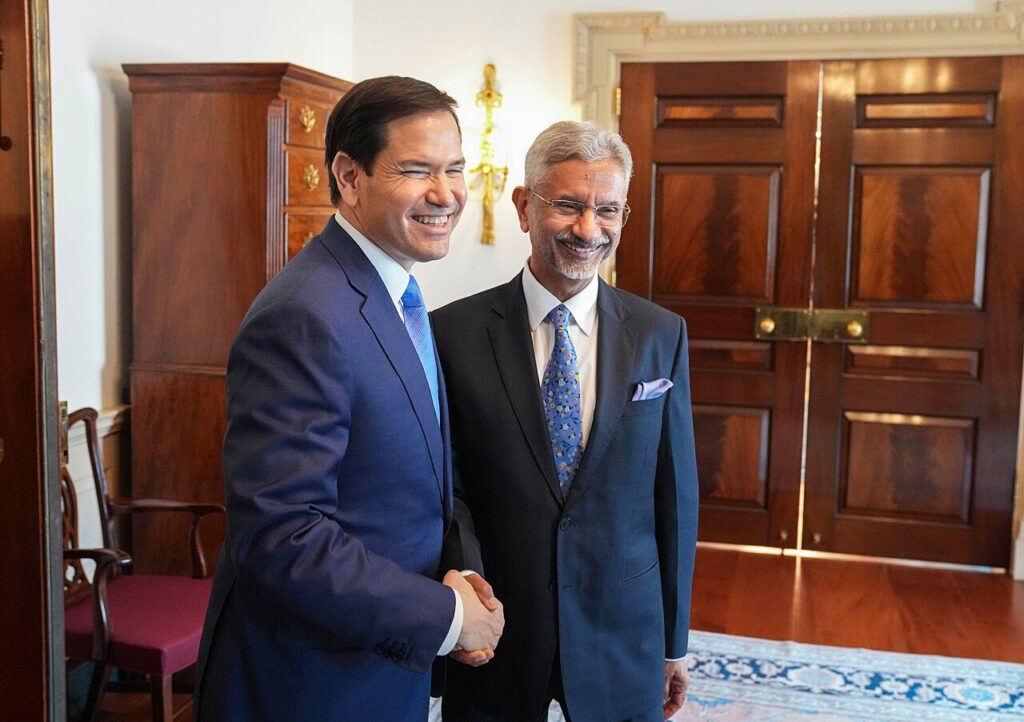
Rubio flew into Mumbai on Tuesday afternoon from Samarkand, Uzbekistan, where he had been meeting Central Asian leaders. This afternoon he sits down with India’s External Affairs Minister S. Jaishankar — New Delhi’s top diplomat — for talks the two sides say will span trade, energy, defence, security, technology and critical minerals.
It is his second visit to India since May, and it lands at a delicate moment. Trade talks between the two countries have been dragging on for months, repeatedly derailed by tariff threats. But officials on both sides now say a comprehensive deal is “almost complete” — raising the very real possibility that it could be signed before Rubio leaves.
The biggest obstacle was cleared just days ago. On Friday, President Donald Trump waived the punitive provisions of the Sanctioning Russia and Iran Act, a US law passed in September that authorised tariffs of up to 100% on the top five importers of Russian oil. India sits at number two on that list, behind China, and New Delhi had warned that such tariffs could badly damage bilateral ties.
Rubio has said openly that the trade talks helped tip that decision. “We are trying to finalise a trade deal with India right now and we are very close to doing that. So, that’s one of the things we take into consideration when the President makes a decision about national security waivers,” he told reporters in Uzbekistan on Monday.
India’s dependence on Russian oil is the backdrop to everything this week. India imports more than 85% of the crude it needs to power its fast-growing economy, and Russian barrels — sold at steep discounts after Western sanctions on Moscow over the Ukraine war — accounted for nearly half of those imports earlier this year. Purchases have been declining since August, but India still buys millions of barrels of Russian crude every day.
Rubio acknowledged the difficulty of a faster pivot on Sunday: “You’ve got countries like India, for example, that have voluntarily diversified their energy portfolio, but are still getting a substantial amount of energy from Russia because it’s hard to pivot from one day to the next,” he said. “But they’re also an important ally and partner of the United States.”
There is an irony hanging over the visit that has not gone unnoticed. While Washington has pressed New Delhi to cut its Russian oil imports, the United States itself signed a deal last week to import diesel from Russia to bring down domestic fuel prices ahead of America’s midterm elections — a move Ukraine’s president called a gift that would help fund the war. Asked about the contradiction, Rubio said Monday that “every country has a complex set of factors that they have to take into account,” adding: “Geography is real. For some countries, it’s very difficult to acquire energy from alternative sources.”
The waiver is not a permanent pass. The administration has opened a 60-day review period to decide which tariffs, if any, it will impose on Russian-oil buyers — meaning the clock on this week’s diplomacy is real. Michael Kugelman, a senior fellow at the Atlantic Council, called the waiver “the confidence-building measure that gives the two sides the negotiating space to get over the final hump.”
Rubio’s itinerary underlines the energy angle. After the Jaishankar meeting in Mumbai, he travels to Jamnagar in western India — home to the world’s largest oil-refining complex, run by billionaire Mukesh Ambani’s Reliance Industries — and is meeting business leaders as part of a large delegation.
Regional crises will also be on the table. The talks are expected to cover developments in Ukraine and West Asia and their implications for food, fuel and fertiliser security — issues that matter enormously to India, which lives with the inflationary fallout of every oil shock.
The visit also has a domestic American subplot. Six US lawmakers wrote to Rubio ahead of the trip urging him to raise alleged excessive force against protesters in India and alleged surveillance of protesters in the United States by Indian consulates — a reminder that the India relationship is watched closely on Capitol Hill.
Why this matters
A US-India trade deal would be one of the defining economic agreements of the year: it links the world’s largest democracy with its largest economy at the moment when global supply chains are being redrawn and every country is being asked to pick its energy partners. Whether Washington rewards New Delhi’s gradual pivot away from Russian crude — or reaches for the tariff lever again after the 60-day review — will set the template for how the United States deals with every other buyer of Russian energy, from China to Brazil. This week’s visit is where that template starts being written.