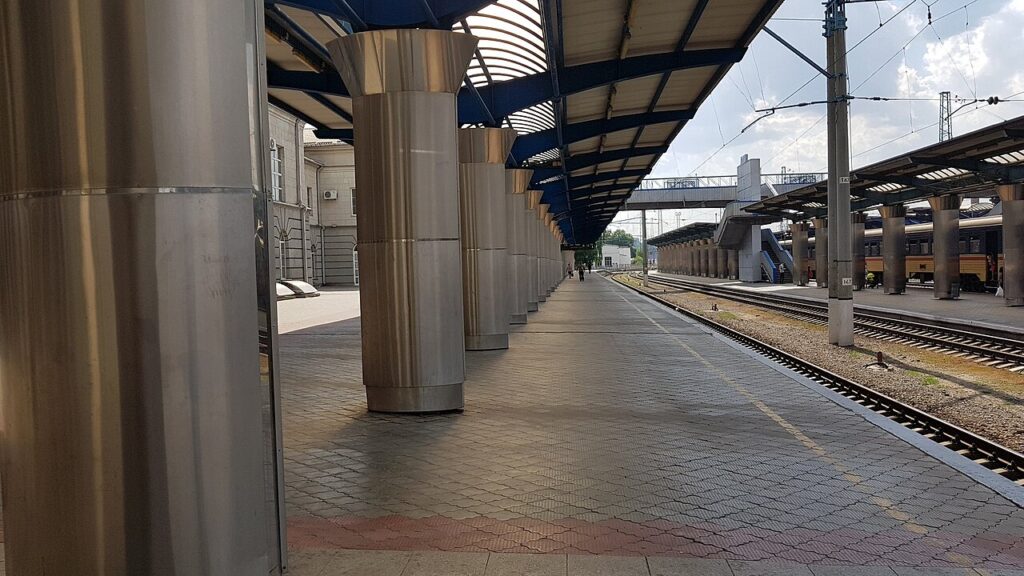
A Russian drone struck a crowded railway platform in the Ukrainian city of Dnipro on Thursday morning, killing 14 people and wounding at least 14 more as passengers stood beside a commuter train preparing to leave for Zaporizhzhia.
Ukraine’s state railway operator, Ukrzaliznytsia, said a jet-powered drone hit one of the platforms at Dnipro’s main station, where train No. 866, bound for Zaporizhzhia, was standing at the time. An elevated threat warning had been issued before the strike, the operator said, but large numbers of people were still on the platform.
“Despite a warning of heightened danger, people were on the platform,” Ukrzaliznytsia said in a statement. Rescuers, medics and police rushed to the scene as smoke rose over the station.
Oleksandr Hanzha, head of the Dnipropetrovsk regional military administration, confirmed 14 deaths and said the wounded toll had risen to 14. Six of the injured are in critical condition, he said: an 11-year-old boy, men aged 40 and 53, and a 26-year-old woman. The rest are in moderate condition and are all in hospital.
Dnipro’s mayor, Borys Filatov, described the attack in stark terms on social media. “Many people were killed. Lots were injured,” he wrote, calling it “a tragedy” for the city.
President Volodymyr Zelensky condemned the strike as “horrific” and used it to press his case against easing pressure on Moscow. “A horrific Russian strike on the railway station in Dnipro,” he wrote. “The Russians used a drone to attack the platform where a regular suburban commuter train and a scheduled passenger train were located. Unfortunately, as of now, 13 deaths have been confirmed. My condolences to the families and loved ones.”
Zelensky went further, tying the attack to the sanctions debate now running in Washington. Sanctions “against Moscow and its war machine must not be eased for as long as this Russian war continues,” he said, asking how many such strikes Russia had carried out since sanctions on some Russian oligarchs and the energy sector were lifted. Earlier this month, US President Donald Trump waived a sweeping Russia sanctions bill a day before it was due to bite, sparing India and China from tariffs of up to 100 percent. There was no immediate comment from Russia on the Dnipro strike.
Dnipro is a major city in south-eastern Ukraine, on the river of the same name, and its railway station is one of the country’s busiest junctions. With civilian air travel shut down since Russia’s full-scale invasion in February 2022, trains have become the backbone of everyday travel in Ukraine, carrying passengers, evacuees and supplies across a country where a journey from east to west can take a full day. That is what makes a strike on a station platform so jarring: the people killed on Thursday were not soldiers at a front-line position but commuters standing beside an ordinary scheduled train.
The attack also landed on a day when a very different story was supposed to be unfolding elsewhere in Ukraine. A limited, localised truce in the Russian-occupied town of Oleshky, secured with the involvement of US First Lady Melania Trump, was due to begin on Thursday to let aid in and civilians out. By the afternoon, that aid had still not moved. Dnipro showed, in the same hours, how little a local pause means for the wider war.
Why this matters goes beyond one station. Russia has repeatedly struck Ukraine’s rail network, and each hit forces the same calculation on millions of people: whether the train, the safest way to move around a country at war, is safe at all. Strikes on transport hubs also ripple outward, disrupting evacuations, freight and the movement of troops and equipment. And with winter approaching, attacks on civilian infrastructure carry a heavier weight, testing both Ukraine’s emergency services and its allies’ willingness to keep pressure on Moscow. Thursday’s toll, 14 dead on a platform in broad daylight, is a measure of what that pressure is meant to prevent, and of what happens while it is debated.
Correction: An earlier version of this article stated 13 people were killed, 13 wounded and four in critical condition. It has been updated to reflect the revised toll of 14 killed, 14 wounded and six in critical condition. October 29, 2026.