Ukrainian drones struck a Russian oil refinery before dawn on Friday, setting it on fire and ending a pause in refinery attacks that had lasted nearly two weeks. The strike landed barely a day after reports emerged that Kyiv had quietly suspended such attacks under pressure from Washington — and days before Americans vote in midterm elections that the White House had wanted kept calm.
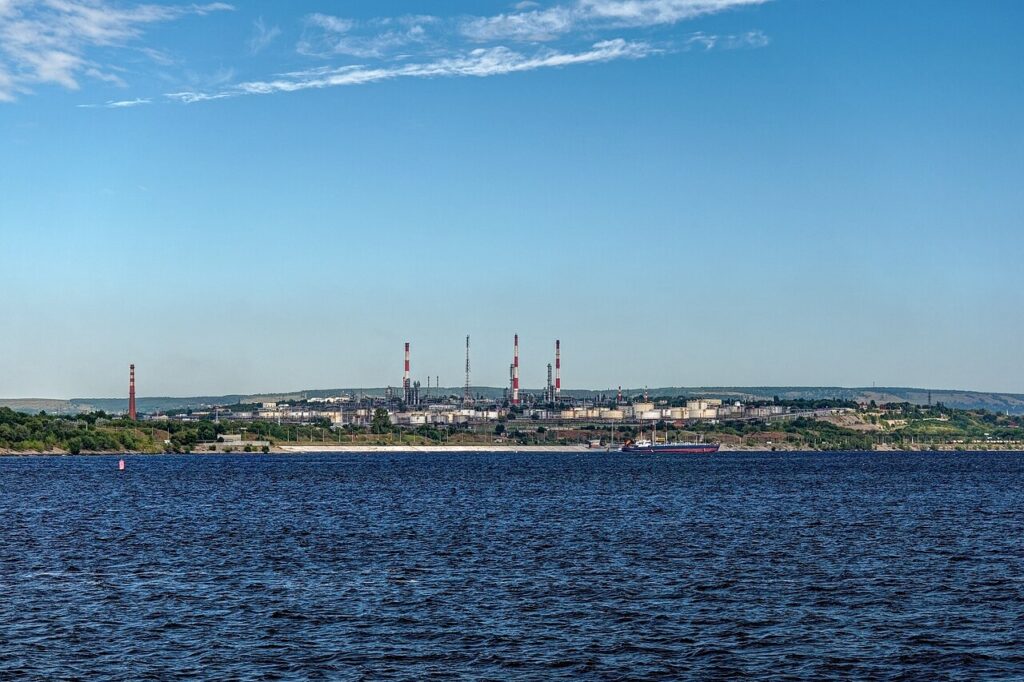
The target was the Novokuibyshevsk refinery in the Samara region, on the Volga river southeast of Moscow. Residents reported explosions and air-defence fire in the early hours, and regional authorities declared a drone alert at around 6 a.m., by which time the attack was already under way. Photographs sent in by readers allowed the independent Russian outlet ASTRA to identify the fire site as the refinery, and footage shared by Ukrainian monitoring channels showed thick columns of smoke over the plant.
What remains unconfirmed is as important as what is known. Samara’s governor, Vyacheslav Fedorishchev, confirmed that the region came under drone attack but did not name the facilities hit or describe any damage. Ukraine’s General Staff had not claimed the strike in the hours after it, and the Kyiv Independent said it could not independently verify the circulating footage. The Ukrainian drone maker Fire Point said its FP-1 drones carried out the attack and hit a diesel hydrotreating unit — a claim that, so far, rests on the manufacturer alone.
The plant itself is no minor facility. It has belonged to Rosneft, Russia’s state-controlled oil giant, since 2007, processes about 8.8 million tonnes of crude a year, and turns out more than 20 products — including jet fuel used by Russia’s Aerospace Forces. Ukrainian drones have hit it before: a strike in August set it on fire, and attacks in April forced two of its main crude distillation units to suspend operations.
The timing is what makes this strike a story in itself. The Wall Street Journal reported on Thursday that Ukrainian military units had informally suspended long-range refinery strikes in mid-October after pressure from President Donald Trump’s administration, with the pause expected to last past the November 3 midterms and possibly deeper into November. Ukrainian forces had not hit a refinery since October 15, and had not struck any oil infrastructure since October 20. President Volodymyr Zelensky, asked about the pause on Tuesday, was careful with his words: “Our guys tried to be a little more careful during these days. But they do not have an order” not to hit refineries.
According to the Journal, the decision to strike Novokuibyshevsk came despite advice from European allies to hold off until after the American vote, to avoid adding to the recent tensions between Zelensky and Trump. Trump has publicly blamed Ukraine’s refinery campaign for high global fuel prices — a claim energy analysts largely dispute, pointing instead to the wider war in the Middle East. Zelensky, for his part, has said Ukraine wants stronger protection for its own energy infrastructure, which Russia has been systematically destroying ahead of winter, in exchange for halting refinery strikes. On Thursday alone, a Russian drone strike on a railway station in Dnipro killed 15 people, and Russian attacks have repeatedly knocked out power for hundreds of thousands of Ukrainians.
The overnight operation went wider than one refinery. Ukrainian drones also hit the Konservsushprod factory in Starodub, in the Bryansk region — a plant that supplies food rations to Russia’s armed forces — starting a large fire there. The drone wave also forced all four of Moscow’s major airports to suspend operations overnight.
Why this matters beyond the fire itself: the refinery campaign is one of the few levers Kyiv holds that directly costs Moscow money, striking at the oil revenues that help finance the invasion. Pausing it was a concession to an ally whose support Ukraine cannot afford to lose; resuming it, days before that ally’s elections, is a gamble that the leverage matters more than the friction. Whether Friday’s strike was a one-off return or the start of a renewed campaign is the question now — and the next visible test will be whether more refineries burn in the coming nights, and how loudly Washington objects.
For now, the pause that dominated Thursday’s headlines lasted barely a day in public view. It joins a longer pattern in this war: understandings between Kyiv and Washington that hold until the battlefield, or the winter, makes them impossible to keep. The reported pause itself was never announced by Kyiv, and neither, so far, has its end been. But the smoke over Samara is difficult to read any other way. Zelensky’s earlier offer — a 30-day refinery pause in exchange for Patriot missiles — now looks less like a deal on the table than a bargain that was never accepted.