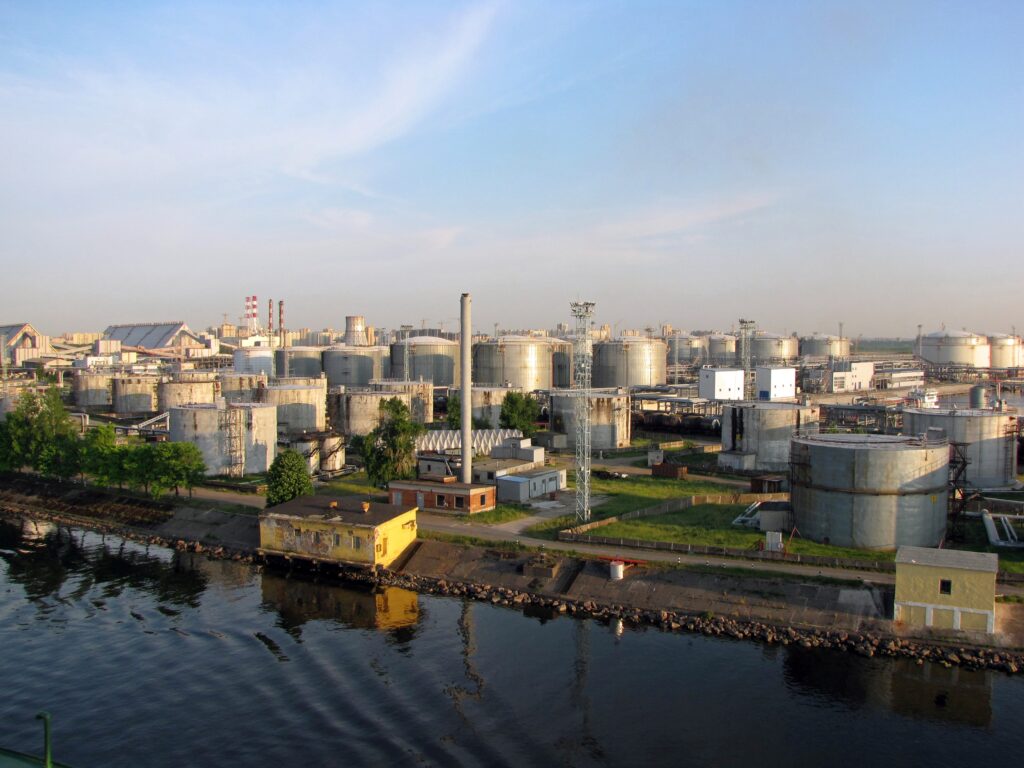
St. Petersburg woke to sirens and fire crews on Sunday morning after one of the largest Ukrainian drone attacks of the war reached deep into Russia’s second city. The St. Petersburg Oil Terminal — one of the country’s biggest fuel export facilities — caught fire, a data center belonging to the Russian social media giant VKontakte was struck, and the city’s Pulkovo airport suspended all arrivals and departures.
According to Ukrainian monitoring channels tracking the raid, the attack began at about 2:50 a.m. local time. Eyewitness videos filmed by residents show drones crossing the night sky over the city of 5.6 million people, air-defense guns firing back, and large explosions lighting up the waterfront near the port. Other clips appear to show a drone slamming into an eight-lane bridge — a claim Russian state media did not repeat.
What Russia is saying
Alexander Beglov, the governor of St. Petersburg, acknowledged the attack on Sunday morning, saying the drones had targeted the oil terminal and civilian infrastructure across four districts of the city. He reported a fire at the terminal, initially saying there were no casualties; officials later confirmed on Sunday that one person had been killed and five others injured. The federal air transport agency, Rosaviatsia, suspended all flights at Pulkovo, and passengers and staff were moved to safe locations, the state news agency TASS reported.
Aleksandr Drozdenko, governor of the surrounding Leningrad region, said air defenses had shot down as many as 127 Ukrainian drones — though the figure shifted through the morning, first quoted at 95, then 126. Debris from intercepted drones damaged a private house near Kirovsk, an apartment building in Vsevolozhsk, four parked cars and power lines, according to the official tallies. None of the accounts says how many drones were actually launched.
VK, Russia’s largest social network, confirmed that one of its data centers in the Leningrad region had been hit. “VK services remain available to users as usual,” the company said in a statement carried by TASS — a sign the strike caused damage but not a shutdown.
What Ukraine is claiming
Ukrainian monitoring channels Exilenova+ and Supernova+ described the raid as “massive” and reported that the city’s port infrastructure, oil tankers and the data center were all targeted. The Ukrainian drone manufacturer Fire Point claimed that one of its FP-1 attack drones struck the oil terminal.
The Kyiv Independent, which carried eyewitness footage of the terminal engulfed in flames, cautioned that it could not independently verify the targets or the extent of the damage — a caveat that applies in both directions. The Russian opposition outlet Astra reported separately that a power substation was hit, causing blackouts and low water pressure in parts of the region, and that an apartment building was damaged.
Ukraine has struck the St. Petersburg terminal before, on July 4, and has hit multiple Yandex data centers in recent weeks — a campaign Kyiv has framed as answering Russia’s own strikes on Ukrainian energy and data infrastructure.
The terminal at the center of it
The St. Petersburg Oil Terminal sits in the city’s port and is one of Russia’s largest fuel storage and export facilities, handling petroleum products shipped by river, rail and road, with a reported throughput of 12.5 million tons a year. Fuel exports are one of the Kremlin’s most important revenue streams — and Ukraine has made knocking out the infrastructure behind them a central strategy of its long-range drone campaign.
Why this matters
The strike lands barely a day after Russia’s own overnight barrage of Ukraine’s power grid killed eight people and left more than a million without electricity — the latest round in a war over energy infrastructure that neither side is willing to pause. Ukraine’s message is that Russia’s second city, more than 850 kilometers from the Ukrainian border, is no longer out of reach. For global energy markets, the symbolism cuts deeper than the flames: every successful hit on a Russian export terminal tightens the pressure on the revenues funding the war, and every retaliation deepens the cycle of strikes on both countries’ grids. As winter approaches, both sides are racing to break the other’s lights before the cold does it for them.
This is a developing story. It will be updated as verified information becomes available.
Correction: An earlier version of this article stated that St. Petersburg’s governor reported no casualties in the drone attack. It has been updated to reflect officials’ later confirmation that one person was killed and five others injured. 18 October 2026




One Comment