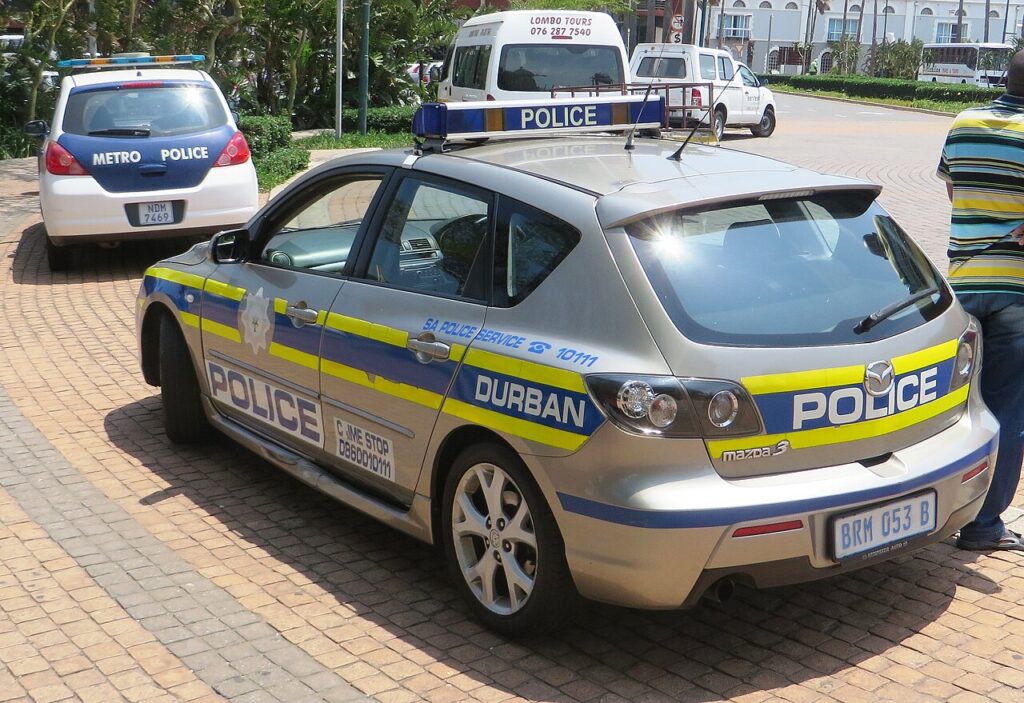
Gunmen killed at least 27 people in two mass shootings in South African townships within hours of each other this weekend, police said on Sunday, in a night of carnage that has pushed the country’s gun-violence crisis to the front of the national agenda. No arrests have been made in either attack, and police say a manhunt is under way.
The first and deadliest attack came at around 9:30 p.m. on Saturday, when eight men armed with AK-47 rifles and pistols stormed a tavern in Wedela, a township about 80 kilometres southwest of Johannesburg. Police said the men, wearing balaclavas — some in jackets bearing the colours of neighbouring Lesotho — opened fire on patrons drinking outside, then moved inside and kept shooting. Before fleeing, they searched some of the victims, stole their mobile phones, and set two vehicles alight outside the bar.
Seventeen people were killed at the scene — 13 men and four women — and 15 more were taken to hospital with gunshot wounds, according to the South African Police Service. The victims included South African nationals, citizens of Lesotho, and one Ethiopian. There was a bitter irony at the entrance of the tavern: a sign reading “No weapons allowed.”
Deputy provincial police commissioner Major General Fred Kekana, who visited the scene, said investigators had clear images of the suspects. “We managed to get clear pictures of the suspects and we will get them,” he said. “The criminals think it’s a fashion. They want to make it something which we need to get used to, but that cannot be allowed and tolerated.”
About four hours later, at around 1:46 a.m. on Sunday, gunfire erupted again — this time at a venue selling grilled meat in Lwandle township, outside Cape Town, South Africa’s second-biggest city. Gunmen killed 10 people and wounded 11 more. Five of the victims were declared dead at the scene; the others died on the way to hospital.
A country already on edge
President Cyril Ramaphosa condemned the attacks and promised an all-out security crackdown. “This cannot go on like this,” he said. “This is the level of criminality that we must bring down, and our security forces are now going to continue pulling out all stops.”
Investigators have offered only tentative explanations. In Wedela, police are examining whether the attack was tied to rivalries between illegal-mining gangs. The township sits in a gold-mining region that has been a focus of a government crackdown on illegal mining, with soldiers deployed alongside police to tackle criminal networks around abandoned mine shafts. The illegal miners are known locally as “zama zamas” — an isiZulu expression meaning “taking a chance.”
Provincial police commissioner Tommy Mthombeni said one line of inquiry was a “turf war in terms of illegal mining.” It could also have been retaliation: one of the dead was reportedly being sought by police in connection with a shooting at the same tavern last month, in which one person was killed and another wounded. In Cape Town, early lines of inquiry pointed to a possible business dispute — preliminary, not established.
The numbers behind the horror
The Wedela attack is now the deadliest mass shooting of 2026 in South Africa, surpassing a massacre in Johannesburg on June 9 that killed 13 people. According to a count by the Daily Maverick, at least 196 people have been killed in mass shootings in South Africa since January. Just five days ago, gunmen attacked a house party near Durban and killed 11 people, including a pregnant woman. Police have not reported any arrests in that case either.
Crime expert Yusuf Abramjee told Reuters the problem runs deeper than individual shooters. “South Africa has a serious illegal firearms problem, and firearms are frequently used by organized criminal groups and in gang-related and other violent crimes,” he said. “Every mass shooting therefore should trigger more than an investigation into immediate perpetrators. Authorities must examine wider networks behind the violence.”
Why this matters beyond South Africa
South Africa’s gun crisis is not a purely domestic story. The country is the continent’s most industrialized economy, a major gold producer, and a magnet for migrant workers from across southern Africa, including Lesotho.
The attack also exposes a structural problem that reaches far beyond one township. Illegal mining in abandoned shafts has grown into a parallel economy run by armed syndicates, fed by a steady flow of illicit weapons. As the United States has learned in its own struggles with mass shootings, the weapons rarely arrive out of nowhere; they move through organized channels, and stopping the shooters means following the guns. Ramaphosa has promised security forces will “pull out all stops” — and in Wedela, residents are waiting to see whether this time is different.