The man in charge of France’s police force stood before cameras on Monday and said what no French interior minister in years has dared to say: his officers had lost control.
“On Saturday, in some major cities, you couldn’t look shopkeepers in the eye after hundreds of shops had been looted and tell them we hadn’t lost control,” Interior Minister Laurent Nunez said. It was an extraordinary admission — and it came with an extraordinary offer. Nunez told reporters he had handed his resignation to President Emmanuel Macron on Sunday. Macron refused it.
Nunez acknowledged a “lack of anticipation” in how security forces were deployed for Saturday’s protests, which began as a cost-of-living march and curdled into some of the worst urban violence France has seen in years. He estimated that 60,000 law enforcement personnel were deployed nationwide that day — and it was not enough. “Given the damage that has been caused, it was only right that I should hand in my resignation,” he said.
The Elysee Palace confirmed the sequence on Monday. “The interior minister submitted his resignation to the president on Sunday,” it said in a statement. “Given the necessity for continued leadership of law enforcement at this time, the president refused.”
But Macron’s decision to keep Nunez came with conditions that read like an indictment. The president acknowledged “failures in anticipation and intelligence” and ordered his interior minister to “take all necessary steps to ensure transparency over the failures in planning and intelligence that led to the violence.” He also instructed Nunez to put “new operational methods for security forces” in place quickly — a directive aimed at ending the barricades and looting.
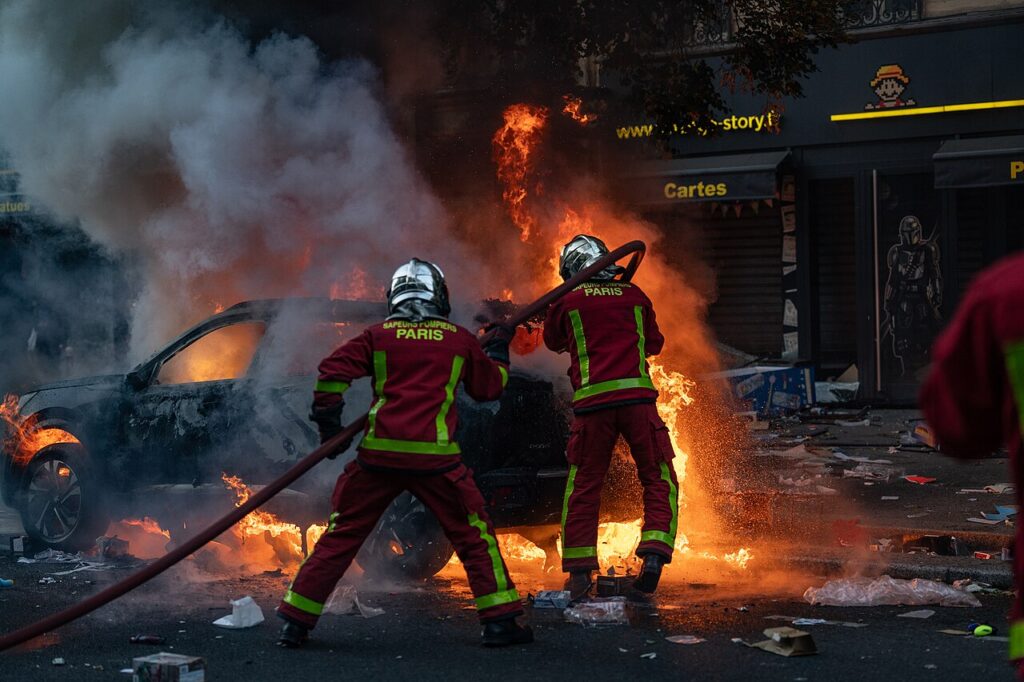
The numbers explain the urgency. Nearly 2,400 people were arrested on Saturday, with almost 1,000 police officers and gendarmes injured, according to the interior ministry; some outlets put the arrest total above 2,500. One protester lost a hand to a police crowd-control grenade.
The violence did not stop on Saturday. Looting continued on Sunday, when riot police intervened in Paris and Marseille to stop attempts to ransack businesses. Paris Mayor Emmanuel Gregoire said Monday that around 30 shops had been targeted in the capital the previous day, calling the scenes “unbearable.” Nunez said 350 people were arrested in Paris on Sunday and overnight.
Across the weekend, more than 2,330 people were taken into police custody — 70 percent of them adults, Justice Minister Gerald Darmanin said Monday. The economic toll is already staggering: more than 2,000 shops are expected to have been affected, with damage running into “hundreds of millions of euros,” according to chamber of commerce president Alain Di Crescenzo.
Nunez’s admission follows Macron’s televised national address on Sunday evening, in which the president told rioters they would “pay” for the damage and blamed “seditious elements” from the far left. It lands two days after Saturday’s “yellow and youth” day of action, when half a million people marched across France against the rising cost of living before looters peeled off toward luxury stores in Paris, Marseille, Lyon and Bordeaux. Some opposition politicians have already called for Nunez to be sacked.
Why this matters — and why it matters beyond France: a sitting interior minister admitting that the state lost control of its own streets is a rare and destabilizing event for any government, and France is no ordinary case. It is Europe’s second-largest economy and a nuclear-armed G7 power whose president has now publicly conceded that his security apparatus failed to anticipate one of the worst nights of urban violence in years. Macron’s refusal to accept Nunez’s resignation ties the president personally to whatever happens next. With a presidential election looming in 2027, the question hanging over France is no longer just about policing tactics — it is whether this government can convince its citizens that it is still in control of the country.