- Q3 GDP rose 4.5% year on year, beating the 4.4% consensus forecast and rebounding from Q2’s three-year low of 4.3%. The first nine months of the year came in at 4.6%, within Beijing’s 4.5–5% annual target range.
- Exports did the heavy lifting. September shipments surged 29.6% in yuan terms, the nine-month trade surplus hit $938.1 billion, and chip exports roughly doubled — putting China on track for a surplus north of $1 trillion this year.
- Households didn’t share the boom. Retail sales crept up just 1.1% in September — barely above zero once inflation is stripped out, per Pinpoint’s Zhiwei Zhang — while property investment plunged 20.6% and new housing starts fell 24.9%.
- Beijing is reaching for more stimulus. The finance ministry unlocked 550 billion yuan in unused local-government debt quotas for infrastructure and emerging industries, days after new mortgage subsidies.
- Why it matters beyond China: a record trade surplus and weak domestic demand mean China is exporting deflationary pressure and factory overcapacity to the rest of the world — while commodity producers are caught between booming Chinese factories and a property sector that still isn’t buying.
Beating the forecast — but look closer
China’s National Bureau of Statistics — the NBS, the agency behind the country’s official economic data — announced on Monday that the economy grew 4.5% in the third quarter, a shade above the 4.4% economists had penciled in. The number is worth pausing over: after the second quarter’s slump to 4.3%, the weakest in more than three years, Beijing can credibly say its annual target of 4.5–5% is still alive. The economy expanded 4.6% over the first nine months of the year.
The quarter-on-quarter figure tells the more upbeat part of the story. GDP rose 1.2% from the previous quarter, beating expectations, and September’s monthly data carried most of it: industrial output accelerated to 5.5%, retail sales picked up to 1.1% from August’s 0.4%, and the urban unemployment rate ticked down to 5.2%. Zhiwei Zhang, president of Pinpoint Asset Management, cut through the optimism with a dry note: retail sales “rebounded slightly,” he wrote, but after adjusting for inflation, real retail sales “barely grew compared to one year ago.” Economists at Oxford Economics, meanwhile, described domestic demand conditions as “quickly deteriorating.”
Factories hum, households hold their wallets
The split inside the numbers is what economists have taken to calling a two-speed economy, and the gap between the two speeds keeps widening.
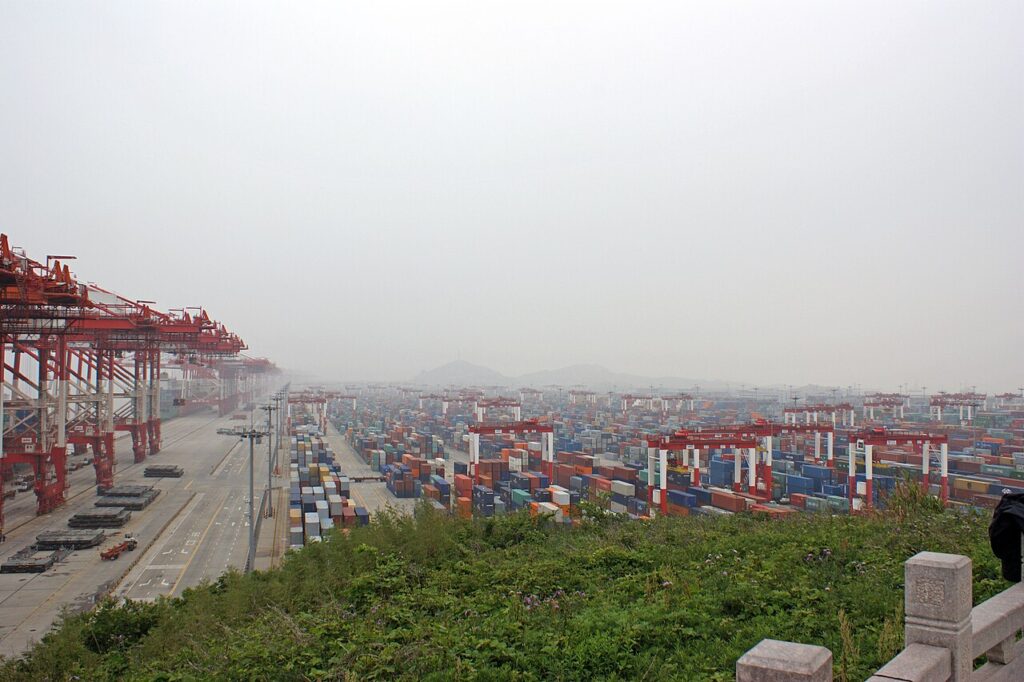
On one side, manufacturing and exports are running hot. High-tech manufacturing value-added climbed 14.3% in the first nine months. Exports rose 16.4% over the same stretch, powered in part by the global artificial intelligence boom — chip exports more than doubled in value. The January-to-September trade surplus of $938.1 billion leaves China within reach of topping last year’s record $1.2 trillion, and economists already expect the annual tally to cross $1 trillion.
On the other side, the domestic picture is bleak. Fixed-asset investment fell 7.2% in the first nine months. Property development investment plunged 20.6%, deeper than August’s 19.9% drop, and new housing starts by floor area collapsed 24.9%. This is the fifth year of the property downturn, and it matters more than the construction figures suggest: an estimated 70% of Chinese household wealth is tied up in real estate, so a frozen housing market means households that feel poorer — and spend like it.
Beijing isn’t pretending the domestic side is fine. Last month’s call for “intensified countercyclical adjustments” was followed by 550 billion yuan ($82 billion) in unused local-government debt quotas earmarked for infrastructure and emerging industries, plus mortgage subsidies widely read as a “mini stimulus.”
Why it matters beyond China
Here is the part that reaches past China’s borders. An economy growing on exports while its consumers stay home exports its imbalances abroad. A trade surplus crossing $1 trillion will intensify trade tensions with partners who see subsidized Chinese goods undercutting their own manufacturers — the European Union is already escalating on that front, and Beijing’s parallel push to tighten export controls on everything from drones to tunnel-boring machines shows it intends to use its export dominance as leverage, not wind it down.
For commodity markets, the split is a genuine puzzle. China’s factories devour copper, iron ore and energy — good news for exporters in Latin America, Africa and Australia — while its property sector, traditionally the biggest consumer of steel and cement, keeps shrinking. One Chinese economy is a commodity bull; the other is a commodity bear. Which one wins in 2027 will move prices from São Paulo to Perth.
And there is a quieter export: deflation. When factories with nowhere to sell at home ship abroad instead, the world imports falling prices along with the goods. For consumers in the West that sounds pleasant. For manufacturers in India, Mexico and Southeast Asia competing with those prices, it is a squeeze. Xu Tianchen of the Economist Intelligence Unit sees full-year growth reaching 4.7% on the back of exports and state spending. The IMF, for its part, trimmed its China forecast to 4.5% this month, warning that even strong exports can’t fully offset weakness at home. The NBS itself struck a triumphant tone — the economy “forged ahead against pressure,” deputy head Mao Shengyong said — but the real question isn’t whether Beijing hits 4.6% or 4.7%. It’s how long an economy can run on one engine before the other one stalls it.