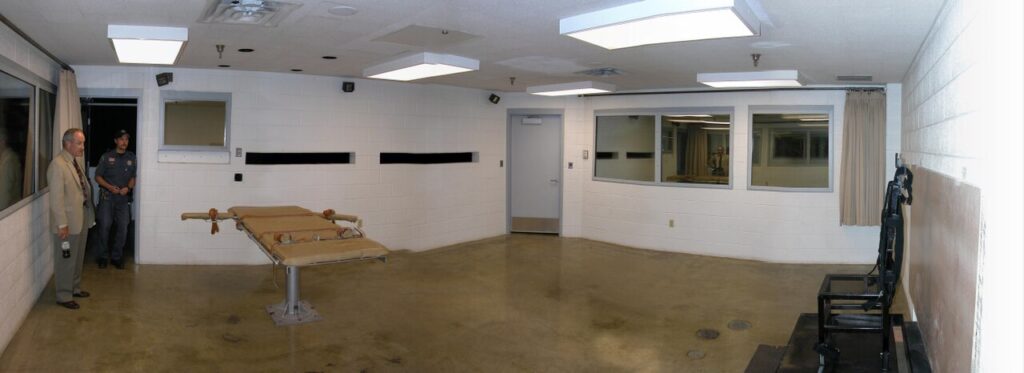
For nearly an hour on the evening of September 30, Tennessee’s execution team struggled with the first step of a lethal injection — getting the drugs into the condemned person’s veins. They went through about 10 needles on Christa Pike’s arms, bent one of them, and warned before injecting anything that a vein in her left arm might have “blown,” or ruptured. Pike survived anyway. Now her lawyer’s minute-by-minute account, filed in court on Thursday, offers the most detailed picture yet of the failed execution — and exposes what Tennessee’s own protocol does not cover: what happens when two doses of the lethal drug are not enough to kill someone.
Pike, 50, was hospitalised after surviving two doses of pentobarbital — the barbiturate Tennessee uses for executions — at the Riverbend Maximum Security Institution in Nashville. She had been sentenced to death for the 1995 stabbing murder of her classmate Colleen Slemmer, committed when Pike was 18. After the failed attempt she spent days on a ventilator; at one point, her lawyers did not expect her to live. She eventually regained consciousness and was returned to prison.
According to the account written by her lawyer, Randy Spivey, the team began trying to place the two IV lines required by Tennessee’s protocol at 6:34 p.m. When they struggled, Pike herself helped, advising them to look in her upper arm for a usable vein. An IV went into her right arm within about six minutes. The left arm took nearly an hour.
“Pike was wincing and grimacing” as team members moved the needles around inside her left arm, Spivey wrote — and the staff kept voicing doubts. At 6:57 p.m., one team member said a vein “might be blowing”; two others said they could not tell. “One of them said something like, ‘it’s either blood or blown, I need to know,'” Spivey wrote. They tried a different spot. The needle, he said, appeared to be severely bent when they pulled it out. At 7:07 p.m., a team member said, “I think it’s blown.” After more attempts, the team decided at 7:13 p.m. that a working line was finally in place. They taped her hands down and connected her to a heart monitor.
Minutes later, Spivey wrote, phone calls began coming into the chamber — apparently the staff pushing the pentobarbital, in an adjoining room, asking for repeated checks of the left-arm IV. At 7:34 p.m., Pike said her arm was hurting. “I feel like my arm is about to bust. It burns,” she said, according to Spivey. She talked to her spiritual adviser for another 10 minutes, then began making what Spivey described as an “agitated snoring sound.” Over the next half hour, she strained, flinched, moved her head and seemed to struggle to breathe. Spivey asked to use a phone; instead of the one in the witness room, he was led on a seven-minute winding route through the facility. At 8:22 p.m., he called fellow lawyers and asked them to stop the execution — a third dose is not authorised under Tennessee’s protocol — and told the deputy attorney general that Pike needed immediate medical care. An ambulance was on the way by 8:50 p.m., and 20 minutes later staff were performing life-saving measures. An ambulance reached the hospital at 9:14 p.m.
Tennessee’s protocol calls for a second dose of pentobarbital if the first does not produce death. It says nothing about what to do if the second dose fails too — the precise situation Pike’s body created. The new filing is part of a separate legal challenge in which people on Tennessee’s death row are contesting the state’s lethal-injection procedures. “Our predictions about the likelihood of botched executions have come true — and will continue to come true — without substantial change,” said Kit Thomas, a lawyer representing death-row inmates in that case.
For readers outside the United States, some context: Tennessee is one of about two dozen American states that still carry out the death penalty, and lethal injection is the default method in nearly all of them. The question of whether the drugs and the procedures around them inflict needless suffering has shadowed American executions for years. This case matters beyond Tennessee because it is one of the rare instances where the failure is documented almost minute by minute, by the condemned person’s own lawyer watching through the witness-room glass. It also leaves the state with an unanswered question it has never had to put in writing: what is the legal status of a person the state tried to execute, twice, and did not kill?
Execution methods have been under fresh scrutiny in the US this month. President Trump cancelled a planned livestream of the firing-squad execution of the Fort Hood shooter, and Pike’s survival itself made headlines in September — she was one of the youngest women ever sentenced to death in the United States.