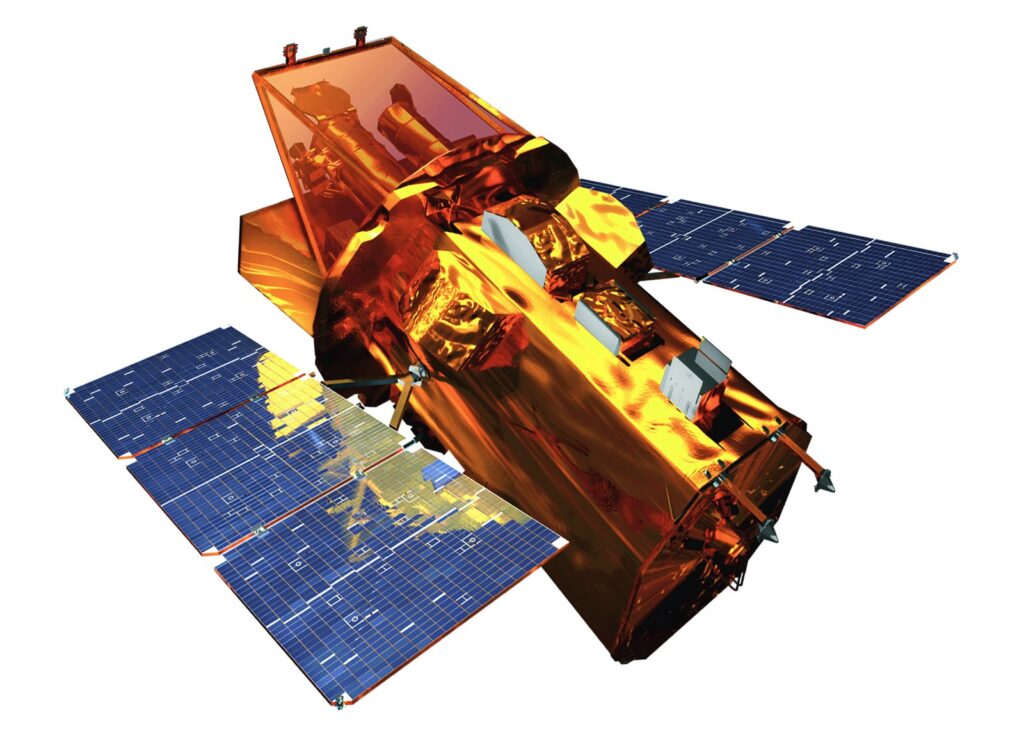
Nov 20, 2004 — launch. Swift blasts off from Cape Canaveral on a Delta II rocket, built to solve a mystery more than 30 years old: what causes gamma-ray bursts, the brief flashes of high-energy radiation that are the most powerful explosions known in the universe. The mission is designed to last two years.
2004–2026 — the overachiever. Swift does not stop at two years. It runs for more than 22, detecting over 2,000 gamma-ray bursts and more than 1,400 exploding stars, plus comets, asteroids and stars shredded by black holes. Its data feeds about 7,000 published papers. With NASA’s Fermi telescope it catches GRB 221009A, nicknamed the BOAT — the brightest of all time — from 2.4 billion light-years away. Swift becomes the first responder of astronomy: it spots the flash, and Hubble, Webb and telescopes on the ground swing round to look deeper.
July 2026 — the rescue that failed. Swift has been slowly losing altitude for years. A commercial servicing spacecraft launches to boost it to safety. The rescue goes wrong before it reaches its target — the craft begins spinning out of control — and the chance to save Swift is gone.
Oct 20, 2026 — science ends. Swift has sunk to 275 kilometres above Earth, so low that the thin upper atmosphere drags on it too hard for its telescopes to hold steady on a target. It slips into safe mode, and the operations team at Penn State sends the command that effectively ends the mission.
Late October 2026 — shutdown. By late October the telescope is too low to point at all, and its systems are switched off. NASA’s Brad Cenko, the mission’s chief scientist, confirms what comes next: most of the 1.5-tonne spacecraft will burn up in the atmosphere, but a handful of pieces made of tungsten — denser than lead — and some mirror parts could survive the fall.
Now — the fall. Forecasters put re-entry in the first days of November, with some predictions centred on Nov 2 and others, from the Aerospace Corporation’s tracking centre on Oct 30, on about Nov 4. Any surviving wreckage will most likely plunge into the ocean. But the possible re-entry band stretches between 20.5 degrees north and 20.5 degrees south of the equator, taking in swathes of Africa, Australia, India, Southeast Asia and Central and South America. There is no controlled de-orbit: where exactly Swift comes down will only be known after the fact.
Why this matters: Swift’s end is a small parable about the space age’s second act. The telescope was built when a two-year mission was a triumph; it survived long enough to watch the field it created grow up around it. Its replacement gap is real — astronomers are still working out how to fill the rapid-response role Swift played for a generation. And its uncontrolled fall is a reminder that everything we put up eventually has to come down, in a sky that is far more crowded than it was in 2004.
Related coverage on this site: read our explainer on what gamma-ray bursts are and what Swift’s 22 years taught us.