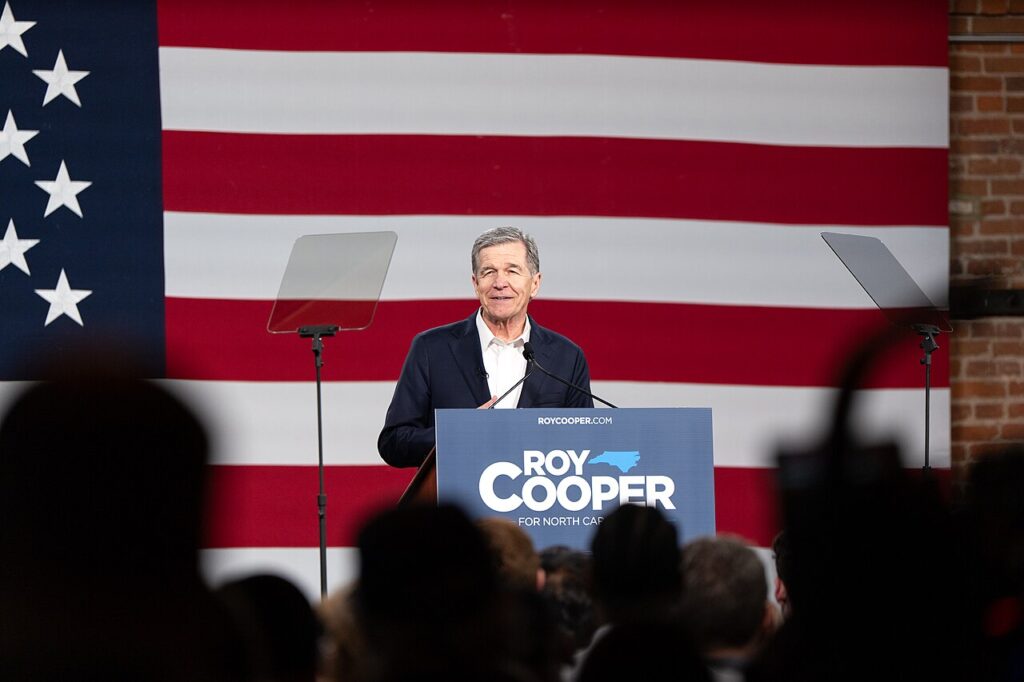
The Associated Press called North Carolina’s Senate race for Democrat Roy Cooper at 8:24 p.m. Eastern time on Tuesday, handing Democrats their first pickup of the 2026 midterm elections — and their first Senate victory in the state since 2008.
Cooper, 69, the state’s former two-term governor, led Trump-backed Republican Michael Whatley by roughly two to one — about 67 percent to 32 percent, with more than half the vote counted, when the AP made the call. It was the first seat to change parties in either chamber of Congress on election night, and it came in a state Donald Trump has carried three times in a row.
Cooper is one of the best-known Democrats in the American South. He served as North Carolina’s governor from 2017 to 2025 and as the state’s attorney general before that, and Tuesday’s win was his seventh consecutive statewide election victory — he has never lost a race. Whatley, a former chairman of the Republican National Committee, had never held elected office and campaigned alongside Trump, including at a rally in Greenville in late October.
The seat was open because the Republican who held it, Thom Tillis, chose not to seek a third term after breaking with Trump over cuts to Medicaid — the government health programme for low-income Americans — in the president’s signature tax and spending law. Trump had threatened to back a primary challenger against him.
Cooper campaigned almost entirely on the cost of living, under the slogan “Make Stuff Cost Less”, arguing that grocery, energy and housing bills were rising faster than pay. Exit polls suggested the economy was the top issue for voters in this election, ahead of the state of democracy and immigration. After the race was called, Cooper posted on X: “North Carolina — I’m grateful for your trust. We have more in common than divides us. Here’s to building better days ahead!”
Elsewhere in the early results, Democrats held the seats they were expected to hold. In Georgia, the incumbent Jon Ossoff defeated the Republican congressman Mike Collins. In Virginia, Mark Warner won re-election over Bert Mizusawa. In New Hampshire, Chris Pappas defeated the former senator John Sununu, becoming the first openly gay man elected to the US Senate. Democratic incumbents also held on in Rhode Island, Delaware and New Jersey.
In the House of Representatives, where all 435 seats are contested, early projections also leaned Democratic — 52 seats projected for Democrats against 25 for Republicans by about 9 p.m. Eastern, according to AP data reported by NPR — but that is a small fraction of the chamber, and no overall winner has been projected. One closely watched Florida race illustrates how unfinished the night is: in the redrawn 22nd district, Democrat Pia Dandiya leads Republican Casey Askar with about 52 percent of the vote and almost all precincts reporting, but the AP has NOT called that race, and it must not be reported as won.
That caution applies to the whole night. Polls were still open in the western United States when the North Carolina result was called, with Alaska the last state to close, at 1 a.m. Eastern. Democrats entered the night needing a net gain of four seats to take the Senate from its 53-47 Republican majority, and the races that will decide it — in Texas, Maine, Alaska, Iowa, Ohio, Michigan and Kansas — were still uncalled. Some may take days to resolve, and every result so far is a projection by news organisations, not an official certification: state authorities will canvass and certify the counts in the days ahead.
Why this matters beyond the United States: the midterms decide who controls Congress for the final two years of Trump’s second term. The House controls government spending and the power to investigate the president; the Senate confirms judges, ambassadors and senior officials. A Democratic House would put a check on presidential power at home, and governments around the world — from Kyiv to Tehran to Beijing — will read the result as a measure of how much political room Trump has left to pursue his foreign policy. North Carolina does not settle that question on its own, but the scale of Cooper’s win, in a state Trump keeps winning at presidential level, is an early sign that voters are judging the administration first on prices.
This is a partial picture from election night and will be updated as more races are called. Earlier, we explained what the 2026 midterms would decide — and when we would know.




One Comment