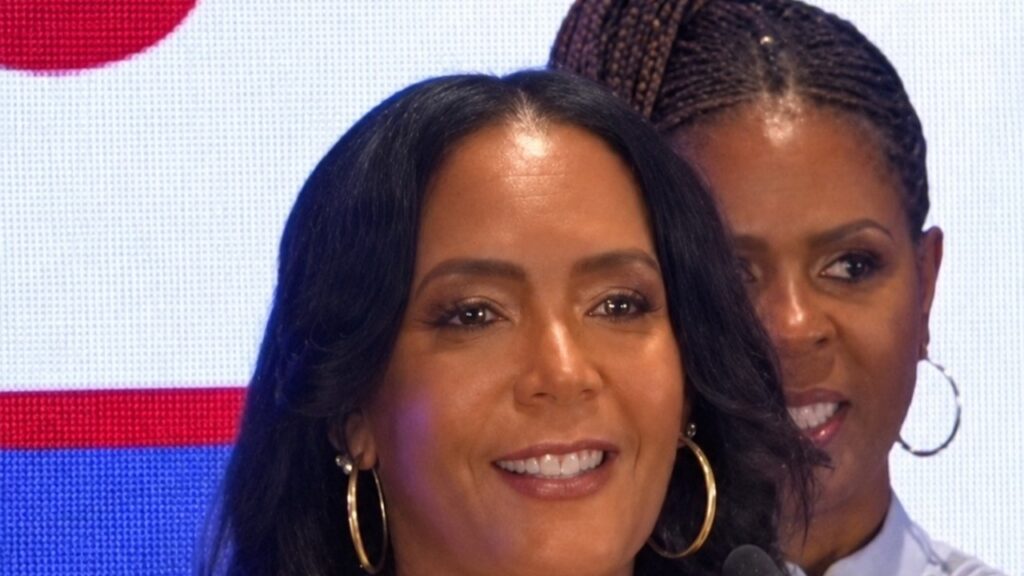
The Associated Press has called Georgia’s governor race for Democrat Keisha Lance Bottoms, and the call carries a weight no American election result has carried before. Bottoms, 56, will become the first Black woman ever elected governor of a US state — and the first Black governor, and the first woman governor, in Georgia’s own history.
With about three-quarters of the vote counted, Bottoms led Republican Rick Jackson 55.4 percent to 44.6 percent, according to the AP tally. Georgia’s Secretary of State figures put her ahead 55.59 percent to 44.41 percent at the moment the race was called on Tuesday night in the United States, early Wednesday in Pakistan. The AP vote count stood at roughly 1.83 million for Bottoms against 1.48 million for Jackson.
Bottoms is a former mayor of Atlanta who later worked in Joe Biden’s White House. She will succeed Republican Brian Kemp, who has governed Georgia since 2019 and was barred by law from seeking a third term. Her victory ends 24 years of Republican control of the governor’s office — the last Democrat to hold it, Roy Barnes, left office in 2003.
The scale of the win is striking because of the money stacked against it. Jackson, a health care executive, poured more than $200 million of his own fortune into his campaign, according to AP reporting. Bottoms won anyway, running a campaign built around the cost of living: property tax relief, a cut to the state gas tax, letting local governments waive sales tax on groceries, expanding the Medicaid health insurance programme to hundreds of thousands more Georgians, and raising the state minimum wage to $15 an hour.
“Let’s choose hope over fear, progress over division, and come together to build a better Georgia for everyone,” she said ahead of Election Day — a line that now reads like a preview of the speech Georgia will hear from its next governor.
The history here runs deeper than one race. This was the third Georgia governor’s election in a row with a Black woman leading the Democratic ticket. Stacey Abrams, also a Black woman, ran in 2018 and 2022 and lost both times to Kemp. Before Tuesday night, only three Black governors had ever been elected in the United States, and all three were men. Bottoms breaks that pattern at a stroke, and she does it in a state that was, until a few years ago, written off as reliably Republican.
Her win completed a Georgia sweep for the Democrats at the top of the ticket: Senator Jon Ossoff held his seat the same night, giving the party both of the state’s most-watched races. Georgia, once a Republican stronghold, has now delivered its governorship to a Democrat for the first time in a generation — and it did so in a midterm election widely read as a verdict on President Donald Trump’s second term.
Elsewhere on election night, the Democratic gains kept coming. In North Carolina, Democrats’ first Senate flip of the night in North Carolina had already been called for Roy Cooper. And in Florida, the Associated Press has now called the redrawn 22nd Congressional District for Democrat Pia Dandiya, who beat Republican Casey Askar 151,926 votes to 140,933 — about 51.9 percent to 48.1 percent, with nearly 99 percent of votes counted. That corrects the position earlier in the night, when Dandiya was only leading and the race was uncalled; she is the first Indian American elected to the House from Florida, winning a district Donald Trump carried by roughly 10 points in 2024.
What has not been decided, even now, is control of Congress itself. Neither the House nor the Senate has been called for either party, and counting continues across the country, with western states still reporting. The night’s results so far point to a Democratic wave, but the final shape of Congress — and with it, the last two years of Trump’s presidency — will take hours, and in some races days, to settle.
Why does a governor’s race in one American state matter to readers far from Georgia? Because in the United States, governors hold powers that touch daily life more directly than almost anything Washington does: they run state budgets, schools, health programmes and the machinery of elections themselves. Georgia is also the country’s great bellwether — a state whose voters have swung national elections in recent years. And a barrier broken in Atlanta echoes well beyond it: the first Black woman to lead a US state government changes what leadership looks like in the world’s most closely watched democracy, and it does so in a state where, five generations back, her own family history traces to a plantation.
Bottoms is due to take office on January 11, 2027, once the results are certified. The projections reported here are calls by news organisations and election desks, not certified results — but the margin, and the history, are no longer in doubt.
For background on the stakes of this election, see our guide to what the midterms decide.