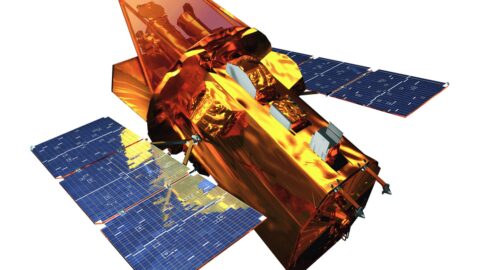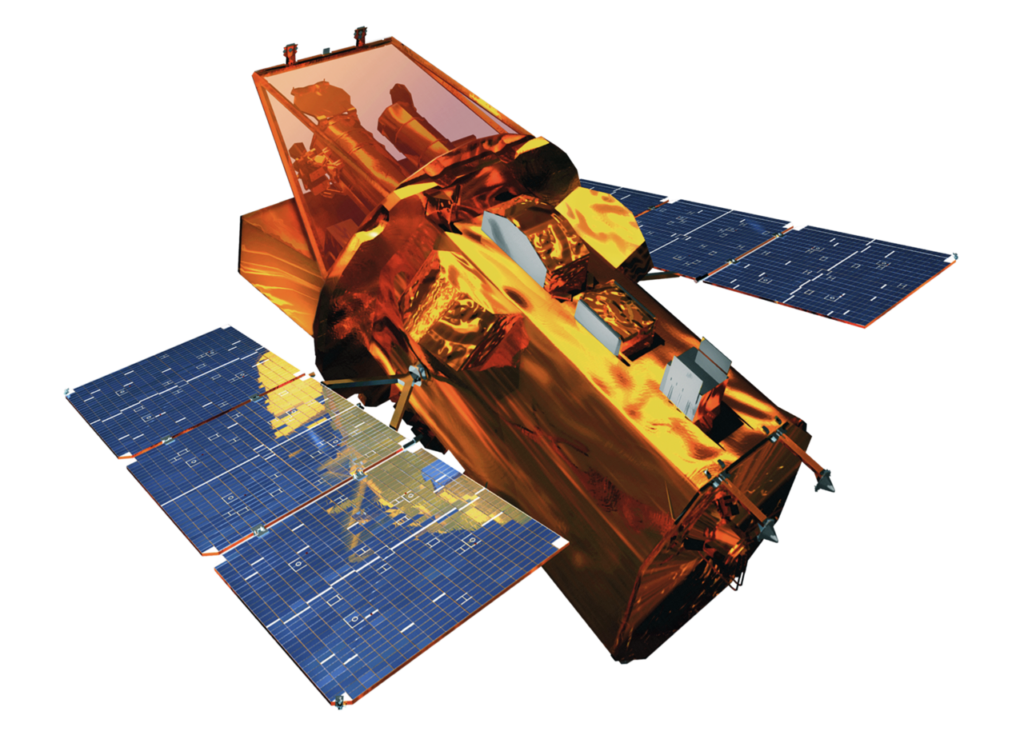
NASA’s Neil Gehrels Swift Observatory, a space telescope that spent nearly 22 years studying the most violent explosions in the universe, is expected to fall back to Earth today, Wednesday 4 November. Most of the roughly 3,200-pound (1,450-kilogram) spacecraft should burn up on the way down. Some pieces are expected to survive — and NASA puts the risk of harm to anyone on Earth at approximately 1 in 2,100.
20 November 2004 — launch. Swift lifts off on what was supposed to be a two-year mission to study gamma-ray bursts, the most powerful explosions known. It carries three telescopes: the Burst Alert Telescope, the X-Ray Telescope and the Ultraviolet/Optical Telescope.
2004–2026 — a mission that refused to end. Swift goes on to detect more than 2,000 gamma-ray bursts and about 1,400 stellar explosions, contributing data to thousands of scientific papers. It becomes one of the great work horses of high-energy astronomy — the instrument astronomers turned to whenever the sky flashed.
Late 2024 — the fall begins. Unusually strong solar activity heats and expands Earth’s upper atmosphere, increasing the drag on Swift and pulling it down faster than predicted. The telescope that was meant to die of old age in orbit starts dying of friction instead.
3 July 2026 — the rescue that failed. NASA contracts the startup Katalyst Space Technologies to send a spacecraft called LINK to capture Swift and boost it back into a stable orbit. LINK launches, but suffers orientation-control problems and never reaches its target. The rescue attempt fails.
20 October 2026 — the end of science. Swift, now at an altitude of just 171 miles (275 kilometres) and unable to compensate for drag, goes into safe mode. It makes its final scientific observation. NASA shuts the observatory down later in October.
4 November 2026 — re-entry day. As of Monday, the US Space Force predicted re-entry at approximately 3:30am Eastern time (08:30 UTC, 1:30pm Pakistan time), with an uncertainty of 11 hours either way. That window is the story in itself: for an uncontrolled re-entry, forecasters cannot say where debris will land until almost the last orbit. What they can say is the band it must fall within — between 20.6 degrees north and 20.6 degrees south latitude, a belt that covers much of Africa, South and Southeast Asia, northern Australia and Latin America, but is mostly open ocean.
Why this matters beyond one telescope: Swift’s fall is a preview of a busier, messier low orbit. Thousands of satellites are going up every year, and every one of them must eventually come down — by design, or by drag, like Swift. The difference between a controlled re-entry over the Pacific and an uncontrolled one over a populated latitude band is planning, fuel and money. Swift, built in an era when none of that was standard, is a reminder of what the old rules leave behind. Its science — a planet reborn from a dead star is the kind of discovery Swift’s successors chase, even as the Moon is slowly leaving us — will outlive the spacecraft by decades. The spacecraft itself has hours left.