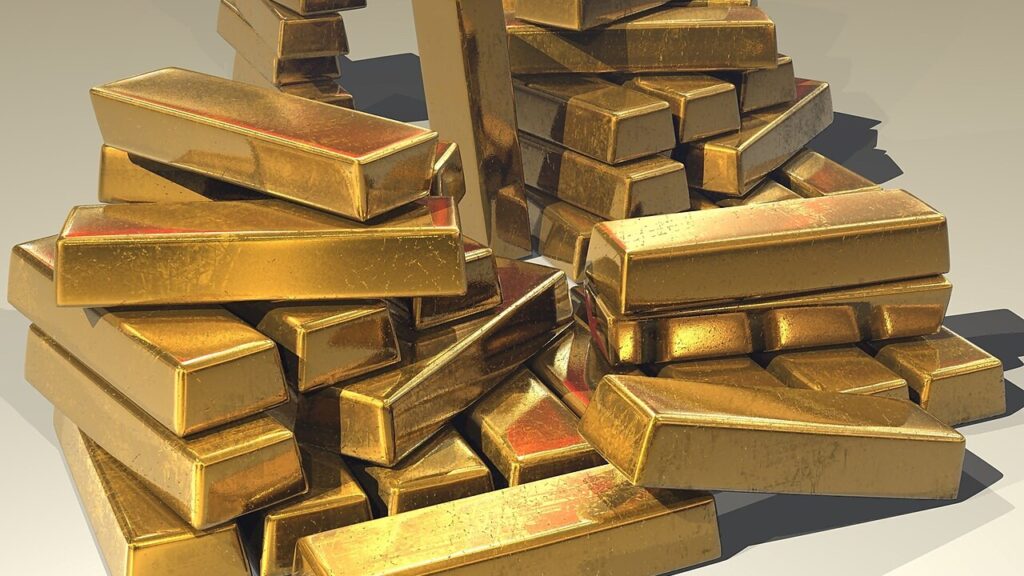
Informopedia Explains: picture every gram of gold humanity has ever dug out of the ground — every wedding ring, every pharaoh’s mask, every bar in every central bank vault on Earth — melted down into a single cube. It would measure about 22.5 metres on each side. You could fit it under a motorway bridge. And it would be worth roughly US$31 trillion.
That cube is the whole puzzle of gold in one image. It is a soft yellow substance with almost no practical use in daily life that has nevertheless been treated as wealth for more than 5,000 years — longer than any currency, any empire, any bank that ever existed. Why? The answer is not one thing. It is five things, all pointing the same way at once, and almost no other material on Earth can claim the same combination.
First, it is genuinely scarce
Gold is rare before humans ever touch it. Its atoms were forged in violent cosmic events — colliding neutron stars — long before Earth formed, and when the young planet was still molten, most of its gold sank deep inside, far beyond any mine’s reach.
The numbers tell the story. According to the World Gold Council, roughly 220,000 tonnes of gold have been mined in all of human history — that 22.5-metre cube, worth about US$31 trillion at the end of 2025. The world’s remaining economically mineable reserves are estimated at only about 64,000 tonnes, and major new discoveries are rare. Mining adds just 1.8% a year to the total above-ground stock. Nobody can print gold, grow it, or synthesise it in any meaningful quantity. Supply grows slowly, by geology’s permission, and that is the foundation of its value.
Second, it never goes away
Gold is one of the least reactive elements on the periodic table. It does not rust, tarnish, or corrode in air or water. A gold coin buried for 2,000 years comes out of the ground looking like it was minted last week; a gold mask from an Egyptian tomb still shines exactly as it did when it was sealed away.
That permanence changes the economics completely. Roughly 98% of all the gold ever mined still exists somewhere today — in vaults, in jewellery boxes, in reserves — because gold is never used up, only passed along. It can be melted down, refined and remade endlessly without losing purity. So the market is not just about this year’s mine output. It is about a vast, permanent stock that can flow between buyers and sellers whenever prices or moods change. Scarcity that never degrades is a very different thing from scarcity that rots, rusts or gets consumed.
Third, it is almost absurdly practical as money
For something to work as money, it needs a short list of qualities, and gold ticks nearly all of them. It is dense — a small bar holds a lot of value, so it is easy to store and carry. It is divisible: melt a bar, cut a coin, and each piece is worth exactly its weight, no more, no less. It is uniform — one ounce of pure gold is identical to any other ounce, anywhere in the world. And it is instantly recognisable. A merchant in Istanbul, a jeweller in Mumbai and a trader in London all agree on what it is and what it is worth, without needing to trust each other’s governments.
That universal recognition is something paper money has never matched. A banknote is only worth what the government that printed it says it is worth. Gold’s value needs no issuer, no promise, and no institution standing behind it. It carries no counterparty risk: it cannot default, go bankrupt or be frozen by a sanctions order.
Fourth, it has 5,000 years of history behind it
Gold’s record as wealth starts before writing did. Egyptian pharaohs were buried with it. Greek and Roman mints struck it into coins. For most of recorded history, paper money was either directly exchangeable for gold or pegged to it.
The modern version of that system, Bretton Woods, was built in 1944: the US dollar was fixed to gold at US$35 an ounce, and other currencies were pegged to the dollar. It worked until it didn’t. Through the 1960s, American spending on the Vietnam War and domestic programmes piled up dollars abroad faster than the gold reserves behind them, and foreign central banks — France most openly — began demanding physical gold for their dollars. On 15 August 1971, President Richard Nixon suspended convertibility, the “Nixon Shock”, and the gold standard ended. Currencies have floated on trust ever since.
But gold never left the system. Central banks still hold about 18% of all the gold ever mined as reserves, and in recent years they have been buying again at a pace not seen in decades — diversifying away from holding all their wealth in other countries’ currencies. The metal that backed money for centuries now backs the institutions that print the money.
Fifth, everyone still wants it
Demand for gold comes from four directions at once, and that breadth is part of its strength. Jewellery takes the largest share — about 45% of all the gold ever mined, nearly 100,000 tonnes, sits in necklaces, rings and bangles, above all in India and China, where gold is woven into weddings and festivals as well as savings. Investment — bars, coins and gold-backed exchange-traded funds — is the second pillar. Central banks are the third. And technology is the fourth: gold’s resistance to corrosion and its excellent conductivity make it essential in electronics, from smartphones to spacecraft, where a failed connection is not an option.
When those four sources of demand pull together, the price moves. And when fear rises, the investment pillar takes over. Gold has repeatedly been the asset people reach for when other things fall apart: during the 2008 financial crisis, through pandemic-era uncertainty, and in every bout of inflation or geopolitical shock since. It is not that gold always rises in a crisis — in the first panicked days of a crash, investors sometimes sell it to raise cash — but over the length of a crisis, it has a long habit of holding its value while shares, bonds and currencies wobble.
That is the safe-haven logic in one line: when confidence in the system itself is the question, people want an asset that is not part of the system. On days when stock markets plunge so fast that circuit breakers halt trading, gold needs no panic button — there is no company behind it to fail.
The limits: what gold does not do
None of this makes gold a perfect asset, and its flaws are as real as its virtues. The biggest is simple: gold pays nothing. It produces no interest, no dividend, no rent. A bar in a vault earns exactly zero while a bond pays coupons and a share pays dividends, so whenever interest rates are high, holding gold carries a real cost in forgone income.
Its price can also swing hard. Gold fell from around US$370 an ounce in the mid-1980s to roughly US$252 by 1999, a long decline driven partly by central banks selling their reserves. More recently it has surged to record levels — World Gold Council data put the price above US$5,000 an ounce in early 2026 — a reminder that the same forces that push it up can reverse. Add storage and insurance costs, and the case for gold is a case for patience, not for a quick gain.
Why this matters
Gold matters because it is the oldest stress test in finance. Every generation rediscovers it at the moment trust frays: when inflation eats savings, when a currency slides, when a war or a crisis makes people ask what their money is actually worth. The answers change — coins, bars, funds, jewellery — but the question keeps coming back to the same yellow metal, because the properties behind it have not changed in 5,000 years.
For ordinary savers, the lesson is narrower than the headlines suggest. Gold is not an investment that grows; it is insurance that endures. It will not make anyone rich on its own, and it has long stretches where it does nothing at all. What it does, better than almost anything else humans have tried, is survive.
What happens next
The forces shaping gold now are the same ones that shaped it in 1971: debt, inflation, and how much the world trusts the dollar. Central banks are buying at a historic pace, investors are piling in at record prices, and mine supply can only grow at under 2% a year.
Either way, the cube itself will still be there: every ounce ever mined, still in existence, still gleaming, still waiting for the next generation to decide what it is worth.