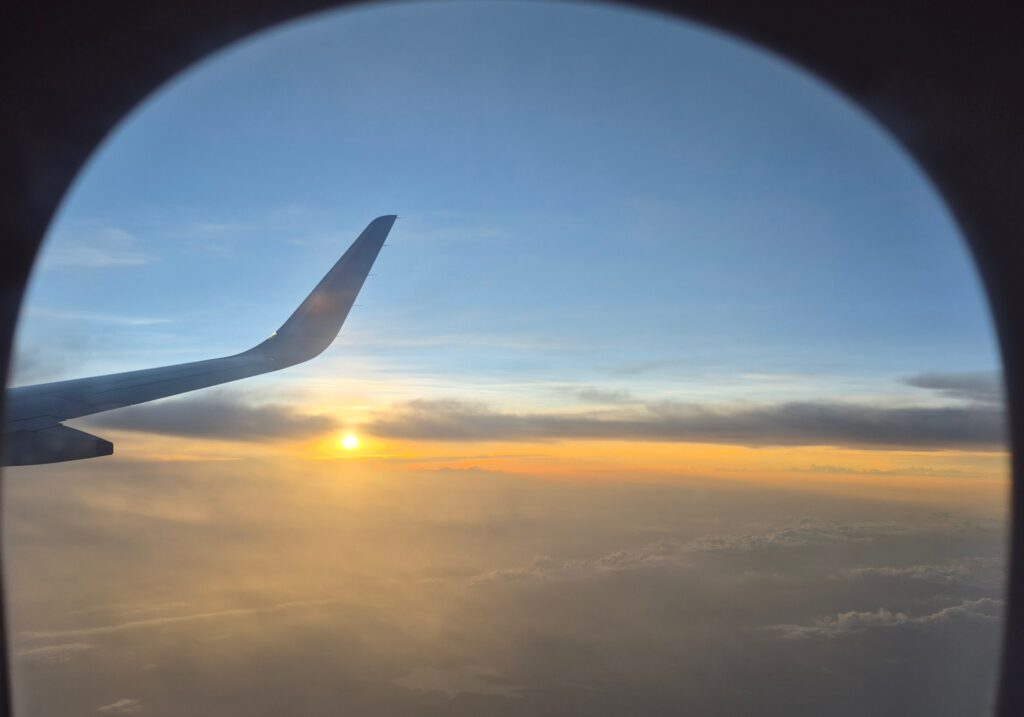
Informopedia Explains: the flight from New York lands in London at dawn, and the woman in seat 14A has a problem that no amount of coffee will solve. Her body is convinced it is 2 a.m. She will spend the day in a fog and wake at 3 a.m., wide awake, staring at a hotel ceiling. Fly the same route in reverse a week later and the whole thing will feel noticeably easier — same distance, same aeroplane, same number of time zones. The difference is not in her head. It is in a cluster of about 20,000 nerve cells behind her eyes, and it runs on a schedule that is not quite 24 hours.
Your body clock runs slow
Deep in the brain, just above where the optic nerves cross, sits a pinhead-sized region called the suprachiasmatic nucleus, or SCN. It is the body’s master clock. It takes light signals from the retina and sets the timing of almost everything: alertness, temperature, melatonin, appetite.
Left alone, with no daylight and no schedules to correct it, that clock does not run on 24 hours. In a landmark 1999 study at Harvard, Charles Czeisler and his colleagues kept volunteers cut off from every time cue in carefully controlled dim light for weeks. The answer was about 24 hours and 11 minutes — 24.18 hours, remarkably consistent from person to person.
Eleven minutes does not sound like much, but it means your clock has a built-in drift: left to itself, it slips a little later every day, and morning daylight corrects it daily. That tiny bias is the whole story of jet lag.
Delay is easy. Advance is a fight.
Flying west lengthens your day. You land, and bedtime arrives later than your body expects. All you have to do is stay up — delay your clock — which is the direction it already wants to drift. Flying east shortens your day. Bedtime arrives early, and you have to advance your clock: fall asleep before you are tired, wake before your body thinks morning has come. That works against the drift, and the clock resists.
Researchers call these two moves phase delay and phase advance, and the speeds are measurably different. The US Centers for Disease Control and Prevention (CDC), in its Yellow Book guidance for travellers, puts the average rate of adjustment at about 1.5 hours a day after flying west — and only about 1 hour a day after flying east. A six-hour shift takes roughly six days to absorb going east, but only about four coming back.
The asymmetry shows up outside the laboratory, too. A 2017 study of twenty seasons of Major League Baseball examined more than 46,000 games. The effects of jet lag appeared mainly after eastward travel: home teams returning from the east won about 3.5 percent fewer games — close to the entire usual home-field advantage.
What jet lag actually feels like
Jet lag is not just tiredness. The CDC’s diagnostic description lists poor sleep, daytime sleepiness, trouble concentrating, feeling generally unwell, and an upset stomach, after crossing at least two time zones. But the pattern changes with direction. After flying east, the usual complaint is lying awake at night, unable to fall asleep, then dragging through the morning. After flying west, the problem is waking too early and fading in the evening.
The deeper problem is that the clock does not move as one piece. Different organs adjust at different speeds — a state researchers call internal desynchrony. Your brain may be on London time while your gut is still on New York time.
The wrong-way trap
There is one more twist, and it explains why the very longest eastward trips can feel so disorderly. Because the clock repeats every 24 hours, a shift of more than 12 hours is shorter in the other direction. Cross ten or more zones eastward — London to Auckland, New York to Tokyo — and the body clock sometimes gives up on advancing and adjusts by delaying instead, going the long way round. Researchers call this antidromic re-entrainment.
It can also be triggered by light at the wrong moment. The clock has a turning point in the small hours, roughly two hours before your habitual wake time, known as the temperature minimum. Light after that point pulls the clock earlier; light before it pushes the clock later. Land in Tokyo while your body still thinks it is the middle of the night, and bright daylight can hit before that turning point — shoving your clock later, exactly when you need it earlier.
Light is the lever — but timing is everything
Of all the tools for beating jet lag, light is the strongest by a wide margin. The rule of thumb: after flying east, seek bright morning light to pull your clock earlier; after flying west, seek light in the late afternoon and evening to push it later. Get outside — daylight, even on a cloudy day, is far brighter than indoor lighting.
But the timing matters as much as the amount. On the first day or two after a big eastward jump, very early morning light can backfire: your temperature minimum is still on home time. The CDC advises avoiding bright light in the early morning after eastward travel over three to five zones, and aiming for daylight in the late morning instead. As your clock shifts, the right hours shift with it.
There are two more tools the CDC lists alongside timed light. Melatonin, the hormone your brain releases after dark, can help when taken at the right time — but timing is the whole point, and the wrong time can make the misalignment worse. The CDC notes that 0.5 to 1 milligram is often enough to shift the clock, and advises against routinely using doses above 5 milligrams. For short trips of under about two days, the advice is not to adapt at all: stay on home time.
A plan that actually works
Two or three days before you fly, start shifting your sleep by an hour a day — earlier if you are flying east, later if you are flying west. From the moment you board, live on destination time: eat, sleep, and seek light according to the clock where you are going, not the one you left behind. Sleep on the plane if it is night at your destination.
Once you land, switch to local time immediately. Get outside in daylight at the right hours, keep naps to 20 to 30 minutes, and avoid caffeine after about 4 p.m. local time. Eat on the local schedule and set an alarm so you do not sleep through the morning. None of this is magic. It is the difference between giving your clock a clear signal and giving it a confused one.
What does not help is worth knowing too. Alcohol may make you drowsy, but it fragments sleep and makes the next day worse. No supplement or app replaces the basic fact that your clock moves about an hour a day eastward — you cannot rush it, only steer it.
When it is not jet lag
Most jet lag fades within a week, roughly a day per time zone eastward. If the heavy, exhausted mornings linger for weeks after your body clock should have reset, something else may be going on — researchers have even proposed that waking exhausted every morning can be a distinct condition of its own, as we reported in our piece on morning exhaustion and depression. Persistent symptoms are worth a conversation with a doctor.
Why this matters
Jet lag is easy to dismiss as the price of a holiday. But the stakes are higher than a ruined first day. Shift workers live with the same biology on a permanent basis, and long-term circadian disruption is linked to real health risks. Athletes lose games to it. Surgeons, pilots, and diplomats make consequential decisions while their clocks are still in another time zone. And as long-haul travel grows, more people will meet this quirk of human biology first-hand.
What happens next
The science is moving from rules of thumb toward personal plans. Apps now build day-by-day light and melatonin schedules from your flight, your chronotype, and your usual wake time. Older travellers, on average, adjust more slowly, which is one more reason a plan beats improvisation.
None of it will change the basic arithmetic: your clock runs at 24 hours and 11 minutes, and east asks it to do the one thing it finds hardest. But knowing the fog is your clock, not your character, turns a miserable first day into a manageable one. Fly east with a plan, and the ceiling at 3 a.m. gets a little less familiar.
For the full official guidance, see the CDC’s Jet Lag Disorder chapter in the CDC Yellow Book. This article is general information, not medical advice; talk to a healthcare professional about melatonin or sleep medication before using them.