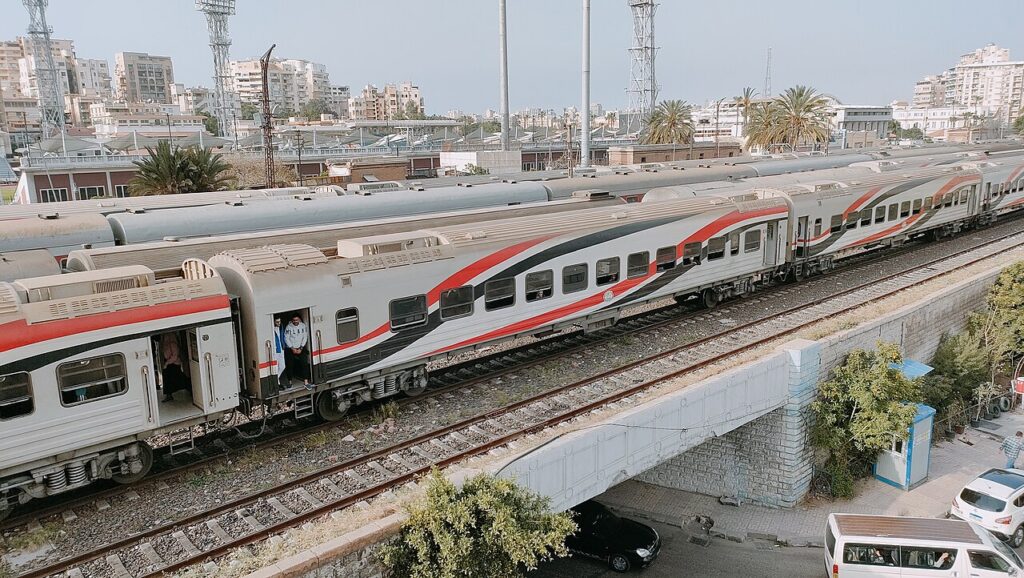
Two passenger trains collided south of Cairo on Sunday, killing at least four people and injuring 88, Egypt’s Health Ministry said — the latest deadly crash on a railway network with a long and grim record of fatal accidents.
A train travelling from Giza to Fayoum, in the south-west of the country, ran into the back of another service heading from Cairo to Aswan, the southern city on the Nile, Egypt’s railway authority said. Several carriages derailed in the impact. The collision happened between Kafr Ammar and Al-Raqqa stations in the Al-Ayyat district of Giza province, south of the capital.
The Health Ministry said 72 ambulances were sent to the scene and the injured were taken to hospitals around Giza. State-owned media had earlier put the number of wounded at 120; the ministry’s figure of 88 is the latest official count, and the death toll is described as an initial figure, meaning it could still change. A train driver was reported among the dead by local media.
President Abdel Fattah al-Sisi said he was following the accident “with great concern” and had directed the authorities to conduct an urgent investigation and “hold accountable anyone found to have been negligent.” Emergency crews brought in cranes to clear the wreckage, and trains between Giza and Upper Egypt — the name Egyptians use for the south of the country — were suspended while the line was cleared. No cause has been given yet, and officials said only that an investigation into what went wrong had begun.
The crash happened in a place Egyptians know all too well. Al-Ayyat was the scene of the country’s worst-ever rail disaster in February 2002, when a fire tore through a packed overnight train from Cairo to Luxor and killed 383 people. Seven years later, in 2009, a rear-end collision in the same district killed 18 people after one train stopped for a water buffalo on the line and another ran into it from behind. Sunday’s crash followed the same pattern — one train striking the rear of another.
It is far from an isolated case. In March 2021, two trains collided near Sohag in southern Egypt; the death toll was first reported as 32 before officials revised it down to 18, with around 200 people injured. An investigation later found that railway staff had switched off the automatic train control system — the safety mechanism designed to stop a train that passes a red signal — in parts of the network. A fire at Cairo’s Ramses station in 2019 killed more than 20 people, and as recently as August 2025 a derailment on the line from Matrouh to Cairo killed three people and injured at least 94.
That record is why each new crash lands so heavily in Egypt. The country’s railway is the oldest in Africa and the Middle East, and it carries millions of passengers every year, many of them on crowded third-class services to the south. Successive governments have promised to modernise it, and after the Sohag crash Sisi said a full upgrade of the system was the only way to end such disasters. Sisi, who has said he will step down in 2030, has since overseen the purchase of new trains and the rebuilding of stations — but the accidents have kept coming, and each one revives the same questions about signalling, maintenance and whether safety systems are actually switched on.
For now, the focus is on the injured in Giza’s hospitals and on the investigation Sisi ordered. The railway authority said crews were working to restore services on the Cairo–Upper Egypt line but gave no indication of how long that would take. Sisi won parliament’s backing last month to deploy troops abroad in a separate, unrelated decision — a reminder of how much authority is concentrated in the presidency, and how directly the response to a disaster like this one runs through him.
Why this matters beyond Egypt: the crash is a window onto a problem that reaches far past one railway line. Egypt is the Arab world’s most populous country, and its trains are how tens of millions of ordinary people travel — workers, students, families heading south for holidays. When the system fails, it fails the people who can least afford alternatives. And the pattern on display in Al-Ayyat — a rear-end collision, the same kind of crash that has killed Egyptians before — suggests the danger is not bad luck but a system that has not yet fixed what its own investigations keep identifying. Until it does, the next crash is a matter of when, not if.