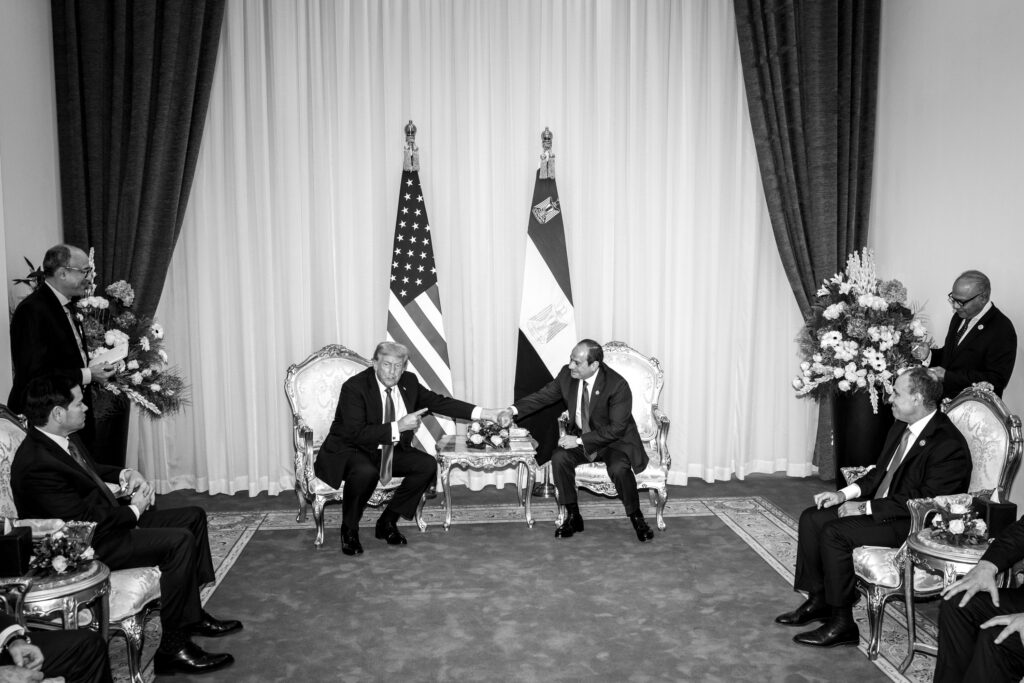
Egypt’s parliament voted on Monday to authorise President Abdel Fattah el-Sisi to send Egyptian forces to Saudi Arabia if Riyadh asks for help, clearing the last constitutional hurdle to a deployment that would put the Arab world’s largest army on the edge of a widening Gulf war.
The vote, taken by roll call behind closed doors, was the third parliamentary session on the question in nine days. Pro-government MP Mostafa Bakry, writing on X after the session, put it plainly: “Parliament approved authorising President El Sisi to send forces to Saudi Arabia if required, and after co-ordination between the two countries.” Parliament has not published the result of the vote.
Under Article 152 of Egypt’s constitution, sending the army on a combat mission abroad requires the backing of two-thirds of the 596-member house — 398 MPs. The approval does not mean troops will deploy immediately. Sisi, as supreme commander of the armed forces, now has the legal authority to act, but he has said Egypt will move only if Riyadh asks. No formal Saudi request has been announced.
That distinction matters, and Cairo has been careful to draw it. When Foreign Minister Badr Abdelatty and intelligence chief Hassan Rashad travelled to Riyadh on October 21 to deliver a letter from Sisi to Saudi Crown Prince Mohammed bin Salman, the message was that Egypt’s support would be limited to defending Saudi territory and borders rather than attacking Yemen. Abdelatty said after that visit that Cairo still wanted to explore “every opportunity” to resolve the Yemen conflict diplomatically.
The road to Monday’s vote began nine days earlier. On October 17, at a graduation ceremony at the Egyptian Military Academy, Sisi asked parliament for the mandate, saying it was inconceivable that Saudi Arabia’s security would be harmed. The next day, the National Defence Council, which he chairs, pledged “all necessary and possible forms of support” to the kingdom, without specifying their form, size or duration. MPs were expected to approve the request quickly — the four main pro-government parties hold 403 of the 568 elected seats — but instead the House met in two closed sessions on October 18 and 19, then adjourned for a week. Deputy speaker Assem El Gazzar said nearly 500 MPs had asked to speak, more than he had seen on any other issue.
Britain has already sent RAF Typhoon jets to fly defensive missions over Saudi skies, and Egypt’s decision now adds the region’s largest military to the list of countries formally prepared to defend the kingdom. Egypt has not taken a step like this lightly, because its history in Yemen is a cautionary tale. Cairo joined the Saudi-led coalition in an earlier phase of Yemen’s war in March 2015 mainly as a naval partner, sending warships to secure Red Sea shipping lanes while pledging air support, and deployed around 800 ground troops in only a limited combat role. Before that, Egypt was involved in a costly military intervention in Yemen in the 1960s, and it has not undertaken a large-scale foreign ground deployment since the 1991 Gulf War.
What has changed is the scale of the threat to Saudi Arabia. Yemen’s Houthis, who control the capital Sanaa and are aligned with Iran, have attacked Riyadh’s international airport and the state oil giant Saudi Aramco in recent weeks, disrupting flights and oil exports. Their advances also threaten the Bab el-Mandeb Strait, the narrow passage between Yemen and Djibouti that is the gateway to Egypt’s Suez Canal — the waterway through which a significant share of world trade passes, and on whose revenues Egypt’s strained economy depends.
Egypt has frequently condemned Iranian and Iranian-backed attacks on Gulf countries, but it has not publicly engaged in direct combat in this war, and it has not joined the Mecca mutual defence pact signed in August by Saudi Arabia, Pakistan and Turkey, under which an armed attack on one member is treated as an attack on all. Abdelatty said this month that Egyptian membership in the pact remains “under serious consideration.”
The timing of Monday’s vote is striking. On the same day, senior officials from Saudi Arabia, Turkey and Pakistan were in Tehran for talks with Iranian officials, in a last attempt at de-escalation: Saudi Defence Minister Prince Khalid bin Salman, Pakistan’s army chief Field Marshal Asim Munir and Turkish intelligence chief Ibrahim Kalin. Saudi Arabia’s foreign ministry said the visit aimed to encourage dialogue and support mediation efforts led by Qatar and Pakistan. In Cairo, United Nations Secretary-General Antonio Guterres said it was “essential to stop any escalation,” warning that the combination of an overwhelming military attack on Iran and an overwhelming attack by Iran on Gulf countries “needs to be avoided at all costs.”
Egypt, in other words, is preparing for war and negotiating against it on the same day. That is not a contradiction so much as a measure of how serious the moment is. A parliament that spent nine days and three closed sessions debating the question has now given its president a blank cheque he says he hopes not to cash. Whether he has to will depend less on Cairo than on Riyadh, Sanaa and Tehran — and on whether Monday’s talks in Tehran produce anything more than another round of warnings.
Why this matters
For readers far from the Gulf, the stakes are not abstract. Egypt is the Arab world’s most populous state, with one of the region’s largest militaries, and the Suez Canal is one of the world’s great trade arteries: if fighting spreads to the Bab el-Mandeb Strait, shipping, energy prices and supply chains feel it everywhere. Monday’s vote also redraws the map of the war itself. Until now, the conflict over Yemen and the wider US-Israeli war with Iran has been fought by a coalition in which Egypt cheered from the sidelines. A formal parliamentary authorisation turns a sympathetic neighbour into a potential combatant — and makes a regional war harder to contain, and harder to end, the moment any Saudi request arrives.
Context: Britain’s RAF Typhoon deployment to defend Saudi Arabia shows how far outside support for the kingdom has already gone.