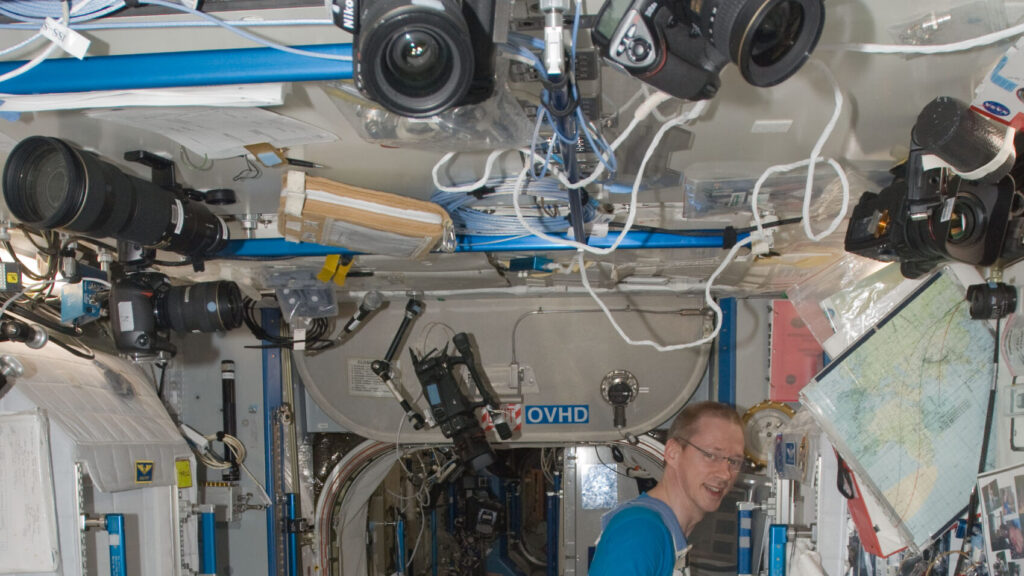
Informopedia Explains: on Thursday, four people fell out of the sky off the coast of Los Angeles, climbed out of a scorched capsule, waved at the cameras — and then had to learn how to stand up properly again. NASA’s Crew-12 had spent 237 days aboard the International Space Station. In that time, their bodies quietly came apart in ways no workout fully prevents. This is what eight months without gravity does to a human being.
The homecoming
The crew — commander Jessica Meir and pilot Jack Hathaway of NASA, Sophie Adenot of the European Space Agency, and Roscosmos cosmonaut Andrey Fedyaev — launched from Cape Canaveral on February 13 aboard SpaceX’s Crew Dragon Freedom. They splashed down in the Pacific at 11:34 a.m. Eastern on October 8, were lifted onto the recovery ship Shannon, and after helicopter and medical checks headed for Houston.
It was a mission of milestones: Adenot became the first French woman to perform a spacewalk, completing three of them; Meir logged four spacewalks totaling more than 27 hours. The crew had originally flown up on an expedited launch to replace station occupants sent home early after NASA’s Mike Fincke fell ill — the agency’s first medical evacuation in 65 years of human spaceflight.
“We are so excited to be back on planet Earth after an incredible mission on the International Space Station,” Meir radioed after splashdown.
The excitement is real. So is the damage.
Your bones start dissolving
Bone is living tissue, constantly rebuilt in response to the loads placed on it. Remove the load and the rebuilding stops — while the breakdown continues. NASA research shows astronauts lose roughly 1 to 1.5 percent of their bone density every month in orbit. For comparison, a person over 50 on Earth loses about 1 percent per year.
Over eight months, that adds up to a decade or more of aging, concentrated in the hips and spine — the bones that carry your weight. Exercise slows the loss but doesn’t stop it; some astronauts are prescribed bone-strengthening drugs, and some density never fully comes back.
Your muscles waste away
Without gravity to fight, the muscles that hold you upright — legs, back, core — begin to shrink within days. Researchers have found postural muscles can lose 10 to 20 percent of their mass in the first months of a mission, and up to 30 percent on the longest flights.
Astronauts fight back with about two hours of daily exercise: a treadmill with bungee harnesses that yank them down onto the belt, a stationary bike, and a resistance machine that simulates weightlifting. It helps enormously. It is not enough. Returning astronauts have described being unable to hold a book for weeks — “super healthy, athletic people,” as one space-medicine researcher put it, reduced to rebuilding the strength to stand in line.
Your fluids float upward
On Earth, gravity pools about two liters of fluid in your legs. In orbit, it all drifts north. Faces puff up, sinuses congest, legs thin out — the classic “puffy face, chicken legs” look of long-duration crews. The body, fooled into thinking it has too much blood, dumps plasma volume, and the heart — suddenly pumping against no resistance — weakens and shrinks slightly.
The stranger consequence is in the eyes. The upward fluid shift raises pressure inside the skull and behind the eyes, flattening the back of the eyeball and swelling the optic nerve. NASA calls it spaceflight-associated neuro-ocular syndrome, or SANS, and it can permanently blur vision. It remains one of the least understood and most worrying effects of long missions — and a red flag for any future trip to Mars, where there is no quick ride home.
One odd bonus: without spinal compression, astronauts grow. Most gain up to 5 centimeters — two inches — in orbit, then shrink back on Earth, often with back pain as the bill comes due.
Radiation and immunity
Beyond low Earth orbit’s partial shielding, the station is still exposed to cosmic rays and solar particles that damage DNA, suppress the immune system, accelerate cataracts and raise lifetime cancer risk. Inside the station, the closed environment — recycled air, altered microbes, disrupted sleep from 16 sunrises a day — reshapes the immune system and the gut. Astronauts’ reaction times can slow measurably by mission’s end.
Relearning gravity
Coming home is its own ordeal. After splashdown, the Crew-12 astronauts will spend weeks in rehabilitation in Houston: balance training, strength rebuilding, cardiovascular reconditioning. The inner ear, which spent eight months without a reliable “down,” has to recalibrate; many returning astronauts stumble, feel nauseated, and struggle with simple coordination for days.
And here’s the part that should humble the Mars planners: everything above describes people in low Earth orbit, a few hundred kilometers up, with the planet’s magnetic field absorbing the worst radiation and a return trip measured in hours. A Mars mission means up to three years — most of it far beyond that protection, with no evacuation possible.
Why this matters
Every long mission is an experiment the crew didn’t exactly volunteer for. The data from bodies like Meir’s, Hathaway’s, Adenot’s and Fedyaev’s — bone scans, blood work, eye exams, cognitive tests — is what will determine whether humans can survive the journey to Mars, and what it will cost them.
The Crew-12 astronauts came home waving and pumping their fists. Behind the celebration is a quieter truth their bodies are still telling: space doesn’t just take you far from Earth. It takes Earth out of you, a little at a time — and putting it back takes months.