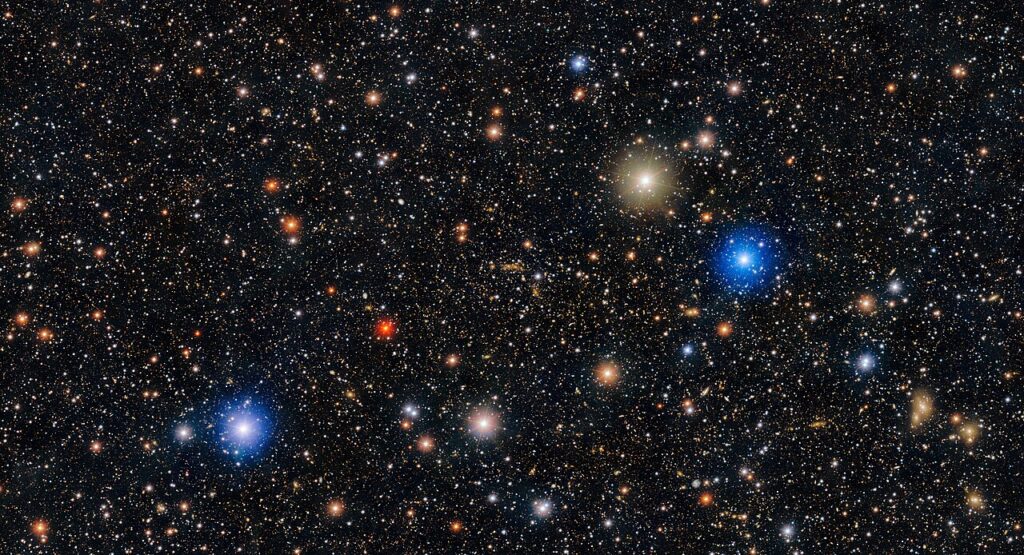
Informopedia Explains: most of the universe is made of something no one has ever seen, never touched, and cannot make in any laboratory on Earth. And yet physicists are sure it is there. This is the story of how you prove the existence of something invisible — four times over, with four completely different kinds of evidence, all pointing at the same missing mass.
Start with the inventory. Everything you have ever seen — every star, planet, person and grain of sand — is made of ordinary matter, the atoms of the periodic table. It accounts for about 5% of the universe. Dark matter accounts for about 27%. The remaining 68% is dark energy, a different puzzle entirely: it pushes the expansion of space to speed up, while dark matter pulls things together. The two names sound alike and are constantly confused. They are not the same thing. Dark matter is stuff with gravity. We just cannot see it.
Put another way: dark matter outweighs everything visible by more than five to one, and makes up roughly 85% of all the matter there is. The luminous universe is the tip of something far larger and darker. Here is how we know.
1933: a cluster that should have flown apart
The first clue came from Fritz Zwicky, a Swiss astronomer studying the Coma Cluster — a swarm of about a thousand galaxies, 320 million light-years away — in 1933. Zwicky measured how fast the galaxies inside the cluster were moving, and did the arithmetic. The visible mass of the cluster, all those shining galaxies added together, produced nowhere near enough gravity to hold it together at those speeds. By his calculation, the cluster needed up to a hundred times more mass than its light suggested, or it would have torn itself apart long ago. He called the missing stuff dunkle Materie — dark matter — and almost nobody believed him. The measurements were crude, the idea was strange, and for forty years it sat mostly ignored.
The 1970s: galaxies spin too fast at the edge
The clue that could not be ignored came from Vera Rubin and Kent Ford in the 1970s. They measured how fast stars orbit inside spiral galaxies, including our neighbour Andromeda. The expectation was simple, borrowed from the solar system: planets near the sun race around it, and the far ones crawl — Mercury laps the sun in 88 days, Neptune takes 165 years — because nearly all the mass is bunched in the middle and gravity weakens with distance. A galaxy’s light is bunched in the middle too, so its stars should do the same: fast near the core, slower out at the rim.
They don’t. The stars at a galaxy’s edge orbit just as fast as the ones halfway in. The rotation curves stay flat, far beyond the bright disk, in galaxy after galaxy. The visible mass cannot explain it. The only way the numbers work is if every spiral galaxy is wrapped in a vast, invisible halo of extra mass — far more of it than there is visible matter — whose gravity keeps the outer stars from flying off into the dark. Rubin kept measuring through the 1970s and 1980s, and the pattern never broke.
Bent light weighs the invisible
Einstein’s general relativity says mass bends the path of light. When astronomers look at distant galaxies through a massive cluster, the images come back stretched, bent and sometimes multiplied into arcs — gravitational lensing. The amount of bending measures the total mass doing the bending, glowing or not, with no assumptions about what it is made of.
Do that for cluster after cluster and the verdict is always the same: there is roughly five to six times more mass than the stars and gas can account for. Lensing also draws maps. In a cluster, most of the ordinary matter is not stars at all but hot X-ray gas drifting between the galaxies — and even that gas, which outweighs all the stars combined, is still nowhere near enough. About 85% of a cluster’s mass is dark.
2006: the Bullet Cluster pulls them apart
The cleanest argument of all came from a collision. The Bullet Cluster, catalogued as 1E 0657-56, is two galaxy clusters that smashed through each other — the event happened about 150 million years ago, which is short on cosmic timescales. In each cluster, most of the ordinary matter is hot gas, and when the clusters hit, the gas clouds collided, dragged on each other and stalled in the middle, like two cars in a pile-up.
But the mass revealed by lensing did not stall. It passed straight through and ended up ahead of the gas, sitting where the galaxies are. The ordinary matter and the gravitating mass had been pulled apart, and you could see them in different places. That is exactly what you would expect if most of the mass is something that barely interacts with itself or with anything else — it sails through a collision that stops normal matter cold. A team using the Chandra X-ray telescope and lensing maps published the result in 2006, and it has been the textbook evidence ever since.
The baby picture agrees
There is a fourth line of evidence, and it comes from the beginning of everything. The cosmic microwave background is the faint afterglow of the early universe, and its tiny temperature ripples were mapped in detail by the European Space Agency’s Planck satellite. The pattern of those ripples fits a universe with about 27% dark matter and 5% ordinary matter. It does not fit one with ordinary matter alone. Four independent methods — spinning galaxies, bent light, colliding clusters and the afterglow of the Big Bang — all land on the same answer.
So what is it?
Here the story stops being a detective triumph and becomes an open mystery, because nobody knows. The leading suspects all have names. WIMPs — weakly interacting massive particles — are hypothetical particles that would feel gravity and the weak nuclear force but almost nothing else, which is why they would be so hard to catch. Axions are ultra-light particles proposed for a different reason entirely, which turned out to fit the dark matter job description. Sterile neutrinos, heavier cousins of the familiar ghost particles called neutrinos, are another candidate. And some physicists still wonder whether part of the answer could be primordial black holes, formed in the first instants of the universe.
The search is one of the biggest experiments in science. Deep underground, detectors like XENONnT in Italy and LUX-ZEPLIN in South Dakota sit in shielded caverns waiting for a dark matter particle to bump into an atomic nucleus — a handful of events a year, if the theories are right. Particle colliders try to manufacture dark matter by smashing protons together and watching for energy that goes missing. Telescopes look for the faint glow dark matter particles might give off when they annihilate each other in the dense hearts of galaxies. So far, every search has come back empty. The particles, if they exist, are more elusive than hoped, or rarer, or lighter, or heavier.
The dissenters
It is worth saying plainly that a minority of physicists think the whole edifice is wrong. Since 1983, a theory called MOND — Modified Newtonian Dynamics — has argued that there is no missing mass at all, and that gravity itself behaves differently at the very low accelerations found at the edges of galaxies. MOND explains the rotation curves elegantly. It struggles with the Bullet Cluster, where the mass and the gas are visibly in different places, and with the cosmic microwave background, which needs the extra mass to make its ripples come out right. Most cosmologists side with dark matter, but the dissent is real science, not crankery — and it keeps the dark matter hunters honest.
What happens next
The next decade is built for this question. New sky surveys — above all the Vera Rubin Observatory in Chile, named for the astronomer who found the first flat rotation curves — will map billions of galaxies and measure the bending of their light with a precision that should pin down how dark matter is distributed across the cosmos. The Euclid space telescope is already charting the dark universe from orbit. And the underground detectors keep getting bigger and quieter.
One way or another, the answer will change physics. If dark matter is a particle, its discovery would be the biggest breakthrough in fundamental physics in half a century — a whole new sector of nature, beyond the Standard Model. If it turns out to be gravity misbehaving, that would be just as revolutionary: a rewrite of a law that has held since Newton.
Until then, the situation is deliciously strange. We live in a universe where the stuff we are made of is a rounding error, where 85% of all matter is invisible, and where the surest thing we know about it is the shape of its absence: galaxies that spin too fast, light that bends too far, clusters that refuse to fly apart. We found something we cannot see by watching everything it pulls. Read NASA’s dark matter pages for the agency’s own account — and remember, the next time you look up at the night sky, that most of what is holding it all together is something no human eye will ever see.