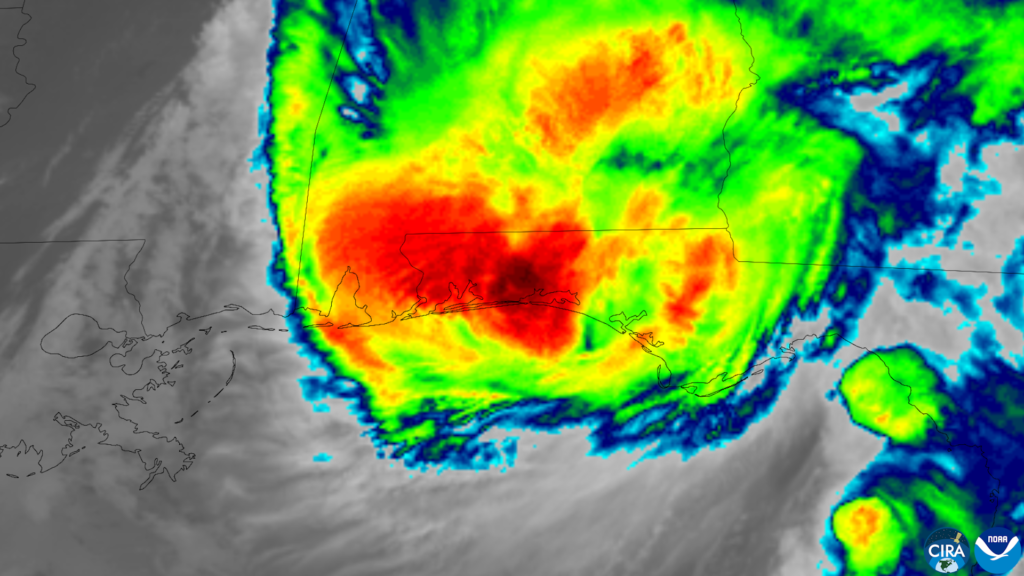
It came ashore just after 8:30 p.m. local time on Friday, near Destin on the Florida Panhandle, with winds of about 105 miles per hour. By Saturday morning, Hurricane Isaias was not a hurricane anymore — forecasters had downgraded it to a post-tropical cyclone grinding north through Alabama with winds of 35 mph. But the wreckage it left across the Gulf Coast was measured in three states.
At least two people were killed, authorities told reporters Saturday — one in Alabama, one in Florida — when trees fell onto their homes. Within minutes of landfall, the power grid began collapsing in chunks: roughly 800,000 homes and businesses across Florida, Alabama and Georgia were without electricity by Saturday afternoon, according to the monitoring site PowerOutage.us, with Florida accounting for more than half. Escambia and Santa Rosa counties in the Panhandle were among the hardest hit; in Santa Rosa alone, more than 79,000 of about 86,000 customers woke up without power.
Governor Ron DeSantis said repair crews had been sent out overnight. “We’ll get everything back up and running and let people go on with their lives as soon as possible,” he said at a briefing in Tallahassee on Saturday morning. Some 16,000 utility linemen had been staged ahead of the storm. Highways, bridges and airports began reopening through the morning as assessment teams fanned out. There was one early encouraging sign: Florida officials said they had received no search-and-rescue requests in the hours after landfall.
The danger is not over. The National Hurricane Center warned of storm surges, flash flooding, damaging winds and a tornado threat across parts of the Southeast through the weekend. Rivers in the western Panhandle were expected to crest Saturday. In Alabama, the emergency management agency said downed trees and power lines had made travel hazardous in Houston County, which was under a flash flood warning — “all Houston County roads are closed until further notice,” the agency posted. Forecasters said up to 8 inches of rain could fall across southern Alabama, the Panhandle and southwest Georgia.
Two airports in the storm’s path — Destin-Fort Walton Beach and Pensacola International — remained closed Saturday for damage checks. In Pensacola, the National Weather Service reported “significant wind damage” stretching north into Alabama, with a 114-mph gust recorded at Whiting Field near Milton and a 117-mph gust on Santa Rosa Island — strong winds, notably, well to the west of the storm’s center.
Isaias was the first hurricane of the 2026 Atlantic season in what has been a relatively quiet year, and the first to strike the United States since Hurricane Milton — which hit Siesta Key, Florida, exactly two years earlier, to the day. Both storms made landfall on October 9 on Florida’s Gulf side, about an hour apart in the clock. Forecasters are already watching two more: Hurricane Simon off Mexico’s west coast and Tropical Storm Rachel, which is headed toward the U.S.-Mexico border.
Why this matters: landfall stories tend to end when the wind dies, but the deadliest phase of a hurricane is often the days after. Falling trees, flooded roads and a stripped power grid do their worst on people trying to get back to normal life — and Saturday’s tornado and flash-flood warnings mean the all-clear has not sounded yet for much of the Deep South.



One Comment