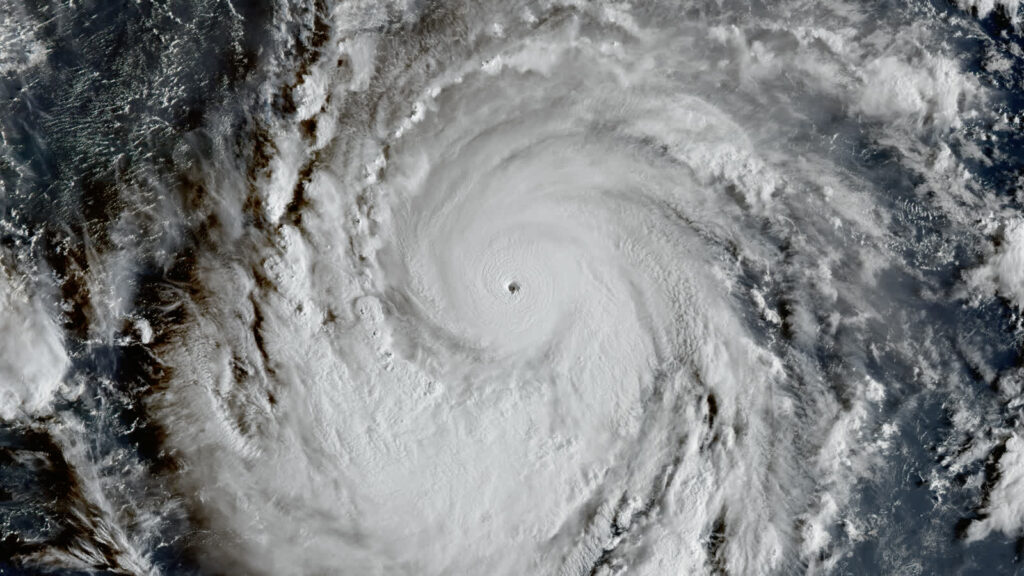
The night Guam had been dreading arrived in the small hours of Sunday. At 3:26 in the morning, the island’s weather service took the rare step of issuing an extreme wind warning for the far south — radar showed the northern eyewall of Super Typhoon Champi, a Category 4 storm packing sustained winds of 140 miles per hour, moving onshore. Not the outer bands. The eyewall. Champi dragged its most violent core across Guam’s southern villages — Talofofo, Inarajan, Merizo, Umatac and Santa Rita — in the hours around 5 a.m. local time, with forecasters warning of a sustained force of 110 to 135 miles per hour and isolated gusts to 175. On Guam, those numbers are not abstract. “Venturing outside can result in death from flying projectiles,” the National Weather Service office in Tiyan warned, describing a “particularly dangerous situation.”
The island was ready, in the way islands that live under typhoons are ready. Governor Lourdes Leon Guerrero had placed Guam in Condition of Readiness 1 — the highest level — at 1 p.m. Saturday, with one instruction for more than 153,000 residents: remain indoors until Condition 4. Rota, home to about 1,800 people, entered the same readiness level at 5 p.m. The Coast Guard set Port Condition ZULU, freezing vessel movements; flights were canceled; airports, harbors and some health facilities closed. Evacuation centers filled through the evening — Astumbo Elementary reached capacity and stopped taking people, with families directed to the remaining centers at Machananao, Talofofo and Inarajan.
Power began failing before the worst arrived. The Guam Power Authority said it did not intend to shut the island-wide system down deliberately, but its own statement read like a forecast of darkness: outages would be “energized immediately” only if circuits survived, and crews would not go out while winds were unsafe. “Houses on the island that are built with corrugated metal may just be gone in the winds,” National Weather Service meteorologist Paul Stanko said on Saturday. “Houses built like concrete bunkers, those won’t suffer too much.” He warned of a possible island-wide outage that could last days — or weeks.
A storm that outran its own forecast
What makes Champi remarkable is how fast it got here. On Friday evening it was a tropical storm with 60-mile-per-hour winds, sitting 510 miles east-southeast of Guam. Less than two days later it was a Category 4 super typhoon. “A period of rapid intensification was expected but this outperformed what was expected,” Stanko said. It is the third powerful typhoon to reach the Mariana Islands since April — the territories are still recovering from Super Typhoons Sinlaku and Bavi — and forecasters say it could still strengthen, with peak winds near 155 miles per hour, as it pulls away west.
For context: Guam is a U.S. territory — its people are American citizens — about 2,000 miles east of the Philippines in the western Pacific. Small, but strategic: home to Andersen Air Force Base and Naval Base Guam, it is the westernmost piece of American sovereign territory in the Pacific and a linchpin of the U.S. military presence there. Both the territory’s governor and the governor of the Northern Mariana Islands requested emergency disaster declarations from President Donald Trump on Friday; the Federal Emergency Management Agency warned that outside resources would likely not reach the islands for three to five days.
The center passed roughly 35 miles south-southwest of Guam — close enough that a small shift would have put the worst directly across the island’s south. Heavy rain, six inches or more, fell under a flash flood warning, and forecasters warned of five-to-seven-foot storm surge on southern and eastern coasts.
Why this matters beyond Guam
Two things make Champi worth watching from anywhere. First, it is a case study in the rapid intensification that has been frightening meteorologists for years — storms that jump from tropical-storm strength to near-maximum power in under 48 hours give islands almost no time to prepare, and the models keep undershooting them. Second, it lands on an island still repairing itself from the last two storms: the disaster compounds, each typhoon arriving before the previous one’s damage is fixed. The full picture will emerge as daylight lets assessment crews out.
The Pacific is having a season for the record books — Hurricane Trudy is simultaneously bearing down on Mexico’s west coast (Hurricane Trudy: Category 3 Storm Bearing Down on Mexico), and Mexico’s Pacific coast just endured deadly flooding from the remnants of two other systems (Six Dead as Hurricane Simon and Storm Rachel’s Remnants Drown Mexico’s Pacific Coast).
Sources for ongoing updates: the National Weather Service office in Guam at weather.gov/gum, and Guam Homeland Security and the Office of Civil Defense at ghs.guam.gov.

One Comment