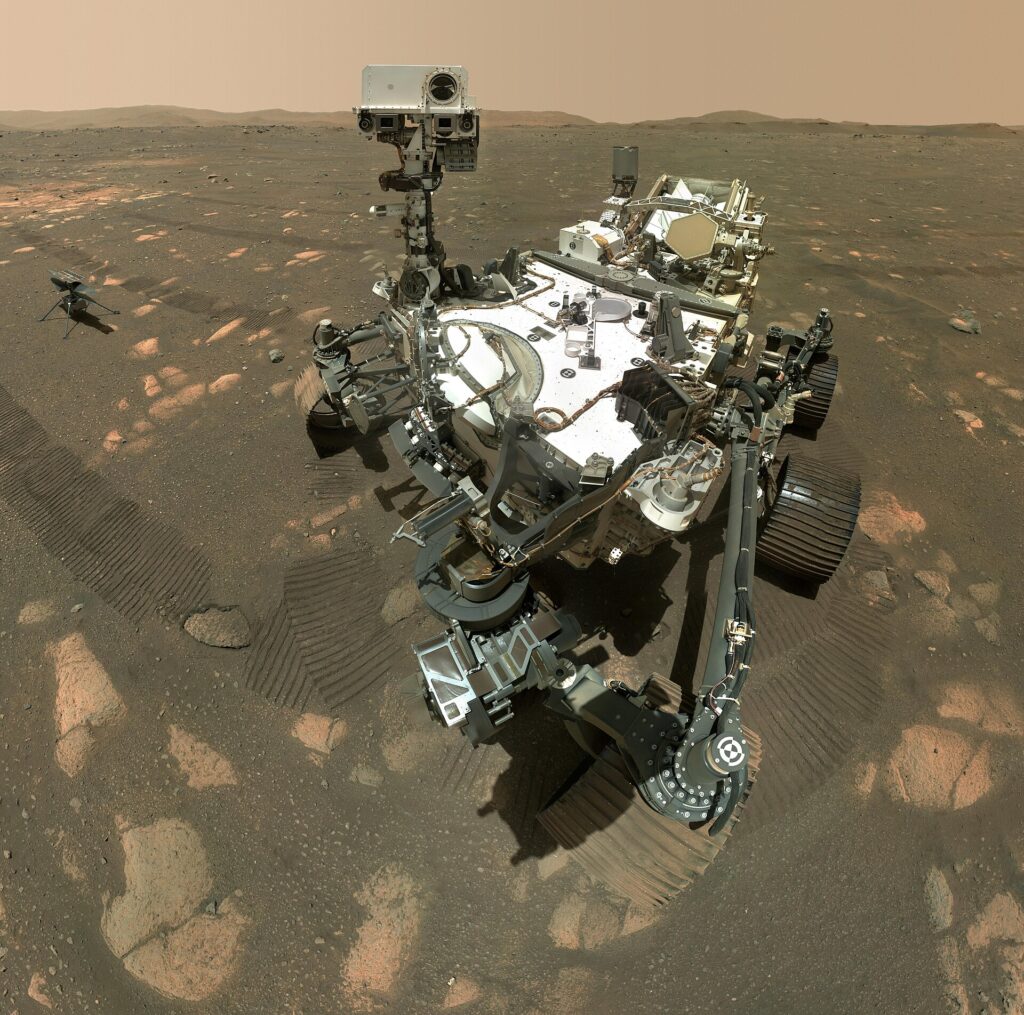
JEZERO CRATER, MARS — Nobody was there to watch it happen, which is exactly the point. On Oct. 11, 2026 — sol 2,006 of its mission — NASA’s Perseverance rover rolled past a line no vehicle has ever crossed before: its odometer read 28.10 miles (45.22 kilometres), breaking the off-world driving record of 28.06 miles (45.16 km) set by the Opportunity rover, according to NASA’s announcement.
The previous mark had stood since 2018, when Opportunity fell silent after nearly 15 years on Mars. Perseverance did it in five and a half — and while driving somewhere far more interesting than a straight line.
Where the record fell
Perseverance broke the record while picking its way through a region called “Lac de Charmes,” off the western rim of Jezero Crater — the ancient lake basin in Mars’ northern hemisphere where the rover landed on Feb. 18, 2021. It is heading for an area named Idubi, where it is studying what scientists believe may be the oldest terrain ever explored in the solar system: rocks so ancient that their equivalents on Earth were erased long ago by erosion and plate tectonics. Researchers hope the site preserves traces of ancient hydrothermal systems — exactly the kind of place life might once have found a foothold.
Timeline: the rovers that went the distance
- 2004–2018: Opportunity drives 28.06 miles (45.16 km) across Mars’ Meridiani Planum, setting a record no machine had touched.
- 2012: Curiosity lands in Gale Crater; it has since covered 23.71 miles (38.15 km) and is still going.
- Feb. 18, 2021: Perseverance lands in Jezero Crater on a mission to hunt for signs of ancient microbial life and collect rock and soil samples for a potential future return to Earth.
- Oct. 11, 2026 (sol 2,006): Perseverance’s odometer hits 28.10 miles (45.22 km) — the new off-world record, beating every Mars rover and every lunar rover before it.
Perspective helps: the rover’s original mission called for no more than 12.4 miles of driving. It has more than doubled that.
Why the speed matters: the rover thinks while it drives
The real story is not the distance but the driver. Perseverance’s secret is AutoNav, an autonomous navigation system that lets it, in NASA’s words, “think while driving”: the rover photographs the terrain ahead, builds three-dimensional hazard maps, and plots its own course around obstacles — all without waiting for instructions from Earth.
More than 90% of Perseverance’s distance has been driven autonomously, compared with about 5% for Opportunity and Spirit. The leap in capability is enormous: where the Sojourner rover of the 1990s processed 20 measurement points per look, Perseverance processes 600,000 — and it can cover up to 1,351 feet (412 metres) in a single sol.
That autonomy is also why the hardware is holding up. JPL project manager Steven Lee — who oversaw both Perseverance and the earlier rovers — says the rover is in excellent shape:
“Perseverance is showing no signs of slowing down.”
Lee says the rover is capable of operating well into the 2030s. Deep time seems to be planetary science’s theme this year — astronomers recently reported a second-generation planet discovered around a white dwarf, a world reborn from the ashes of a dead star.
The record is one more sign of how crowded the space beyond Earth is becoming: one company’s satellite constellation just passed 1,000 spacecraft in orbit, while on Mars two rovers grind on across ground older than almost anything on Earth.
The record will fall again — Curiosity is still driving, and the Moon’s next generation of rovers will eventually push past them both. But 28.10 miles will always be the distance that proved a robot could think its way across another planet. Perseverance, true to its name, is still moving. Idubi is waiting.


One Comment