Informopedia Explains: On Tuesday evening, air-raid alerts buzzed on phones across Riyadh while an orange fireball rose over a fuel depot in Sanaa, some 1,300 kilometres away. Two capitals, two sets of burning fuel — and a war that has just found its most dangerous target: oil itself.
Tuesday evening, two fireballs
Picture Riyadh at dusk on October 13. Commuters are streaming down a major avenue when phones start buzzing in every pocket: the city is facing a hostile aerial threat. Above a shopping mall, a witness watches a projectile cut across the darkening sky, trailing yellowish light and smoke. Then the explosion.
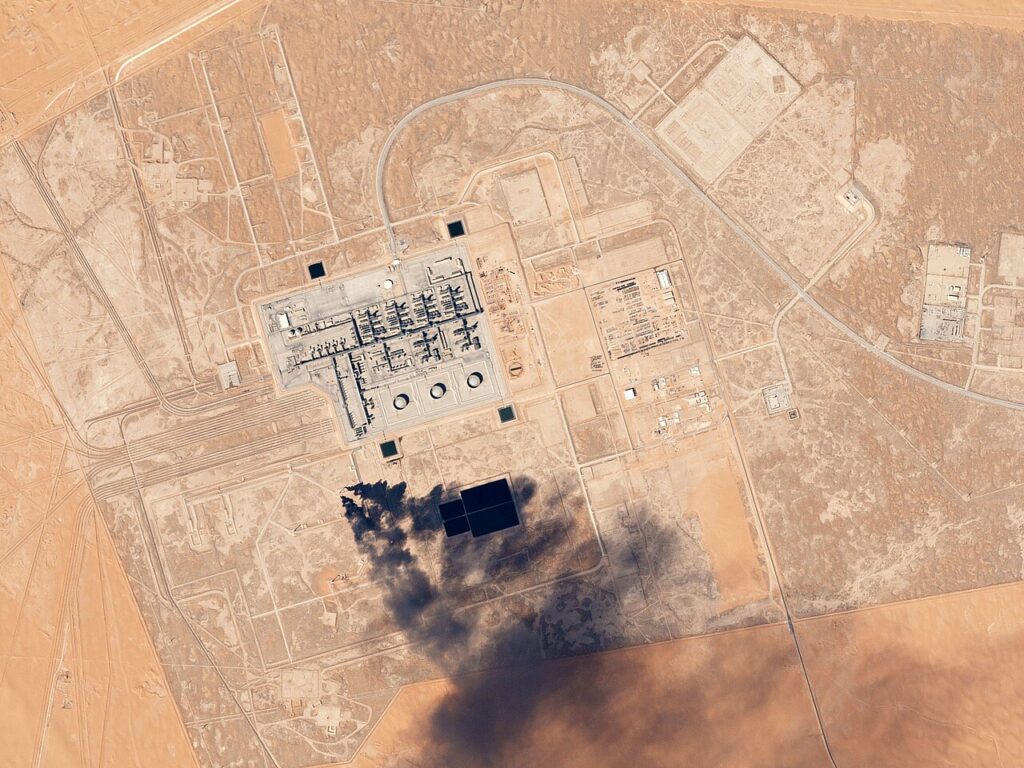
At almost the same hour in Sanaa, the capital of Yemen, a different fireball is climbing into the night — a towering column of black smoke over the Yemen Petroleum Company’s al-Sabah station on the city’s outskirts, hit by Saudi-led coalition warplanes.
Neither strike happened in isolation. Each was an answer to the other. And that is what makes this week different from everything that came before it: Saudi Arabia and the Houthis have stopped hitting just military targets and airports. They are now bombing each other’s fuel.
Who is fighting — and why this flared up now
For readers new to this conflict: the Houthis are a rebel movement from northern Yemen that seized the capital Sanaa in 2014 and now controls much of the country’s north, backed by Iran. Saudi Arabia leads a coalition of Arab states that has been fighting them, on and off, for a decade.
The current flare-up is part of something bigger. A wider war between the United States, Israel and Iran began around February 28, 2026 — roughly seven and a half months ago — and Yemen has been dragged into it. Last month the Houthis seized key areas around the Bab el-Mandeb strait, the narrow waterway at the mouth of the Red Sea through which a huge share of the world’s traded oil passes. Since then, the tempo of attacks has climbed almost daily.
Then came Saturday, October 10: a Houthi strike on Riyadh’s King Khalid International Airport that killed 13 people and wounded more than 300 — the deadliest attack on Saudi soil in years. The airport is still closed, with shutdowns extended to October 17, airlines suspending Riyadh flights and France issuing a travel warning for the kingdom.
That massacre is the reason the gloves came off this week.
The escalation ladder, rung by rung
Saturday, October 10 — the airport strike. Thirteen dead, 300+ wounded. Riyadh had not seen anything like it in a decade.
Tuesday, October 13 — the Saudi cabinet, chaired by Crown Prince Mohammed bin Salman, issued its warning. The Houthis, it said, “will face the consequences,” adding: “The Kingdom will not allow any threat to its security or to freedom of maritime navigation in the Red Sea and Bab al-Mandab Strait.” Hours later, coalition jets were over Yemen — striking oil sites in Sanaa, including the al-Sabah fuel station, plus facilities in Dhamar and Saada provinces, described as sites “used to supply the war effort.” Before the Sanaa strike, the coalition issued an evacuation order for civilians near the facility — its first such order for the Yemeni capital since the war flared back up. Coalition spokesman Maj Gen Turki al-Maliki said on X that the Houthis use “civilian objects and vital resources to sustain its war effort,” naming fuel stations, underground fuel reserves and storage sites.
Tuesday night — the Houthi answer. An administrative building at Saudi Aramco’s headquarters complex in Dhahran was hit. The Saudi Energy Ministry reported a “limited fire” and no casualties; a company source said a ballistic missile had damaged the top three floors of an office tower. The Houthis also claimed strikes on the Riyadh airport and a refinery in the capital. This was the first time the rebels had ever struck Aramco’s Dhahran headquarters directly — a genuine first in this war.
Wednesday, October 14 — falling debris from two intercepted Houthi cruise missiles injured four people in Riyadh and damaged 15 homes. Another ballistic missile was intercepted over the capital. Houthi military spokesman Yahya Saree vowed more attacks on Saudi airports and oil facilities. Four hurt by falling debris as Saudi Arabia vowed the Houthis would face consequences.
Overnight into Thursday — the war reached the water. Two ships sank near the Strait of Hormuz within 24 hours after being hit by projectiles: the Singapore-flagged container ship GFS Pride and a dry bulk carrier. Iran, meanwhile, says it is using “new tactics” to target ships in the strait — and to keep oil prices high.
Read that sequence again. Airport, fuel depot, oil headquarters, ships. Each side is now aiming at the other’s energy lifeline.
Why oil facilities? The cold logic of it
There is a grim rationality to targeting fuel, and both sides are following it.
For the Houthis, Saudi oil is the kingdom’s beating heart. Aramco is not just a company — it is the engine of the Saudi state, and Dhahran sits at the centre of the country’s oil industry, close to the giant fields of the Eastern Province. Every missile that forces Aramco to shut a facility, evacuate workers or spend billions on air defence is a tax on the Saudi war effort. Days before the Dhahran strike, the Houthis had told workers at Saudi oil facilities to evacuate, declaring them a “legitimate target” — the same warning logic the coalition then used in reverse over Sanaa.
For the coalition, the logic runs the other way: fuel is what keeps Houthi missiles, drones and trucks moving. Hit the depots and reserves, and you strangle the war machine at its tank. That is why the strikes named underground strategic fuel reserves and storage facilities, not just the visible stations.
Notice the mirror image. Both sides now issue evacuation warnings before hitting fuel sites. Both call the other’s energy infrastructure a legitimate target. When enemies start copying each other’s playbook, escalation stops being a series of incidents and becomes a system.
What it means for markets — and your petrol pump
Oil traders have noticed. Brent crude spiked to $106.29 a barrel this week and is now hovering around $104.67 — volatile, twitchy, moving on every headline. US benchmark WTI touched a three-week high near $94 after the Aramco attack.
Those numbers could be worse, and the reason they aren’t is instructive: so far, the physical damage to actual oil production has been limited. A damaged office tower at Dhahran is not a destroyed refinery. Markets are pricing in risk, not yet loss.
But the shipping picture is darker. Two vessels sunk near the Strait of Hormuz in a single day is not a statistic traders can shrug off — Hormuz is the world’s most important oil chokepoint, the narrow lane through which roughly a fifth of global petroleum liquids flows. Add the Red Sea and Bab el-Mandeb, where Houthi attacks have already forced ships into long detours, and freight rates are at record highs. The White House is now even considering easing sanctions on so-called “shadow fleet” tankers — vessels that have carried sanctioned Russian, Iranian and Venezuelan oil — just to get shipping costs down.
That tells you how seriously Washington takes the supply threat. When a government starts rehabilitating sanction-busting tankers to calm freight markets, the energy war has gone global.
What happens next
Three things to watch.
First, the United States. President Trump says he is considering joining strikes against the Houthis directly. American involvement would transform this from a Saudi-Houthi exchange into a much wider confrontation — and the Houthis have already shown they will answer escalation with escalation.
Second, Iran. Tehran openly says its new ship-targeting tactics in Hormuz are meant partly to keep oil prices high — energy as a weapon, wielded deliberately. If that campaign intensifies, the $104 Brent of today could look cheap in hindsight.
Third, the calendar. Riyadh’s main airport stays closed until October 17. Every additional week of airport closures, flight suspensions and travel warnings compounds the economic damage to Saudi Arabia — which is precisely the pressure the Houthis want to apply.
The optimistic case: both sides have so far kept the actual destruction of oil production limited — office towers and fuel depots, not refineries and export terminals. There is still a line neither has fully crossed. The pessimistic case: that line gets thinner every time a missile flies, and tit-for-tat has its own momentum. Nobody plans the tenth rung of an escalation ladder; they just keep climbing because the other side climbed first.
Why this matters far beyond the Middle East
This is not a distant regional feud. When missiles fly over Riyadh and ships sink near Hormuz, the effects arrive at petrol stations from Karachi to Kansas: higher crude prices feed directly into fuel costs, shipping insurance and freight rates feed into the price of everything that moves by sea — which is nearly everything. A war fought over oil facilities in Arabia and shipping lanes in the Gulf is, in the end, a tax levied on the entire world economy. That is why the fireballs over Riyadh and Sanaa matter to people who will never set foot in either city.