The most important labor news out of Ireland this week is not a strike — it is the strike that did not happen.
On Friday, October 16, Ireland’s public-sector unions suspended a second 24-hour general strike planned for October 21, barely 48 hours after more than 300,000 workers staged the largest walkout the country has seen since 2009. Instead of a repeat shutdown, the unions agreed to an intensive process — led by former Labour Court chairman Kevin Foley — aimed at getting formal negotiations started at the Workplace Relations Commission (WRC), Ireland’s state mediation body, with talks beginning October 17.
This is the shape of modern European labor disputes: not a knockout, but a pause. And the pause is where the leverage now sits.
What the October 14 strike looked like
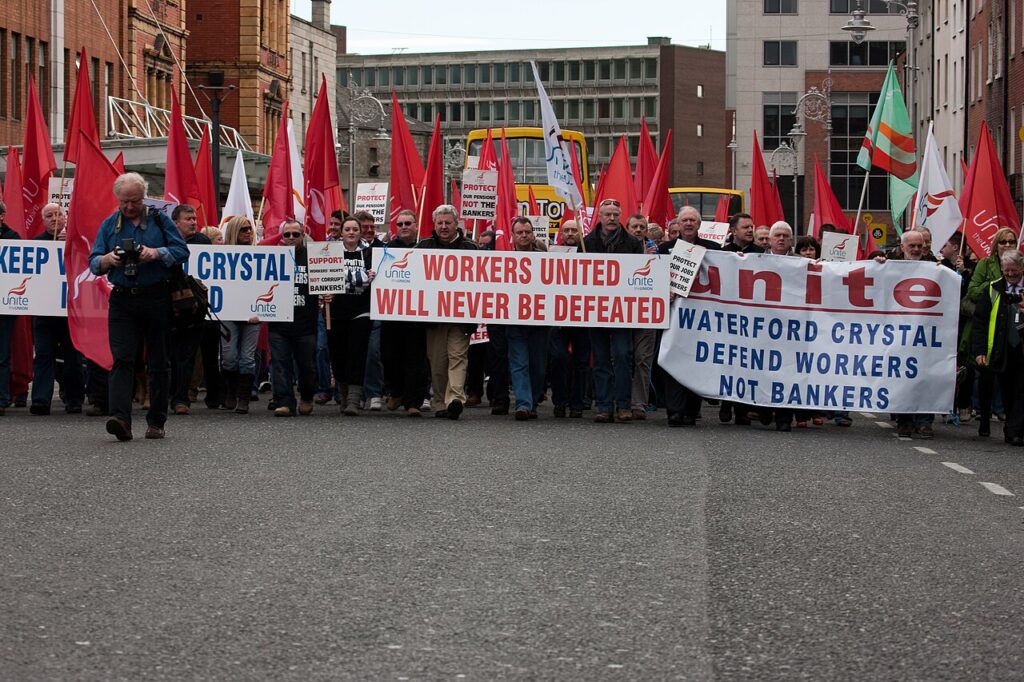
Wednesday’s stoppage was extraordinary by any measure. Nineteen unions, coordinated through the Irish Congress of Trade Unions’ Public Services Committee, walked out across more than 7,000 workplaces. Fórsa, the largest, brought over 100,000 members; SIPTU, the country’s biggest general union, ran 2,000 pickets. Nurses, teachers, university staff — and, for the first time since 1922, dentists — joined in. Schools closed. Tens of thousands of hospital appointments were cancelled. Public transport, unusually, ran normally.
The unions’ case is arithmetic. The last public-sector pay agreement expired on June 30, 2026. Wages are running 5 to 7 percent behind inflation, the unions say. The government’s 2027 budget set aside €1.2 billion for public pay — which, against 4.1 percent inflation, works out to around 2.5 percent. “That’s a pay cut in real terms,” as Fórsa general secretary Kevin Callinan put it.
Three demands sit at the center: settle pay first, before any broader agreement; honor pay awards already promised through local bargaining; and repeal the FEMPI laws — the Financial Emergency Measures in the Public Interest legislation, austerity-era statutes from the 2008 crash that still constrain public-sector pay.
Why the government blinked
Public-sector minister Jack Chambers called the strike “deeply disappointing,” which is what ministers say when they have run out of good options. The more telling moment came when Taoiseach (prime minister) Micheál Martin personally telephoned Public Services Committee chair Kevin Callinan from Brussels, where he was attending EU talks. Prime ministers do not make calls like that unless the political arithmetic has turned: a second shutdown, layered on top of schools already closed and hospital waiting lists already long, was a prospect neither side wanted to test in public.
So Friday’s deal: the October 21 strike is suspended — not cancelled. Kevin Foley, a former chairman of the Labour Court with credibility on both sides, will run an intensive process to get the parties into formal WRC negotiations. The unions’ work-to-rule — the slow, grinding version of industrial action in which workers do exactly their contracted hours and nothing more — continues in the meantime.
The pause is not the peace
Here is the analysis worth sitting with: a suspended strike is a more sophisticated weapon than a strike itself. The unions have shown they can empty schools and hospitals across an entire country on 48 hours’ notice; they have now parked that weapon within reach of the negotiating table, visible to everyone in the room. If the WRC process fails, the October 21 strike can be reactivated. If it succeeds, the unions can claim they won a deal without inflicting a second day of pain on the public — a much better story for an organization that depends on public sympathy.
The government, for its part, has bought time at the price of legitimacy: agreeing to an intensive process under an independent chair is an admission that the normal channels were not working. And the underlying math has not moved. Inflation at 4.1 percent against a 2.5 percent offer is the same pay cut on October 17 that it was on October 14. As the IMF noted in its recent research on cost-of-living shocks, real wages fall during inflationary episodes and stay below their previous levels for an extended time — which is precisely why unions are refusing to lock in a multi-year deal that starts from behind.
Watch what happens in the WRC room over the next two weeks. If Foley can convert the suspension into a framework both sides can sign, Ireland will have demonstrated that the strike-pause-strike rhythm is now the continent’s standard labor choreography — the same pattern playing out as France’s streets fill with protesters over pay and budgets. If he cannot, the 300,000 will be back at the pickets — and this time the government will have no excuse for being surprised.
Sources: Fórsa strike announcement; Irish National Teachers’ Organisation member update, Oct 16.