The death toll from the migrant boat that capsized off Senegal’s north-west coast has risen to at least 35, emergency services said on Sunday night, after more bodies were recovered from the Atlantic waters near Kébémer. Only one survivor has been found, and officials warn the number will almost certainly rise further.
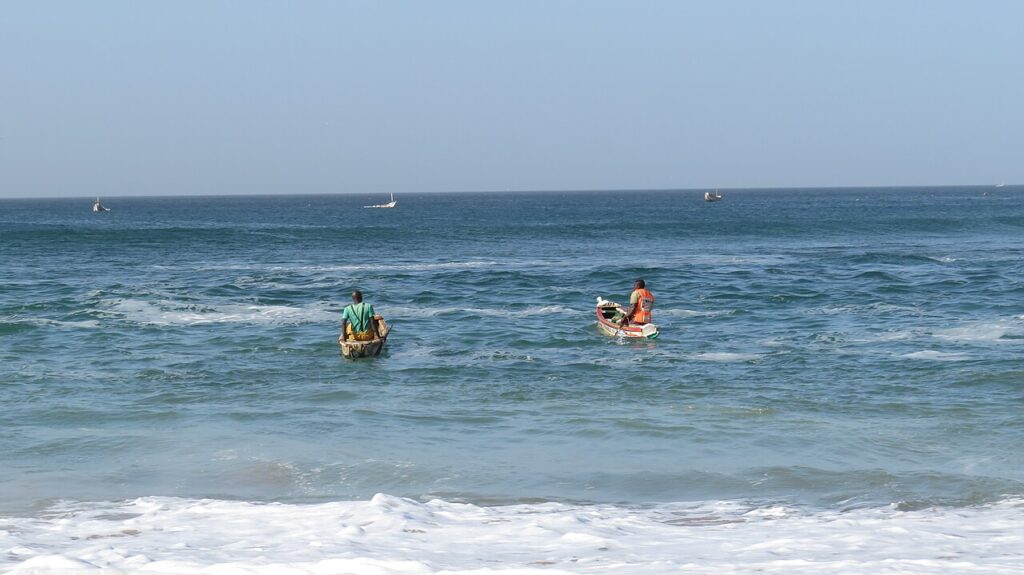
The wooden pirogue — a flat-bottomed fishing boat of the kind used along this coast for generations — went down off the Loumpoul dunes in Kébémer department, in the Louga region about 180 kilometres north of Dakar, between the capital and the northern city of Saint-Louis. Exactly when it sank is still disputed: Senegal’s main migrant aid association, Boza Fii, says the boat went down on Friday, while several media reports put the capsizing on Saturday. What is not disputed is the scale of what followed.
On Saturday evening, Senegal’s interior ministry said 21 bodies had been recovered and one person rescued, describing the figure as provisional while search and rescue operations continued. By Sunday, the official news agency APS reported that further recoveries had lifted the confirmed toll to 34, a figure also confirmed by the human rights group Action for Human Rights and Friendship (ADHA). Then, on Sunday night, emergency services put the toll at at least 35.
“It’s a provisional toll which has been changing since Friday,” an interior ministry source said. “The toll will unfortunately rise.” An indeterminate number of people remain missing, and the authorities have still not said how many people were on board when the boat went down.
The governor of Louga region, Ndèye Ngénar Mbodj, visited the affected sites on Sunday as officials worked to identify and preserve the recovered bodies. The interior minister is expected at the scene on Monday. According to the newspaper Le Soleil, most of those who died came from the Leona and Thieppe districts of Kébémer department — close-knit fishing communities where the long wooden boats serve both the local fishing trade and the migration route. The bodies recovered on Saturday were Senegalese, though the nationalities of all the victims have not yet been confirmed.
The same weekend underlined how busy this route has become. Senegalese authorities said they intercepted 142 migrants on Friday on a separate boat heading for Spain. On the other side of the crossing, Spanish authorities on the island of El Hierro declared an emergency after more than 3,300 people arrived aboard around 30 boats since the start of November.
Why this matters
The Atlantic route from West Africa to Spain’s Canary Islands is one of the deadliest migration corridors in the world, and it is getting busier, not safer. The migrant advocacy organisation Walking Borders has counted 635 deaths on the route in the first five months of this year alone — and that figure covers only the cases its monitors could verify. The boats are fishing pirogues, built for coastal waters, loaded far beyond their design and sent hundreds of kilometres into open ocean. Each sinking like this one is, in a grim sense, unremarkable: the same kind of boat, the same stretch of coast, the same provisional toll that climbs through the weekend. What makes Kébémer different is only that it happened in full view, with officials counting the bodies in public. The route itself will still be there on Monday morning, and so will the reasons people take it.
Our earlier reporting: the first toll of 21 is covered in our report on the capsizing off Kébémer. The wider pattern of deadly crossings is covered in our report on the Djibouti boat disaster, in which 139 people died.