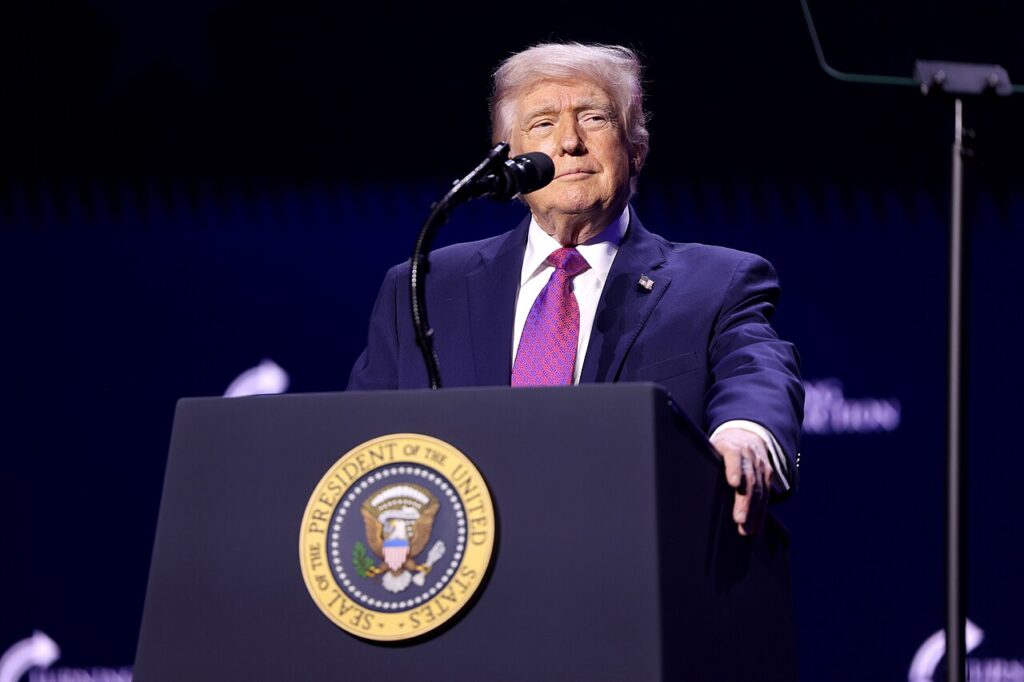
In the space of a few hours on Saturday night, the two most powerful men in Washington made the same claim: the war with Iran has been won — at least, the part of it that mattered most.
President Donald Trump, speaking at a Republican election rally at Northern Kentucky University’s Truist Arena, declared that American military operations had destroyed Iran’s nuclear weapons capability and pledged that Tehran would never be permitted to rebuild it. He framed the campaign as a defining achievement of his second presidency.
“They cannot have a nuclear weapon. They can’t because they’ll use it,” Trump told supporters. “Iran won’t have, doesn’t have, and never will have a nuclear weapon, very simple.”
Trump acknowledged that the campaign had demanded attention and resources at a time when the American economy and stock market were performing strongly. Stopping a nuclear-armed Iran, he argued, outweighed any short-term economic cost — and he predicted the war was nearly over.
“It’s gonna end very quickly,” he said, adding that petrol prices would drop below their earlier levels once the fighting stopped.
A few hours later, Vice President JD Vance echoed the claim on television. In an hour-long town hall in Michigan with CBS News anchor Tony Dokoupil, released Saturday night, Vance was pressed on why the war had dragged on longer than the administration had anticipated.
“Why haven’t we won decisively?” Dokoupil asked.
Vance argued the United States had “in some ways” already won, because American strikes had destroyed the nuclear program he described as the central reason for the operation. “Have we destroyed the Iranian nuclear program? The answer is yes,” Vance said.
But he shifted the goalpost from victory to prevention: Washington now wants a “long-term” and “verifiable commitment” from Iran never to rebuild its nuclear capabilities. “Not over the administration of Donald Trump… but five years from now, could the Iranians rebuild that nuclear arsenal? Could they try to rebuild that enrichment capacity?” he asked.
Vance also conceded the pain Americans are feeling at the pump. “I recognize that gas prices are too high right now,” he said, blaming Iran for “terrorizing commercial shipping through the Strait of Hormuz” and disrupting global oil supplies. He claimed pump prices would be “three times as high” if the US Navy were not protecting commercial ships — and predicted prices would come down when the conflict ends.
“The enemy gets a vote here,” he added.
The two appearances were steeped in election politics. Trump was campaigning for Republican Senate candidate Andy Barr and congressional candidate Ed Gallrein with the midterm elections three weeks away, and he renewed his promise of a $5,000 payment to every adult American citizen if Republicans keep the House and Senate — a pledge he estimated would cost about $1 trillion.
What the victory declarations cannot wish away is the war on the water, which grinds on. On Saturday, the United Kingdom Maritime Trade Operations agency reported that a skiff carrying seven men fired two shots at an LNG tanker 140 nautical miles southeast of Yemen’s Al Mukalla; the tanker’s armed security team fired warning shots and drove the boat off. More than 23 attacks on commercial vessels have been recorded since the beginning of October — including, earlier this month, the day a supertanker carrying two million barrels of crude hit a naval mine in the Strait of Hormuz. Brent crude remains above $100, and Washington insists the waterway is “open for business.”
Tehran has its own version of the endgame. Iran’s deputy foreign minister, Saeed Khatibzadeh, said Saturday that Iran is willing to answer the International Atomic Energy Agency’s questions and reopen the Strait of Hormuz within seven days — but only alongside an end to hostilities across all fronts. Iran has long denied seeking nuclear weapons and insists on its right to a civilian nuclear program.
And the central claim — that the nuclear program is truly destroyed — has not been independently confirmed. What strikes hit, what damage they caused, and what survives in Iran’s mountain facilities remains outside public verification. Analysts note that even a “destroyed” program is a temporary condition for a country with decades of nuclear expertise, which is exactly why Vance is now talking about a verifiable, long-term commitment rather than a final victory.
Why this matters
Washington’s back-to-back declarations do more than celebrate a military campaign; they set the terms for how the war ends. Trump says the fighting will end “very quickly.” Vance says it ends when Tehran signs a verifiable promise never to rebuild. Between those two statements lies the real negotiation — and meanwhile, tankers keep taking fire, oil prices stay elevated, and Houthi missiles keep striking Saudi Arabia.
For everyone who pays for petrol, heats a home, or watches freight costs feed into food prices, the scoreboard is not a rally speech but the energy markets. That is where this war will actually be won or lost — and where it will be clearest when it is over.


One Comment