Twelve migrants are dead — including a baby — after two boats carrying people from Turkey to Greece ended in disaster in the Aegean Sea on Monday. Six drowned when their speedboat slammed into a Greek coast guard vessel off Lesbos. Six more died hours apart when a second boat capsized off Samos as the coast guard gave chase.
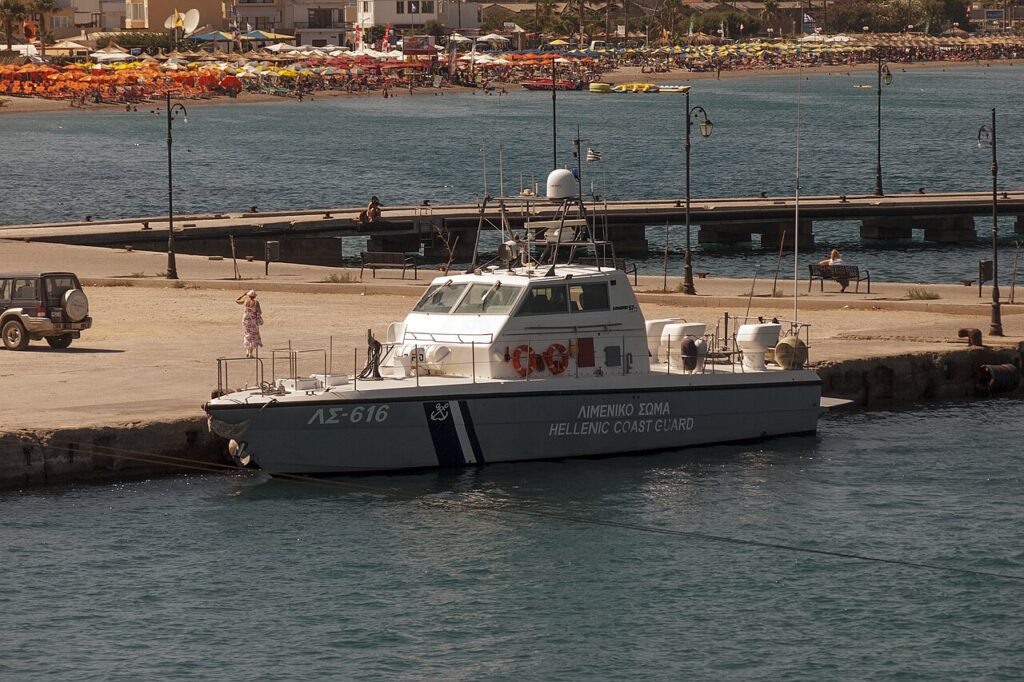
The day began with a collision. A speedboat ferrying migrants from the Turkish coast struck a Hellenic Coast Guard vessel about 3.5 nautical miles south of Agrilia, on the island of Lesbos, early on Monday morning, Greek authorities said. The boat overturned. Rescuers pulled the bodies of four men, a woman and an infant from the water; eight people survived and were taken to hospital.
Among the eight survivors was a 37-year-old Turkish national, whom authorities arrested and identified as the suspected smuggler and the boat’s operator.
Greece’s shipping minister, Vassilis Kikilias, laid the blame squarely on migrant traffickers. Evidence so far indicated the speedboat’s bow struck the left side of the coast guard vessel, he said, though the exact circumstances were under investigation. “Our position is non-negotiable: zero tolerance for smugglers,” Kikilias wrote in a post on X.
The second tragedy unfolded farther south. Roughly four nautical miles north of Samos, another speedboat carrying migrants from Turkey made what the coast guard described as a sudden manoeuvre and overturned. Five men and one woman died; fourteen men survived. A search-and-rescue operation was still under way, and authorities arrested one of the survivors — an Iranian national — on suspicion of migrant smuggling.
A route that has never really closed
Greece has long been the favoured gateway to Europe for people fleeing war, poverty and persecution across the Middle East, Africa and Asia. In 2015 and 2016, it sat at the frontline of Europe’s migration crisis, when nearly one million people landed on its islands — most departing from Turkey, just a few miles across the water.
Athens has since hardened its stance. The coast guard intercepts boats almost daily, and human rights groups have accused Greece of forcibly pushing migrants and asylum-seekers back at its sea and land borders — a practice the government denies, saying its coast guard acts “with full respect for human lives and rights.”
Yet the crossings continue, and the death toll keeps rising. In September, one person died and 25 were still missing after a boat carrying migrants sank off Gavdos, near Crete. Just a week ago, 139 migrants died off Djibouti on another of the world’s deadliest migration corridors — a grim reminder that these journeys are getting more, not less, dangerous.
Why this matters
Twelve deaths in a single day, on one of the world’s shortest and most watched sea routes, is a measure of how desperation is outpacing deterrence. Greece has spent a decade trying to seal the Aegean — with patrols, fences and expulsions — and people still board fragile speedboats in the dark, piloted by smugglers who have every incentive to run from the coast guard rather than be caught.
For Europe, the question is no longer whether the route can be closed. It can’t. The question is what happens next: whether the deaths of an infant off Lesbos and six more off Samos will be treated as a one-day tragedy — or as the latest evidence that the continent’s migration strategy is pushing the human cost onto the sea. People keep risking these crossings for reasons that haven’t changed: war, hunger and the calculation that even a dangerous boat is better than what they left behind.
Sources: Reuters; Arab News; Firstpost; TimesLive; Telegraph India.