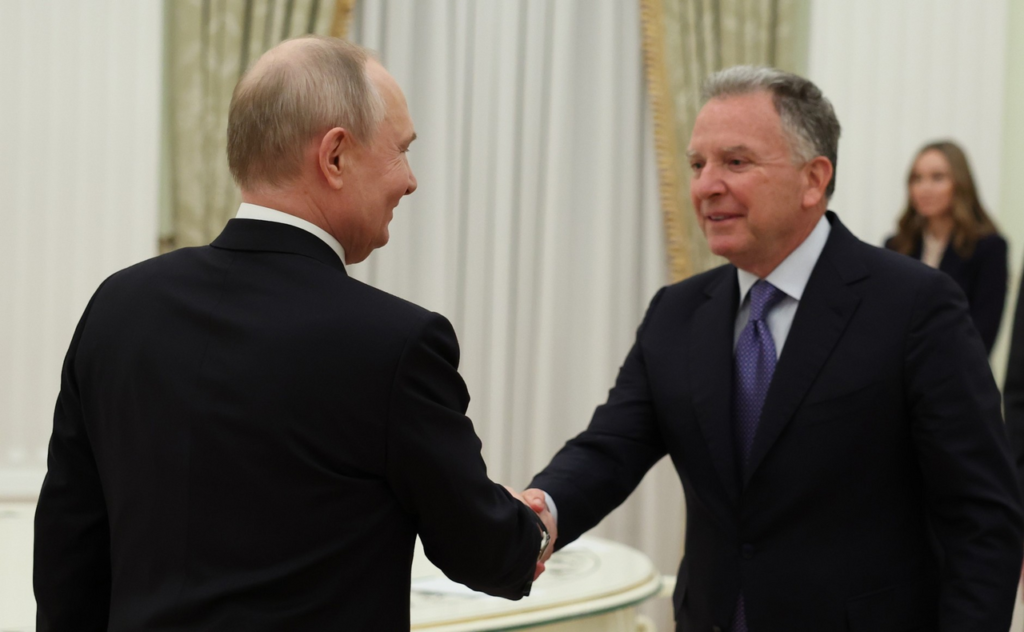
Nearly five hours of talks, two delegations, and at the end, no deal. U.S. special envoy Steve Witkoff’s meeting with Russian President Vladimir Putin in St. Petersburg on Wednesday produced no compromise on the central question of Ukraine’s territory, the Kremlin said — a sobering verdict on what was supposed to be the breakthrough moment of a week of frantic diplomacy.
Witkoff had flown in carrying fresh ideas. The day before, he sat down in Oslo with Ukrainian President Volodymyr Zelenskyy, the leaders of Norway and Finland, and European and NATO advisers to hash out written security-guarantee proposals for Kyiv — NATO membership, an Article 5 commitment, or something Article 5-like. The plan, as reported on the eve of the trip, was for Witkoff to hand those options to the Russian side and expect an answer within a day.
Putin’s foreign-policy aide Yuri Ushakov briefed reporters after the St. Petersburg session, and his summary was blunt: “No compromises have been found as of yet. Some American proposals are acceptable to Russia, while others are not,” he said, as quoted by RT. The meeting ran almost five hours and included Trump’s son-in-law Jared Kushner alongside Kremlin investment envoy Kirill Dmitriev.
The “territorial issue” — who controls which parts of Ukraine — was squarely on the table, Ushakov confirmed. Asked whether peace had moved closer or further away after the talks, he answered: “Definitely not further.” Dmitriev, who has become Moscow’s informal back channel to the Trump administration, summed the session up in a single word on social media: “productive.”
The backdrop is a 28-point American peace proposal that Washington has been circulating — and revising — after pushback from Kyiv and European capitals, who said the first draft leaned too far toward Moscow’s terms. In Oslo, Zelenskyy had presented Ukraine’s own counter-proposals, and U.S. Secretary of State Marco Rubio called those talks “positive.” Rubio, speaking from Mumbai, also reiterated that Washington had never ordered any changes to Ukraine’s Starlink access — the satellite dispute still simmering in the background of the diplomacy.
Hours before meeting Witkoff, Putin had set a harder tone. At an investment forum in Moscow, he accused European governments of blocking diplomatic efforts and said Russia was ready for a military confrontation if Europe chose escalation: “We are not planning to go to war with Europe, but if Europe wants to and starts, we are ready right now,” he said. “They are on the side of war.”
Why this matters. The territorial question has always been the wall this war’s diplomacy crashes into, and Wednesday’s readout confirms it is still standing. Russia holds roughly a fifth of Ukraine’s land, and Moscow wants its gains written into any settlement; Kyiv says no agreement without Ukraine is acceptable — and no agreement that rewards invasion can hold. For Washington, the result exposes the limits of shuttle diplomacy: Witkoff is now carrying answers neither side can use, and a future Putin–Trump meeting — the prize this whole effort was building toward — hinges on progress nobody can point to. For everyone else, from energy markets to the governments watching to see whether borders can still be moved by force, the message is the same: the war is not ending this week.
What comes next is more talking. Ushakov said Putin asked Witkoff to carry “a number of important political signals” back to Trump, and that the two governments would stay in contact. The diplomacy continues — it just has nothing to show for its longest day yet.

One Comment