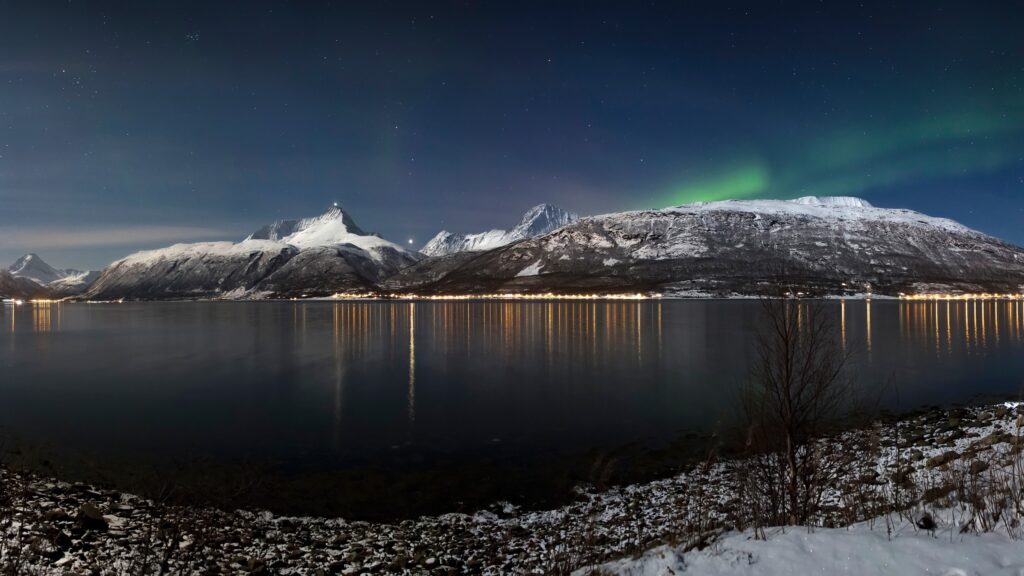
Informopedia Explains: on a May night in 2024, people in Florida stepped outside and saw the sky glowing green. In Puerto Rico, closer to the equator than to the Arctic, cameras caught curtains of red light. Nobody had travelled anywhere. The Arctic had come to them.
That night, the strongest geomagnetic storm in more than twenty years swept over Earth, and the northern lights spilled far beyond their usual polar home — the visible end of a chain reaction that starts 150 million kilometres away, on the surface of the Sun.
So what actually makes the sky light up? The short answer is a collision: charged particles from the Sun slam into gases high above the poles, and the gases answer with light. The longer answer explains everything from the colours to the dancing — and why the same storms that paint the sky can also knock out satellites.
It starts with the Sun’s wind
The Sun never stops shedding material. Its outer atmosphere, the corona, is so hot that it constantly boils off a stream of electrically charged particles — mostly electrons and protons — that races outward through the solar system. Scientists call this flow the solar wind. It blows at roughly 400 kilometres per second in quiet times, and it carries a piece of the Sun’s magnetic field along with it.
But the Sun also has moods. Openings in its magnetic field called coronal holes let faster streams of wind escape for days at a time — a Halloween solar wind stream is exactly this kind of event, and it can light up skies far from the poles. And then there are the eruptions: coronal mass ejections, or CMEs, in which the Sun hurls billions of tonnes of magnetised plasma into space in a single blast. When one of those clouds is aimed at Earth, it arrives in one to three days — and the light show begins.
Earth’s magnetic shield — and the gap in it
Earth is not defenceless against this bombardment. Churning molten iron deep inside the planet generates a magnetic field that wraps the whole world in a protective bubble called the magnetosphere. Most of the solar wind slides around it and streams harmlessly past.
But the shield has a weak point. When the magnetic field carried by the solar wind tips southward — the opposite direction to Earth’s own field at the dayside boundary — the two fields can link up and merge, a process called magnetic reconnection. For a while, the barrier is open, and solar particles and energy pour through the gap.
The stolen energy collects in the magnetosphere’s stretched-out night side, the magnetotail, until the field lines snap into a new shape and fling electrons back toward Earth at high speed. Those electrons follow the field lines down toward the poles — which is why the aurora appears as a glowing ring around each pole, the auroral oval, rather than scattered randomly across the sky.
The colours: a fingerprint of the air itself
The light itself is made about 100 to 300 kilometres overhead. The incoming electrons crash into oxygen atoms and nitrogen molecules, knocking their own electrons into a higher energy state. An atom cannot hold that extra energy for long: within a fraction of a second it drops back down, releasing the surplus as a tiny packet of light — a photon.
Green is the colour most people picture, and it is the most common: oxygen atoms glowing at roughly 100 to 240 kilometres up. The same oxygen, struck much higher — 200 to 300 kilometres and above — produces a deep, rarer red, which is why the tops of tall auroral curtains sometimes blush crimson. Nitrogen adds the purples and blues, usually along the lower edges of the display, and it releases its light almost instantly, while oxygen’s green can linger for a second or more.
That difference in timing is part of why the aurora seems alive: new particles arrive in waves, different gases answer at different speeds, and the whole curtain shimmers and folds as the rain of electrons shifts overhead.
Why the lights dance
Watch an aurora for ten minutes and it never sits still: it hangs like a curtain, then breaks into rays, then sweeps across the sky in a wave. The movement comes from the magnetosphere itself, a restless structure, and the electrons pouring down along its field lines arrive in bursts, not a steady stream.
During a substorm — a sudden release of energy stored in the magnetotail — the aurora can brighten dramatically in minutes, surge toward the equator, and break into fast-moving folds that cross the sky in seconds.
Reading the forecast: the Kp index and the solar cycle
Aurora chasers do not rely on luck. They watch two numbers. The first is the Kp index, a global measure of geomagnetic disturbance updated every three hours by the NOAA Space Weather Prediction Center. It runs from 0, dead calm, to 9, an extreme storm. At Kp 5 and above, a geomagnetic storm is under way and the auroral oval swells toward the equator; at Kp 7 and higher, the lights can reach well into the mid-latitudes — which is how Florida saw them in May 2024.
The second number is slower: the Sun’s roughly 11-year cycle. Near solar maximum, sunspots multiply and CMEs become frequent. Solar Cycle 25 peaked in late 2024, more strongly than first forecast, which is why the past two years produced some of the most widely photographed auroras in decades. The cycle is now easing, but the fiercest storms can arrive years after the peak — the Halloween storms of 2003 came two or three years after theirs.
How to see them
The recipe is simple and unforgiving: dark skies, a clear night, and the right latitude. The auroral oval normally sits over the high Arctic, so northern Norway, Iceland, Alaska and northern Canada are the reliable bets, and the long dark nights of winter help. Town lights can wash out a faint display, so get away from them and look north when the Kp forecast reads 5 or higher.
The north has no monopoly. The southern hemisphere has its own version, the aurora australis, produced by exactly the same physics over Antarctica and the southern oceans — often at the same time, a mirror image fed by the same stream of solar particles.
The beautiful side has a sharp edge
Every aurora is also a warning. The same geomagnetic storm that paints the sky drives electric currents through the ground and through anything long and conductive on it — power lines, pipelines, undersea cables. Satellites can be charged, blinded or knocked off course; GPS accuracy degrades; airlines reroute polar flights.
The record still belongs to the Carrington Event of September 1859, when a colossal solar eruption set telegraph offices on fire and pushed the aurora as far south as Cuba and Hawaii. A storm of that scale today would threaten transformers and communications for weeks. The May 2024 storm, by contrast, reached G5, the highest category on NOAA’s scale, produced the most photographed aurora event in decades, and caused no catastrophic grid failures — though GPS glitches were reported across North America and Europe.
That is the double nature of the invisible explosions above the poles: wonder and hazard, delivered by the same physics. NASA and NOAA now watch the Sun around the clock, and spacecraft parked a million and a half kilometres sunward give grid operators between 15 and 48 hours of warning before a big cloud arrives.
Why this matters
The northern lights matter because they are the one piece of space weather you can see with your own eyes. Every other effect of a solar storm — the currents in the grid, the drag on a satellite, the static on a radio — is invisible until something breaks. The aurora is the storm made visible.
It also matters because the show is about to change address. As the solar cycle declines, the great displays will retreat toward the poles again, and the chances of seeing the lights from a backyard in the mid-latitudes will fade for years.
What happens next
Scientists expect strong storms to keep arriving through 2026 and into 2027, even past the cycle’s peak. The next step is better warning: new solar observatories are being built to watch the Sun’s far side and measure the solar wind closer to its source, giving forecasters more than the current day or two of lead time.
For the rest of us, the advice is simpler. Check the Kp forecast on a clear winter night, drive away from the town lights, look north, and give your eyes twenty minutes to adapt to the dark. The sky may stay black. Or it may start to glow green — and for a few minutes, you will be watching the Sun touch the Earth.