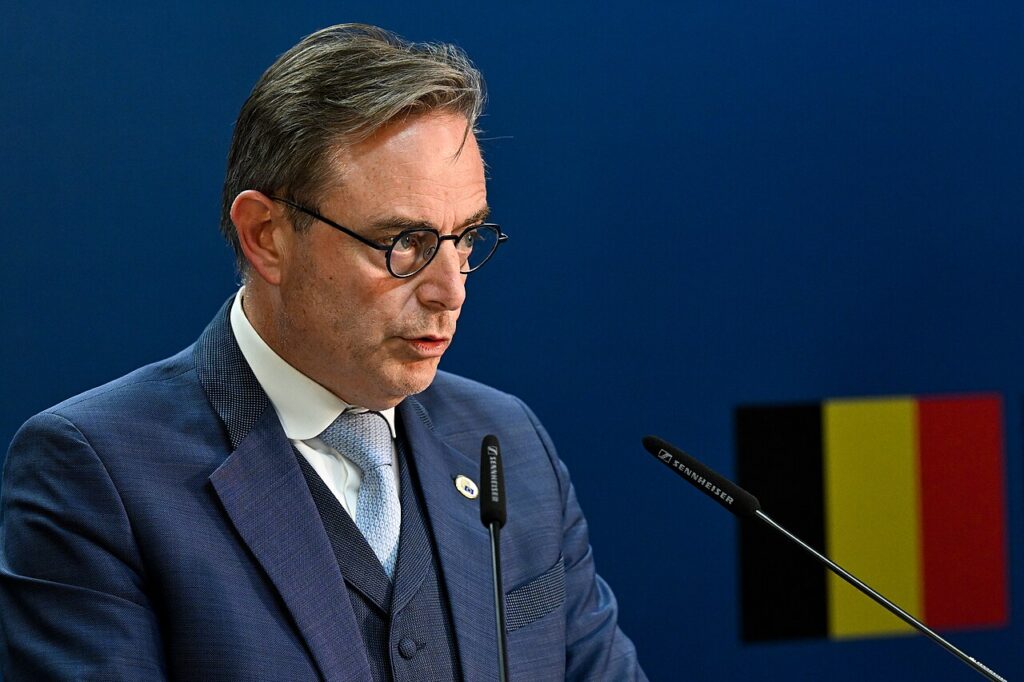
Belgium’s government survived on Friday — at least for now. King Philippe refused to accept Prime Minister Bart De Wever’s resignation and sent him back to the negotiating table, giving the country’s five-party coalition ten days to close a budget gap worth €10 billion.
De Wever had offered his resignation on Monday morning after overnight budget talks collapsed. He spent 90 minutes with the king at the Royal Palace in Brussels that day, and Philippe held his decision in reserve while he consulted the leaders of all five coalition parties, one by one, from Tuesday to Thursday.
On Friday morning, De Wever returned to the palace for the verdict. The king’s office announced afterwards that budget negotiations would resume immediately, and that the prime minister had been tasked with leading a new round of talks and reporting back to the king on 16 November.
The palace said that in its conversations this week, all the parties had shown a willingness to compromise. It was the opening De Wever needed. On Thursday, addressing parliament, he had hinted that he would rather stay than go, saying he still hoped to secure a budget that would bring financial stability for the coming years.
What the €10 billion fight is really about
Belgium’s problem is not a lack of arguments. It is arithmetic. The government needs to find about €10 billion — roughly $11.2 billion — in spending cuts and extra revenue by 2029 to steady the public finances. The budget deficit stands at 5.2% of GDP, far above the European Union’s 3% ceiling, and public debt is running at about 110.5% of GDP, one of the heaviest burdens in the bloc.
De Wever told parliament on Thursday that the state is now paying €16 billion a year in interest on its debt alone — money that buys no schools, no hospitals and no soldiers. He has warned for months about what he calls an interest snowball: new loans taken out to pay the interest on old ones.
The five parties in the coalition — known as “Arizona” after the colours of its members — agree on the size of the hole. They disagree on who should fill it. De Wever’s Flemish nationalist N-VA and the French-speaking liberal Reformist Movement favour deeper spending cuts, including in healthcare. Others in the coalition want tax increases to carry more of the weight. The Reformist Movement has insisted that new taxes on the highest earners must stay limited to one-ninth of the total package, a red line that has blocked every compromise so far.
The coalition has been in office only since February 2025, after 234 days of negotiations to form it. It reached a budget agreement in November last year only after more than 20 hours of continuous talks. This time, the same partners spent months arguing and still left the table empty-handed on Sunday night.
A king who acts as referee
Belgium’s king holds no executive power, but moments like this are exactly why the monarchy still matters in Belgian politics. When a government falls, it is the king who decides what happens next: send the prime minister back to try again, ask someone else to form a government, or call early elections.
On Monday, Philippe made his view plain. In a palace statement, he said he regretted that no agreement had been reached, warned that “the country cannot afford a prolonged political crisis”, and appealed to everyone “to demonstrate a sense of responsibility” and put “the general interest and the spirit of compromise” first.
It was not a new role for him. A year ago, in November 2025, De Wever came to the palace with the same problem and asked for more time instead of resigning. The king gave him 50 extra days. This time, the reprieve is ten days — and the palace has made clear that the parties themselves asked for the chance.
Why this matters beyond Belgium
Belgium is a founding member of the European Union and home to both the EU institutions and NATO headquarters in Brussels. A government collapse there would not just be a domestic embarrassment; it would leave one of Europe’s central states in caretaker mode for months, at a moment when the continent is arguing over defence spending, support for Ukraine and how to respond to American tariffs.
The fight in Brussels is also a preview of a dilemma spreading across Europe. Governments are being asked to spend far more on defence while EU spending rules demand smaller deficits — and the money has to come from somewhere. Belgium’s €10 billion gap is, in miniature, the same argument now playing out in Paris, Madrid and Rome: cuts or taxes, and whose voters pay.
For now, the Arizona coalition has a second chance. If the talks fail again, the king’s options narrow fast. Without a 2027 budget approved by 31 December, Belgium would start the new year on provisional spending rules, limited to one-twelfth of this year’s budget each month — the stopgap the country already used last year, and one De Wever has ruled out repeating.
The deadline is 16 November. The king will be waiting.
Spain’s prime minister called a snap election last month after his own budget plans were defeated — another European government brought down by the same arithmetic. And Somalia’s supreme court ruled this week that its president’s term expired in May, ordering elections within 90 days — a reminder of how constitutional referees, courts and kings alike, are being called on to settle political deadlocks.