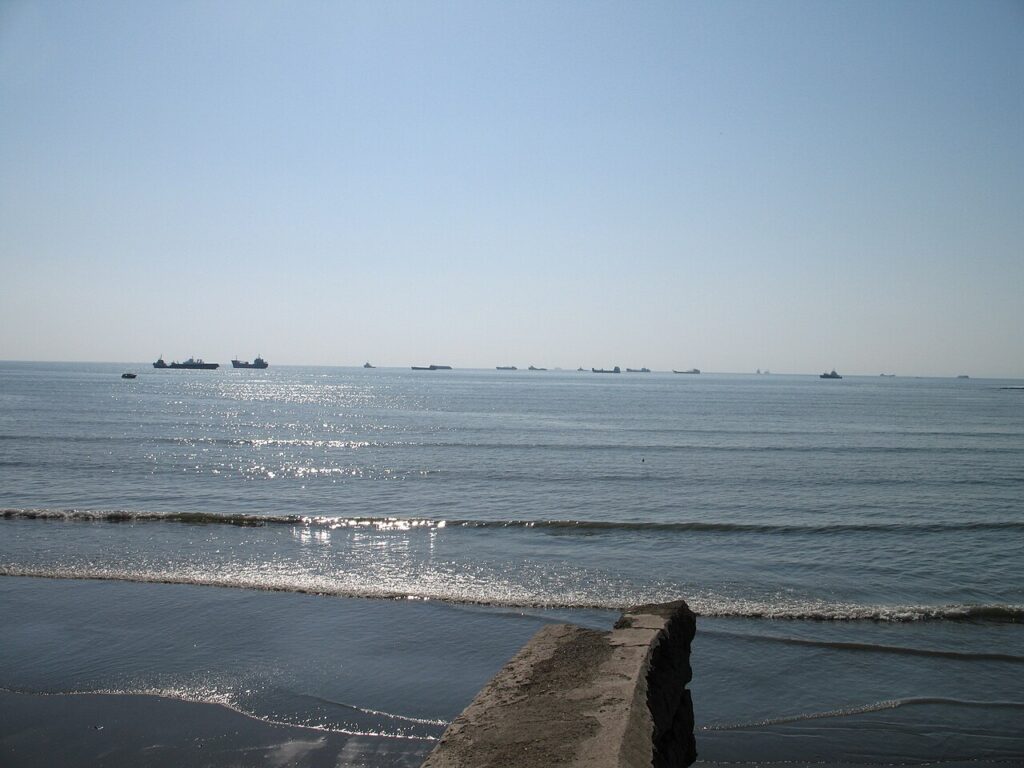
Explosions were heard on Saturday evening across Iran’s southern coast — on Qeshm Island, in the Strait of Hormuz, and at the port of Jask, further east on the Gulf of Oman — and hours later, no one had said what caused them.
Iran’s official news agency, IRNA, reported blasts on Qeshm, the large island that sits at the mouth of the Gulf. The semi-official ISNA news agency then reported further explosions at Bandar Abbas and Sirik, on the mainland coast facing the island. Israeli media relaying the Iranian reports said video had also emerged of an explosion in the port city of Jask.
Reuters, citing Iranian media, reported the explosions on Qeshm and at Jask with the cause unclear, and said there was no official confirmation from the Iranian side about what set them off. No casualty or damage figures had been reported by Saturday night.
What the blasts were is, for now, a matter of competing claims. Unverified channels on Telegram said the Jask explosions came from an American strike on an anti-ship missile launcher, and reported four blasts and a rising smoke plume at the port. None of that has been confirmed by the United States, which has said nothing about the Saturday evening reports, and Iranian officials quoted so far have described explosions without assigning blame.
A later eyewitness account carried by the semi-official Tasnim news agency pointed in a different direction, suggesting the sounds were linked to activity in the Strait of Hormuz rather than an attack. The two accounts cannot both be right, and neither has been independently verified.
The blasts are the third such episode around Qeshm in a week. American forces struck targets on Qeshm and the nearby island of Hengam on 2–3 November. Then Trump confirmed on Friday that US forces had carried out “minor” strikes on an Iranian air-defence system on Qeshm. “We do minor strikes,” he told reporters in Florida. “They built a little bit of an anti-aircraft device and we knocked it out in about 15 minutes, maybe five.”
Iranian state television said its air defences had shot down an American MQ-9 drone over Qeshm. The United States has not confirmed that claim. US Central Command, asked about the reports, described the situation as “relatively calm” and offered no further comment.
Washington has, however, been tightening the screws around Iran in other ways. Its Central Command announced a reward of up to $20 million for information about Iran’s nuclear programme, and said it had struck and disabled a commercial vessel, the M/V Huda, after it tried to breach the naval blockade in the Gulf of Oman. A new task force has been set up to disrupt Iran’s land-based supply routes.
The timing matters. Hours before the blasts, Iran’s Revolutionary Guard said it had lifted its self-imposed 2,000-kilometre limit on the range of its missiles, with a spokesman saying the force’s duty was now to demonstrate the new reach “on the battlefield”.
The Wall Street Journal reported that President Trump’s advisers are pressing him to decide whether to end the war with Iran or return to major combat operations, with the defence secretary and the head of Central Command said to favour renewed strikes. The USS Theodore Roosevelt carrier strike group is steaming towards the region. At the same time, Qatari mediators are making an eleventh-hour attempt to keep diplomacy alive, and Iranian officials were expected to return to Doha for talks.
That is the fog in which Saturday’s explosions sit: a war that neither side calls a war, fought in short bursts and denials, on the waterway that carries around a fifth of the world’s traded oil.
Why this matters is not just the blasts themselves — no one has yet reported anyone killed by them — but what they signal. Each unexplained explosion on this coastline narrows the space for both sides to step back. Washington has spent the week showing it can hit Iranian targets almost at will, while insisting each strike is limited. Tehran has answered by dropping its own self-imposed limits and promising a response without geographical boundaries. With a carrier strike group on its way and a decision sitting on the president’s desk, the next blast may not come with the word “minor” attached.
What to watch now is whether either government breaks its silence — an American statement, an Iranian damage report, or word from the Doha talks — and whether the explosions spread beyond the Hormuz coastline. Until then, the most honest description of Saturday evening on Iran’s southern coast is also the simplest: something exploded, and no one in authority will say what it was.

One Comment