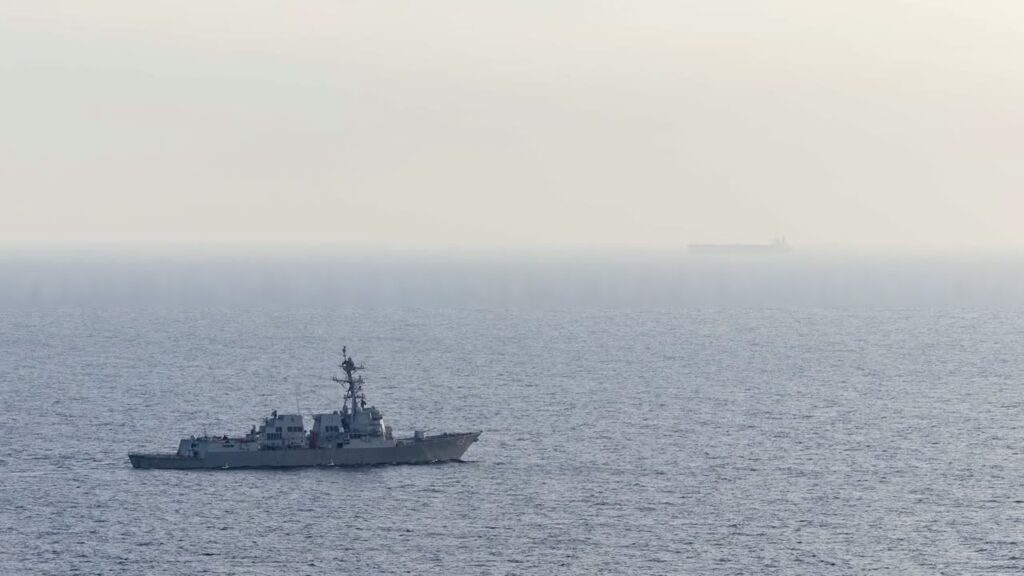
A United States military aircraft opened fire on a commercial cargo ship in the Gulf of Oman on Saturday, disabling the vessel after its crew repeatedly ignored warnings to turn back, US Central Command said.
The ship was the M/V Huda, a bulk carrier sailing under the flag of St Kitts and Nevis — a small Caribbean nation whose registry is often used by foreign-owned ships, a common arrangement in international shipping known as a flag of convenience. The 24,993-tonne vessel, built in 1999 and managed by a Turkish company, had called at an Iranian port and was trying to leave regional waters when American forces moved in.
According to Central Command, known as CENTCOM — the US military command responsible for the Middle East — the crew ignored repeated warnings and tried several times to break through the naval blockade the United States has enforced against Iran since July. A US military aircraft then fired precision munitions at the ship’s stern, the rear of the vessel, after forces on the scene directed the crew to abandon the targeted spaces first.
“CENTCOM forces disabled a commercial vessel in the Gulf of Oman, Nov. 7, after the ship’s civilian crew ignored repeated warnings and attempted to violate the naval blockade against Iran multiple times,” the command said in its statement. “A U.S. military aircraft fired precision munitions at the stern of St. Kitts-flagged M/V Huda, disabling the ship after CENTCOM forces directed the crew to abandon targeted spaces.”
The incident took place about 18 nautical miles east of Khor Fakkan, a port on the United Arab Emirates’ east coast, according to the UK Maritime Trade Operations centre, which tracks shipping incidents in the region. Maritime tracking service Vesseltracker reported that all crew members were safe. CENTCOM itself did not say whether anyone aboard was hurt, how many crew were on the ship, what cargo it was carrying, or which Iranian port it had visited.
The Huda is the fifth merchant ship American forces have disabled since the blockade restarted in mid-July, and the first since 10 October, when another bulk carrier, the Ocean Molica, was struck in the same waters. CENTCOM says 147 commercial vessels have complied with its orders and turned back since July. It also says US forces have destroyed 10 Iranian commercial oil tankers it describes as part of a shadow shipping network run by Iran’s Islamic Revolutionary Guard Corps, and it estimates the blockade has stopped more than $25 billion worth of Iranian crude oil from reaching world markets.
Saturday’s announcement came with a second one: CENTCOM said it is launching a new task force to crack down on Iran’s movement of advanced weapons and other sanctioned material over its land borders and through the Caspian Sea — a sign the campaign is widening beyond the water.
The timing matters. The disclosure followed a week in which the confrontation has visibly sharpened. On Friday, President Donald Trump said the US military had carried out new limited strikes against Iran, and on Saturday evening Iranian state media reported the sound of explosions on Qeshm Island and at the port of Jask, at the mouth of the Strait of Hormuz — blasts whose cause remains unclear. Hours earlier, Iran announced it was dropping its self-imposed 2,000-kilometre limit on the range of its ballistic missiles, a move that put US bases across the region within reach on paper.
For now, the Huda sits disabled in the Gulf of Oman, and no towage, salvage or port-of-refuge arrangement has been announced. What happens to its crew — and its cargo — is still unknown.
Why this matters
This was not a warning shot across the bow. It was a US warplane firing live munitions into a civilian merchant ship — the fifth time since July — and it tells shippers everywhere that the blockade of Iran is no longer enforced with orders and boardings alone. For a world that still moves around a fifth of its seaborne oil through the Strait of Hormuz, the narrow channel just west of where the Huda was hit, each such incident narrows the margin between a pressure campaign and an open shooting confrontation. And with CENTCOM now extending the crackdown to Iran’s land borders and the Caspian Sea, the net is closing on more than the water — which is exactly why the next ship to test it will be watched so closely.


One Comment