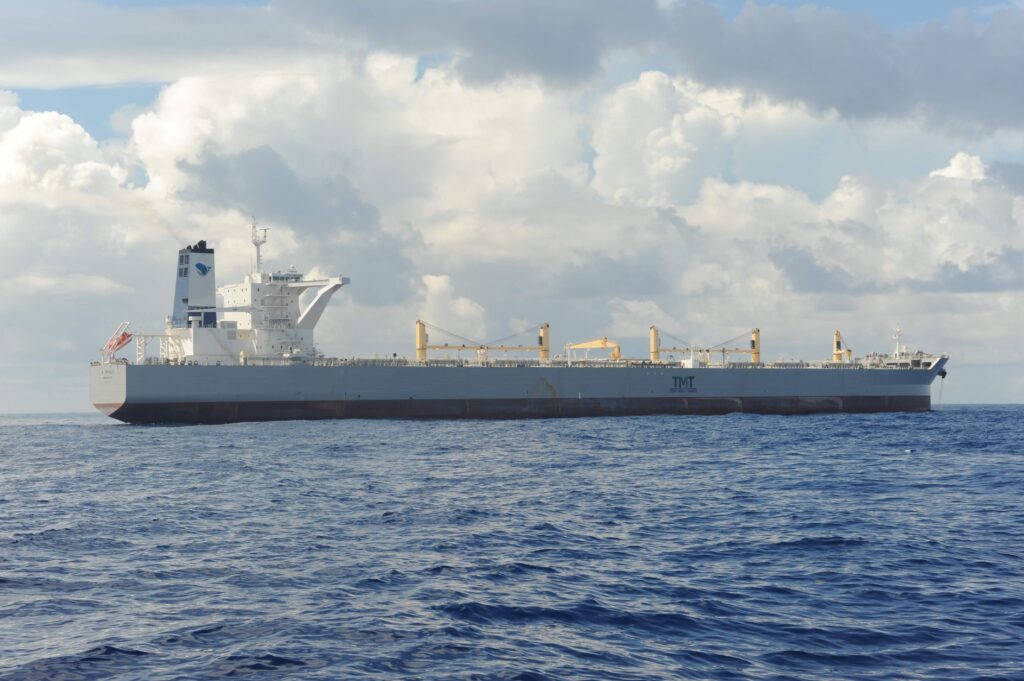
A supertanker carrying roughly two million barrels of crude oil caught fire in the Strait of Hormuz on Sunday, struck on its port side by an unknown projectile — just hours after American forces destroyed a cargo vessel that tried to breach Washington’s naval blockade of Iran.
The United Kingdom Maritime Trade Operations agency said the tanker burst into flames after the strike and that the crew were reported safe. The vessel was not immediately identified. Within hours, Iran’s Islamic Revolutionary Guard Corps offered its own account: the ship, it claimed, had struck one of Tehran’s naval mines while trying to leave the strait through an unauthorized route.
The IRGC shared video of the tanker burning on the water and paired it with a blunt warning: “A devastating fire is the fate of any tanker that violates the rules and disregards security in the Strait of Hormuz.”
It is the most serious in a mounting string of attacks on commercial shipping around the world’s most important oil chokepoint. Iran has launched near-daily strikes on vessels in recent weeks, even as crude keeps flowing at close to pre-war levels under US military escort. According to the United Nations’ International Maritime Organization, at least 11 tankers came under attack in the week that ended October 4 — the highest number of strikes on commercial ships in the strait since the US-Iran war began on February 28.
Hours before the tanker fire, the American military had made its own statement about the blockade. US Central Command said a fighter jet struck the stern of the Panama-flagged cargo ship M/V Ocean Molica — also known as the Arika Sun — in the Gulf of Oman, fully disabling its propulsion. The ship had previously departed an Iranian port and, according to CENTCOM, ignored repeated warnings before attempting to transit regional waters. No crew members were harmed, the command said, and it released video of the strike.
The blockade itself was resumed by Washington on July 14, days after Iran said it had again closed the waterway following a resumption of American strikes on July 8. In three months of enforcement, CENTCOM said, four commercial vessels have been disabled and 135 turned away, while US forces have destroyed 10 tankers it describes as linked to the IRGC’s shadow oil network.
Sunday also produced a smaller, stranger detail: UKMTO said it had received reports from several shipmasters near Ras Al Khaimah, in the United Arab Emirates, that vessels were being instructed by VHF radio broadcasts to leave their anchorages. Authorities were investigating, the agency said, urging crews to report suspicious activity.
Iranian officials have been escalating their rhetoric in parallel. State media reported warnings that if the conflict continues, “not even one drop of oil” will be exported out of the strait or anywhere else in the Persian Gulf. The region’s defenses are already stretched thin — Saudi Arabia has been asking allies including Pakistan and France for help as its interceptor stocks run low, and a drone attack hit an oil tanker at Sharjah anchorage just days ago.
Why this matters: Two things happened on Sunday, and the pairing is what makes it dangerous. The United States is now openly destroying vessels it says are breaching its blockade, while Iran is openly torching tankers it says are violating its rules — two competing blockades enforced by force in the same narrow stretch of water. Roughly a fifth of the world’s oil flows through the strait in normal times; today’s incidents show how close that flow is to being held hostage by both sides at once. Tehran’s threat to choke off exports entirely is leverage for negotiations — but as the burning supertanker demonstrates, it is the kind of leverage that only takes one miscalculation to become an actual global energy shock. The conflict is now in its eighth month, and the pattern is unmistakable: every incident is answered by a bigger one.


2 Comments