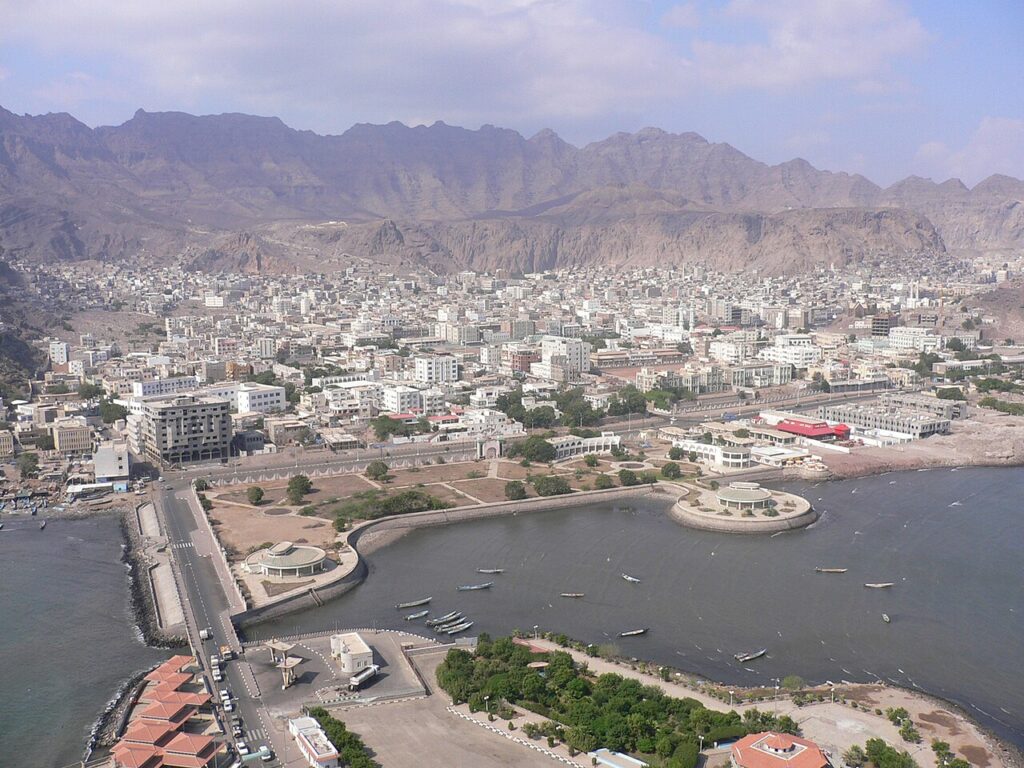
The missile strike came in the middle of the workday. Five ballistic missiles slammed into the al-Maashiq presidential palace compound in Aden on Thursday — the seat of Yemen’s internationally recognized government — killing five people and wounding 16 others, according to Yemeni health officials.
Prime Minister Shaya al-Zindani was inside the compound when the missiles landed. A government minister, speaking on condition of anonymity, said the prime minister was “not harmed in any way,” and the government’s Ministry of Information confirmed that he and cabinet members present were safe. The dead included two members of the prime minister’s own security detail, along with guards and civilian employees working at the complex. Residents across the southern port city heard the explosions; an AFP journalist watched smoke rise over the palace.
Details from the anonymous minister, reported by Agence France-Presse: three of the missiles hit a command center used by Yemeni government forces inside the compound, and two struck a separate command center used by the Saudi-led military coalition. The minister added that there were both Yemeni and Saudi casualties, without giving a breakdown.
The attack did not stop at Aden. Yemeni government forces said the Houthis also fired several ballistic missiles toward Marib, the oil-rich central city, while the Saudi-led coalition said its air defenses — already strained by weeks of attacks — intercepted Houthi drones over the kingdom’s southern region and the city of Khamis Mushait. The strikes follow days in which the Houthis hit Saudi Aramco’s Dhahran headquarters for the first time. Earlier the same day, coalition spokesman Major General Turki al-Malki said the Houthis had attacked Riyadh’s King Khalid International Airport 20 times since the start of October.
The Houthis claimed the strike through their military spokesman, Yahya Saree, who said the group had bombed what it called a Saudi military operations headquarters at the palace — part of what the group calls its policy of targeting “Saudi reinforcements wherever they were located.” Houthi-run media claimed Saudi officers were killed or wounded. Reuters said it could not independently verify those claims.
For readers who haven’t followed Yemen’s war closely: Aden has served as the government’s de facto capital since 2014, when the Houthis — an Iran-aligned movement from Yemen’s north — seized the actual capital, Sanaa, and forced the internationally recognized government into exile. Saudi Arabia has led a military coalition backing that government since 2015. A years-long truce collapsed this summer, the civil war reignited in July, and the Houthis launched a lightning offensive in September that seized swathes of strategic territory along Yemen’s Red Sea coastline. All of it is unfolding inside a wider regional war that began with American and Israeli strikes on Iran in February.
Thursday’s strike was the first on the palace complex since that reignition — and it is a deliberate message. Al-Maashiq is not a military base on some remote front. It is the working headquarters of the government itself, and the missiles landed while the prime minister was in the building.
Prime Minister al-Zindani called the strike a “cowardly” act on X, describing it as “a continuation of its criminal pattern of striking civilian sites and civilians.” Saudi Arabia, meanwhile, pointed the finger at Tehran: deputy minister for public diplomacy Rayed Krimly said the escalation was “encouraged by Iran,” which he accused of continuing to arm and train the Houthis. Riyadh said it remains in contact with Tehran, but that Iran does not appear ready to make concessions — a notable statement given that the two rivals reached a China-brokered thaw in ties in 2023.
Why this matters beyond Yemen: the Houthis have just shown they can hit the seat of the government they are fighting, with its head of government inside. That erodes the last sense of Aden as a safe haven and puts the government’s “Yemen’s Dawn” counteroffensive — launched this month to retake Houthi-held ground near the Bab el-Mandeb Strait, one of the world’s most critical shipping arteries — under fresh doubt. For global readers, the stakes are the ones that touch everyone: oil prices, Red Sea shipping lanes, and a humanitarian crisis in one of the world’s poorest countries that aid agencies say is rapidly worsening.
The government’s cabinet said after the attack that the strike would not deter its forces, and that Aden would remain Yemen’s de facto capital. The question now is whether the government can keep that promise — or whether Thursday’s missiles were the opening of a campaign aimed at the capital itself.




2 Comments