The video is shaky, filmed from the back of a pickup truck somewhere in Ukraine. A man pans across a group of soldiers in Ukrainian military kit and, in Spanish, says they are with the Sinaloa cartel. One of the men wears a patch showing an eagle beside Ukraine’s trident emblem. In another clip, a fighter chants praise for the Jalisco cartel while others shout “Slava Ukraini” — glory to Ukraine.
The footage, circulating on social media this month, poses an extraordinary question: are members of Latin America’s drug cartels fighting in Ukraine — not out of conviction, but to learn how to fly the weapon that has changed modern war?
Mexico’s government is now treating the question seriously. On October 8, President Claudia Sheinbaum confirmed at a press conference that her administration is reviewing the footage. “We are reviewing the case,” she said, “first to determine whether the video is authentic and, second, to see how these individuals ended up in that location.”
An intelligence trail going back years
The videos are only the most visible piece of a story that intelligence services have been building for much longer.
Mexico’s National Intelligence Center warned Ukraine’s Security Service (the SBU) as early as the summer of 2024 that individuals linked to Mexican drug cartels were joining Ukraine’s foreign volunteer units under false pretenses — with the goal, investigators say, of gaining hands-on experience with battlefield drone warfare.
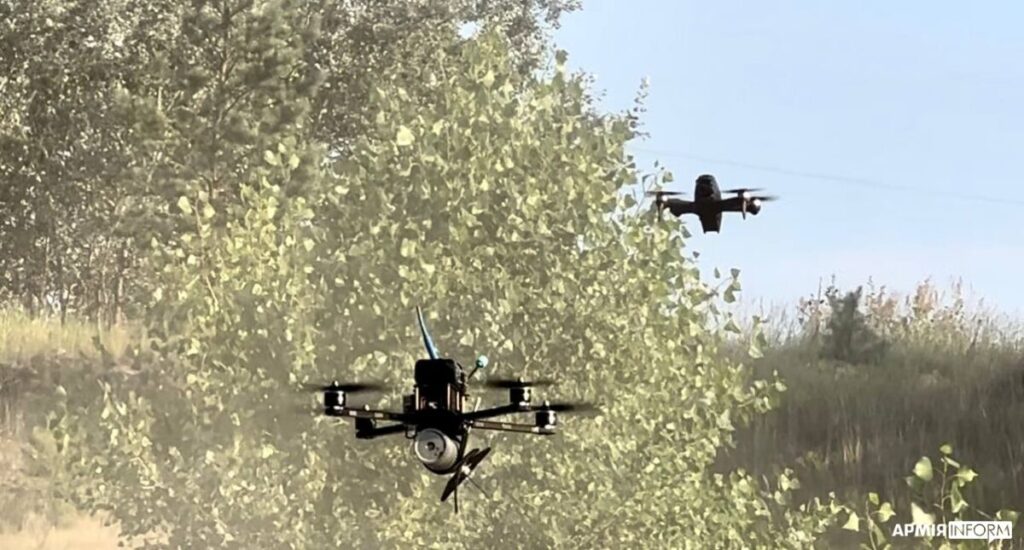
The Mexican newspaper Milenio, citing a Mexican intelligence document shared with the SBU, reported that members of the Jalisco and Sinaloa cartels traveled to Ukraine posing as humanitarian volunteers specifically to learn to fly first-person-view (FPV) drones — the cheap, fast, explosives-carrying quadcopters that have become the signature weapon of the war.
Ukraine’s SBU and military intelligence directorate opened a joint probe. According to a Heritage Foundation analysis, one recruit using the alias “Aguila-7” entered Ukraine in March 2024 on fraudulent Salvadoran papers and showed such skill in drone training near Lviv that instructors asked for an investigation — a review that pointed toward ties to Mexico’s GAFE air-mobile special forces, a unit whose former members have migrated into cartel ranks. The SBU formally opened its probe in the summer of 2025. Poland and Bulgaria have opened their own inquiries into the smuggling routes that moved the recruits.
French investigative outlet Intelligence Online first reported the infiltration, and the SBU says several cartel-linked volunteers entered the country on falsified documents, introduced through private military companies operating out of Latin America that bypassed standard Ukrainian vetting.
Why Washington is worried
The concern in the United States is not really about Ukraine — it is about what comes home.
An internal U.S. government assessment described to The Washington Post in September warned that explosive-drone skills flowing back from the Russia-Ukraine war are changing the fight against Latin American trafficking networks. Cartels are making what the assessment called “alarming” advances with explosive drones, complicating the administration’s campaign to stop narcotics entering the United States.
The pipeline already exists in outline. Cartel use of commercial quadcopters for explosive drops is already routine. A prosecutor’s office in Tijuana has been hit by nail-packed drones. Sightings along the U.S. border run into the tens of thousands — the airspace closure over El Paso in February was the public admission of a problem that had been building for years.
A single experienced drone operator returning from Ukraine can train dozens of pilots back home. The cheap FPV drone — often assembled for a few hundred dollars — is the great equalizer: a weapon a cartel foot soldier can learn in weeks and deploy against armored vehicles, rival gangs, or the state itself.
What is proven, and what is not
Honesty requires the caveats. The identities of the men in the videos have not been confirmed, and it is not known when the footage was shot. The confidential Mexican intelligence memo has not been made public, and investigators have not named charged suspects on the record. Sheinbaum herself framed her government’s review as a two-step question — authenticity first, explanation second.
But the pattern around the claim is well supported. Cartels already use drones and reward those who expand that edge. Ukraine’s war is the world’s laboratory for FPV warfare, producing trained operators at industrial scale. And the intelligence warnings — from Mexico City to Kyiv to Washington — describe the same pipeline independently. The idea that cartels would try to tap that laboratory is not far-fetched.
Why this matters
For three years, the war in Ukraine has been treated as a European tragedy with global ripple effects — grain prices, energy markets, refugee flows. This story suggests a different kind of ripple: the battlefield as a training ground whose graduates carry its lessons far beyond the front lines.
If even a fraction of the reporting holds, the cheapest weapon of the Ukraine war is being reverse-engineered by the most violent criminal organizations in the Western Hemisphere — and the drones over the U.S.-Mexico border are about to get much harder to stop.