Every summer, the Himalayas catch fire — and every year, the fires seem to come earlier, climb higher, and burn more. In 2026, the numbers told a grim story across the entire range: Uttarakhand recorded 476 forest-fire incidents affecting 402 hectares between mid-February and late May. Kashmir logged 366 incidents across a single year, damaging nearly 972 hectares — including 48 fires in the dead of winter, in months that were once considered fire-free. Himachal Pradesh and Jammu and Kashmir saw fire incidence jump by 1,339% and 2,822% respectively against earlier assessments. In Nepal, a single late-April outbreak scorched 17,411 hectares. In Arunachal Pradesh, in India’s far east, February fires burned at altitudes near 2,900 metres, forcing the Air Force to drop hundreds of thousands of litres of water from helicopters over five days.
Different countries, different states, one mountain range — and, scientists say, one common thread running through the flames: the chir pine.
The tree that fuels its own fires
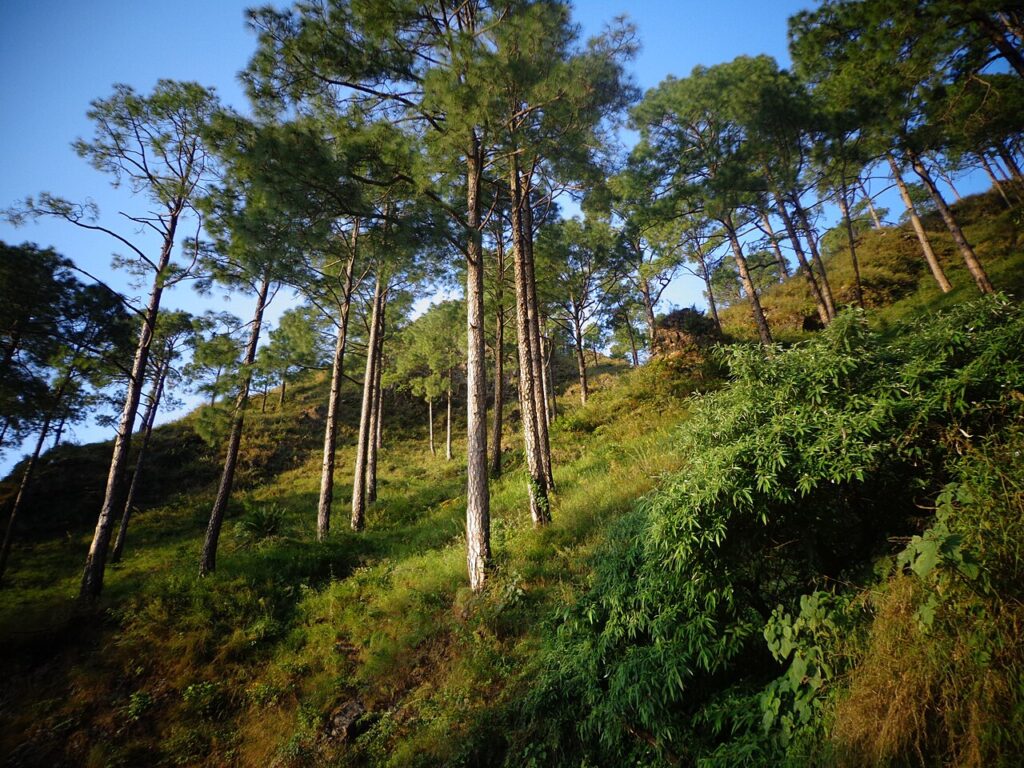
Chir pine (Pinus roxburghii) is native to the Himalayas, growing between 900 and 1,800 metres and reaching 30 to 50 metres tall. Every year it sheds masses of long needles — pirul, as mountain communities call them — that carpet the forest floor in a thick, resin-rich layer. In undisturbed stands, that litter can accumulate to 10 to 12 tonnes per hectare: an enormous reservoir of fuel just sitting on the ground.
Come the pre-monsoon months of April to June, when afternoon humidity drops below 20% and temperatures cross 35°C, the carpet turns lethal. A discarded cigarette, a roadside burn — one spark is enough. Researchers at India’s CSIR-IHBT found that chir pine forests account for nearly 57% of forest-fire incidents in the western Himalayas. More than half of all fires, in one tree’s domain.
The tree is, in a real sense, fire-adapted — it survives flames that kill its competitors, then colonises the cleared ground with wind-blown seeds. Frequent fire gives pine a competitive edge, and pine, in turn, guarantees frequent fire. It is a feedback loop written in resin.
How the monoculture happened
Nobody planted a conspiracy; they planted a cash crop. Chir pine regenerates fast, seeds early and prolifically, and spreads on the wind from ridge to valley. By 1980, organised chir pine plantation in the Himalayas already covered about 20,000 hectares — and it kept marching, encroaching on oak and broadleaf zones.
The economics were irresistible to forest departments. Chir pine yields timber, and its oleoresin is processed into turpentine oil and rosin for the paint and chemical industries. Oak, by contrast, brings the exchequer nothing — which is exactly why, as one classic account puts it, the quasi-commercial forest department “shut its eyes” to the replacement of oak by pine. The decision was made in account books, not in ecology textbooks.
What a single-species forest costs
A forest is not a timber farm, and the bill for treating it as one arrives in several currencies.
Biodiversity. Pine needles are acidic and form a mat that suppresses everything beneath — grasses, shrubs, seedlings. No fruit, no seed, no fodder: birds and mammals thin out. A peer-reviewed comparison in Nepal found planted pine stands had virtually no natural regeneration, frequent fires, and limited species diversity, while naturally regenerated mixed forests had minimal fire incidence, abundant regeneration, and far higher biodiversity.
Soil and water. The needle carpet absorbs almost nothing. Monsoon rain sheets off it, carrying soil with it, because there is no undergrowth to hold the slope. Oak forests do the opposite: falling banj oak leaves build a rich, spongy humus that drinks the monsoon and feeds springs downslope. Hydrologists call banj oak (Quercus leucotrichophora) the lifeline of the Himalayan ecosystem for its role in soil-moisture retention and groundwater recharge. Where pine replaced oak, springs have dried — a complaint heard across the hills.
Carbon and climate. Pine does sequester carbon quickly, which is often cited in its defence. But frequent fires release much of it back, and the net accumulation in pure pine stands runs lower than in pure oak forest. A fast-growing tree that burns every few years is a poor climate investment.
The alternative is already growing
The fix is not exotic. It is the forest that was there before: banj oak, wild olive (kahu), persimmon (amlok), and their broadleaf companions, growing in mixed stands — with chir pine as one member of the community, not its sole ruler. Mixed forests, the Nepal study found, also cost less to regenerate naturally.
Crucially, the argument was never “cut down the pine.” Chir pine belongs in the Himalayas; in mixed forest it has grown alongside other species for millennia. The problem is the monoculture — planting one fire-prone species, hectare after hectare, and calling the headcount a forest.
Why this matters beyond the Himalayas
The Himalayas are the water tower of Asia: the great rivers that sustain nearly two billion people begin in these forests. A forest that burns annually, sheds its soil every monsoon, and dries its own springs is not just a local tragedy — it is a slow-motion threat to the watershed of a continent. And the lesson travels: from Portugal to California to Australia, the plantation monoculture is the same gamble everywhere. The Himalayas are simply showing, in unusual clarity, what the house always wins.
Every plantation season will bring new photographs of saplings in rows. The question worth asking is not how many were planted, but what was planted — and whether anyone will still call it a forest when the next fire season comes.