Informopedia Explains: measles was nearly beaten — a cheap vaccine cut deaths 88% in a generation. Now it’s roaring back on every continent. Here’s the science of why.
The rash is the least of it. A child with measles runs a high fever, coughs, and develops the telltale red blotches — but the virus’s real trick happens invisibly, in the immune system, where it can erase years of the body’s defenses against other diseases. And right now, that virus is surging: Bangladesh is fighting the worst outbreak in its history, the United States is having its worst measles year in three decades, and health agencies count large outbreaks in 57 countries.
How did a disease with a safe, cheap, sixty-year-old vaccine come back? These are the questions that matter — and the answers scientists actually have.
How bad is the surge, really?
Bad enough that the World Health Organization is blunt about it. In 2024, an estimated 95,000 people died of measles — most of them unvaccinated or under-vaccinated children under five. In 2023, the toll was an estimated 10.3 million cases and 107,500 deaths. Those numbers sit against one of public health’s great victories: measles deaths have fallen 88% since 2000, and vaccination has prevented an estimated 59 million deaths in that span. Before the vaccine arrived in 1963, measles killed about 2.6 million people a year.
The current wave is global. Bangladesh has logged roughly 202,000 suspected cases since March — the most of any country this year — with more than a thousand dead, nearly all of them young children. The United States has recorded over 4,000 cases, its worst year since 1991, with five deaths in Pennsylvania. Fifty-seven countries reported large or disruptive outbreaks in 2025.
Why is measles so hard to stop?
Because it is one of the most contagious viruses known. Measles has a basic reproduction number — R0, the average number of people one case infects in a fully susceptible population — of 12 to 18, according to the US Centers for Disease Control and Prevention. For comparison, seasonal flu sits around 1 to 2. Roughly nine in ten exposed, non-immune people will catch it. The virus lingers in the air for up to two hours after an infected person leaves the room.
That contagiousness is exactly why the magic number is 95. The WHO, the Pan American Health Organization and the Measles and Rubella Partnership all say the same thing: communities need 95% coverage with two doses of vaccine to keep measles boxed in. Almost nowhere hits it. In 2025, about 84% of the world’s children received a first dose and 77% a second — and about 29 million infants were left under-protected, according to WHO and UNICEF estimates.
The gap is often not the first shot but the second. In the Americas in 2024, first-dose coverage reached 89% while second-dose coverage sat at 79% — and in 2026, nearly 80% of cases there with known vaccination status were in unvaccinated people. Many children show up once and never come back.
What does measles actually do to the body?
This is the part that changed how scientists think about the disease. Measles doesn’t just make you sick for a week — it can rob you of immunity you already had.
In 2019, researchers led by Michael Mina at Harvard Medical School published the first direct measurement of what they called immune amnesia. Using a tool called VirScan, which can read a person’s complete antibody history from a drop of blood, they compared 77 unvaccinated Dutch children before and after a 2013 measles outbreak. After measles, the children had lost between 11% and 73% of their pre-existing antibody repertoire — the immune memory of influenza, herpesviruses, pneumonia-causing bacteria and more. The median loss was 40% in severe cases. A control group of vaccinated children lost nothing.
“Imagine that your immunity against pathogens is like carrying around a book of photographs of criminals, and someone punched a bunch of holes in it,” Mina said. Rebuilding that memory takes months or years of re-exposure — during which children are vulnerable to infections they had already beaten once. The WHO’s own fact sheet now states it plainly: measles weakens the immune system and can make the body “forget” how to protect itself.
The acute illness is dangerous enough on its own: pneumonia, brain swelling (encephalitis), blindness, severe diarrhea, and particular danger for pregnant women and malnourished children. But immune amnesia explains a mystery epidemiologists had noticed for years — that childhood deaths from other infections stay elevated for two to three years after a measles outbreak. Mina’s earlier 2015 research had already linked measles to that long shadow of mortality. The 2019 study found the mechanism.
If the vaccine works so well, why did coverage collapse?
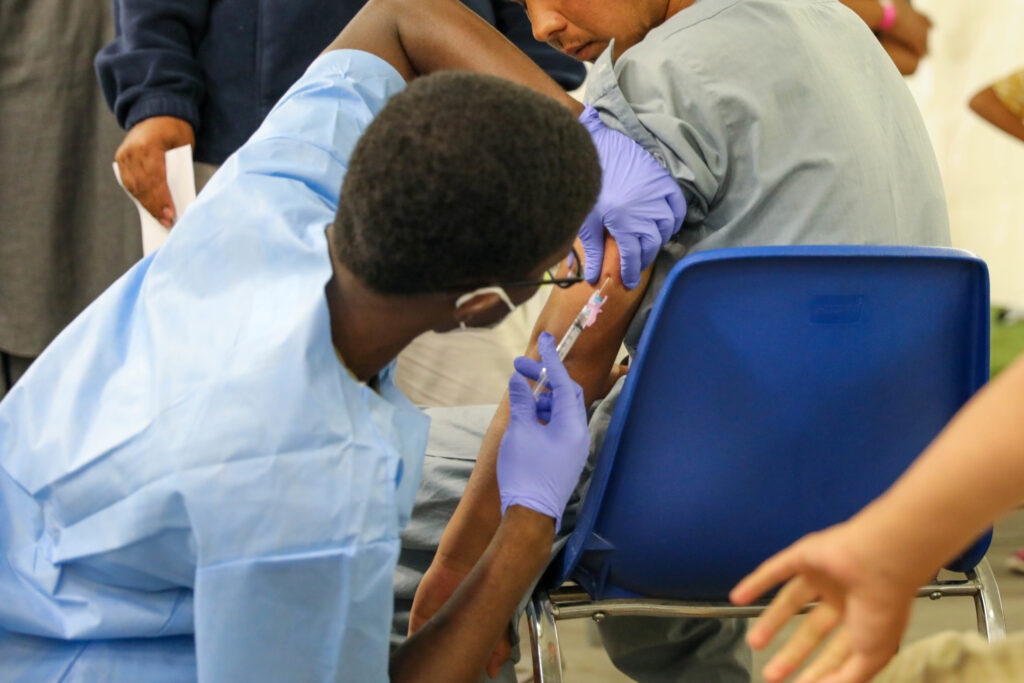
The vaccine does work: two doses of the MMR shot are about 97% effective, it has been in use for roughly sixty years, and a dose costs less than a dollar per child. The collapse is not a science problem. It’s a systems problem — with several interlocking causes.
First, the pandemic hangover. COVID-19 disrupted routine immunization worldwide, and coverage never fully recovered: 84% first-dose coverage in 2025 is still below the 86% of 2019, and an estimated 13.5 million infants missed every routine vaccine last year. About 7.3 million children started their vaccine schedule but dropped out before their first measles dose.
Second, hesitancy. False claims linking the MMR vaccine to autism — thoroughly debunked, but persistent for decades — hardened into organized refusal in many communities, including wealthy ones. Clinicians in countries that had nearly eliminated measles went years without seeing a case, and complacency set in.
Third, political and logistical breakdown. Bangladesh’s catastrophe is the textbook case: after the 2024 uprising that ended 15 years of rule by Prime Minister Sheikh Hasina, the health system fractured — workers struck, vaccine procurement changed under the interim government, a 2024 campaign was postponed and a 2025 nationwide measles campaign cancelled. Coverage slipped, the data systems that track which children are missed went stale, and the virus walked through the gap. A Reuters review found the country’s emergency response was hampered by records that left millions of children invisible.
Why do outbreaks hit countries that vaccinate?
Because national averages lie. A country can report 90% coverage while whole neighborhoods sit at 60% — religious communities, remote villages, migrant populations, districts where the health post closed. Measles finds the pockets. In the US this year, 95% of patients were unvaccinated or of unknown status, and 18 cases were linked to international visitors: in a globalized world, one imported case can seed an outbreak in a susceptible pocket within days.
There’s also a subtler leak: a small fraction of vaccinated people — an estimated 2 to 10% — can lose protection 6 to 26 years after their last dose, a phenomenon researchers call secondary vaccine failure. It’s rare, and these cases transmit less readily, but it means even well-vaccinated populations aren’t hermetically sealed. That’s why elimination, not just control, was always the goal — and why the WHO’s advisory group now says measles elimination is under threat.
What does fixing it actually cost?
Far less than not fixing it. Mark Jit, a WHO vaccine adviser at New York University, put it plainly during the Bangladesh crisis: “Preventing an outbreak through vaccinations was easier, cheaper and safer than responding to an emergency.” Emergency campaigns — the cold chains, the health workers, the hospital beds for the severely ill — cost multiples of routine delivery. Bangladesh has vaccinated nearly 20 million children in emergency drives since April and still has immunity gaps.
What happens next
The trajectory is still climbing, and respiratory virus season is just beginning. The tools are all known — catch-up campaigns for the 29 million under-protected infants, second-dose follow-through, better data systems so no child’s record goes missing, and honest public communication about a vaccine with a sixty-year safety record.
None of that is exotic science. It is plumbing: the unglamorous work of getting two cheap doses into every child, twice. Measles is, in a real sense, the canary in the health system’s coal mine — the first disease to surge when the system falters, because it is the most contagious and therefore the least forgiving. Kenya’s first Ebola cases and the WHO’s campaign against lead poisoning are different crises, but they rhyme: public health is won in the unglamorous middle, between the breakthrough and the last mile.
The encouraging precedent is the one already on the books: 59 million deaths prevented since 2000, an 88% fall. The discouraging one is Bangladesh, where a world-class vaccination program unraveled in two years of turmoil. Measles doesn’t care about the reason coverage fell. It only counts the susceptible — and it is very, very good at counting.