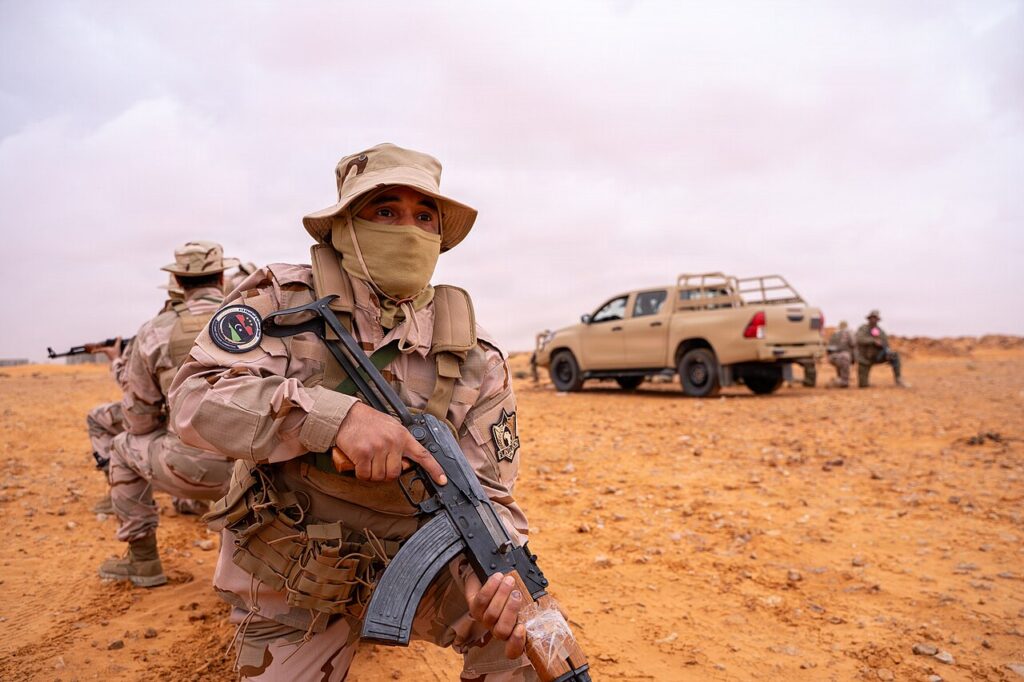
At least five soldiers are dead after a mortar shell exploded during a training exercise at a military camp in the western Libyan city of Zawiya on Sunday evening. A Chinese state news agency reporting from the scene puts the toll even higher: at least eight killed and eight more injured.
The blast ripped through the Security Threats Camp in the Al-Harsha area of Zawiya, a coastal city roughly 60 kilometres west of the capital, Tripoli. According to a security source cited by Libya Review, troops were conducting training exercises inside the camp when the shell detonated. The source said the dead were all soldiers and identified three of the five by name: Abdulrahman Al-Farrakh, Mohamed Al-Osta and Moataz Al-Ashkham.
Several other soldiers were injured, but their number and the severity of their wounds were not immediately clear. The explosion happened on Sunday evening local time; by Monday morning, no official statement had been issued about the incident, the exact number of casualties, or the condition of the wounded.
Death toll in dispute
There are two conflicting accounts of how many died. Libya Review’s security source puts the toll at five soldiers, all killed during the training exercise. Xinhua, citing local media, reported at least eight people dead and eight injured in the Al-Harsha area on Sunday evening.
Neither account has been independently confirmed, and no authority has spoken on the record. One detail that has surfaced: a local hospital put out an appeal for blood donors in the aftermath, a sign of the pressure on medical services in a country where hospitals are often already stretched thin.
What caused the blast is unknown
It is not yet established what made the mortar shell detonate. The Libya Review report describes it as exploding during a training exercise, which raises the possibility of a fatal accident — training deaths from live ordnance are not uncommon in militaries worldwide. But there has been no official word ruling out foul play either, and in Zawiya, where armed groups have a long and violent history, that distinction matters.
For now, the circumstances remain genuinely unclear, and anyone claiming to know more than that is getting ahead of the facts.
Zawiya: a city where rival gunmen decide politics
To understand why even an apparently accidental blast lands differently here, it helps to know Zawiya. Libya has been split between rival governments in the east and west since the 2011 uprising that toppled Muammar Gaddafi, and the real power in much of the country belongs to armed groups that answer to neither government.
Zawiya, home to one of Libya’s two most important oil refineries, is contested ground. In August, six drone strikes in five days hit fuel tanks, a blending plant, a desalination plant and a substation around the city, according to The National. No one was killed and no group claimed responsibility, but the attacks were aimed squarely at the city’s infrastructure — the refinery that keeps Libya’s economy running.
The fighting there pits two local forces against each other, both nominally affiliated with the government in Tripoli: the forces of Mohamed Bahroun on one side, and a rival militia on the other. Just last week, on October 14, the UN envoy for Libya, Hanna Serwaa Tetteh, told the Security Council that attacks on infrastructure may constitute grounds for punitive measures under Council resolutions, and the US delegate urged sanctions on anyone obstructing progress toward elections.
Why this matters
On its own, a training accident that kills five to eight soldiers might not make world headlines. But Libya is a country where the line between an accident and an attack is hard to draw, and where every death at a military camp feeds suspicion that a rivalry is turning violent again.
The timing compounds the worry. The UN is trying — and failing — to broker an election deal that could finally reunite the country. Armed groups in Zawiya have shown they can hold the country’s fuel supply hostage. And an incident like this, at a camp used by security forces, will be read by every faction in the city as either a sign of dangerous incompetence or of something more deliberate. Until investigators speak, neither reading can be ruled out — and in a city armed to the teeth, that uncertainty is itself a risk.