Key takeaways
- A team led by the University of Warwick has discovered the first planet ever found orbiting a white dwarf — the leftover core of a dead star.
- The gas giant, slightly heavier than Jupiter, appears to have been born from material its star shed while dying, making it a rare “second-generation” planet.
- Its chemistry — unusually rich in niobium, copper and zinc — matches the debris of a dying star, and its atmosphere is now evaporating into the white dwarf’s glare.
- The find, published in Nature Astronomy, hints that planets can be born again from a star’s ashes — and that our own sun’s death might not be the end of the story.
Planets were supposed to die with their stars. When a sun-like star reaches the end of its life, it swells into a red giant, swallowing or incinerating anything orbiting too close, then sheds its outer layers into space and collapses into a white dwarf — a dense stellar ember. Nothing about that process sounded like a birth.
This week, a team of astronomers led by the University of Warwick reported that it can be. In a study published in Nature Astronomy, they describe a giant planet orbiting a white dwarf about 250 light-years from Earth, toward the constellation Cetus — and the evidence suggests the world formed out of the star’s own death debris.
Lead author Jamie Williams, a doctoral student in astrophysics at Warwick, called it the first example of a planet forming around a white dwarf. It is classified as a second-generation planet: unlike Earth and every other first-generation world, it did not condense from the disk of gas and dust swirling around a newborn star. It was assembled from the leftovers of a doomed one.
The giveaway is in the chemistry. The planet’s atmosphere is rich in niobium, copper and zinc — exactly the elements certain dying stars cast off as they expand in their death throes. That pattern indicates the planet grew inside a disk of expelled material surrounding the stellar corpse, after the original planetary system had already been destroyed.
What survives of the old system is just the core. The white dwarf, catalogued as HS 0209+0832, is all that remains of a star a bit bigger than our sun. Any planets it once had were most likely ruined when it ballooned into a red giant and ejected its outer layers. Then, somehow, a new world coalesced from the wreckage.
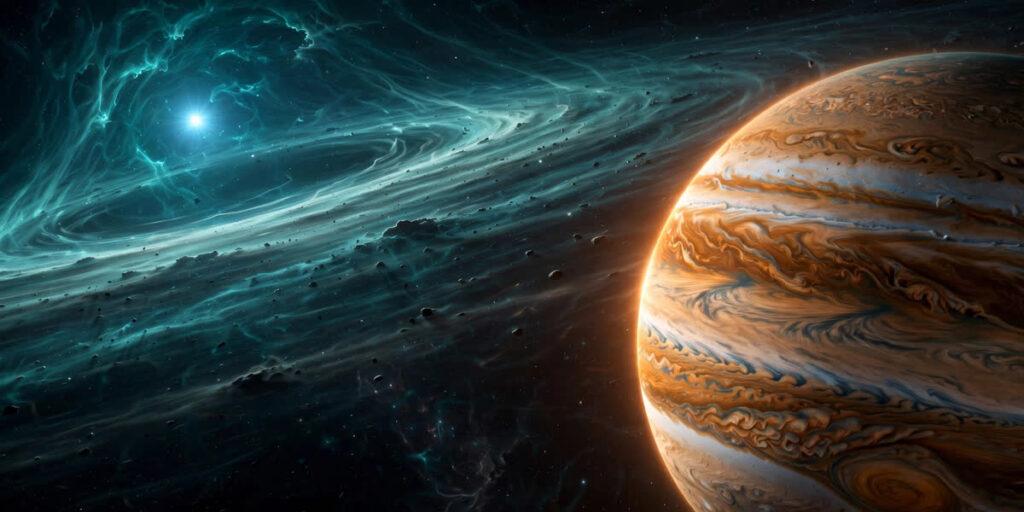
That new world is a gas giant perhaps slightly more massive than Jupiter, circling the white dwarf every 4.4 days at just 4 percent of the distance between Earth and the sun. The proximity is brutal: the blazingly hot white dwarf’s extreme ultraviolet radiation is boiling the planet’s outer atmosphere away, with a portion of it raining back down into the star.
Similar “reborn” worlds had only been suspected around pulsars — a far rarer kind of stellar remnant. Finding one around a white dwarf, the far more common fate of sun-like stars, suggests second-generation planets may be out there in real numbers.
Why this matters goes beyond one strange system. The standard story of planetary science has been a single arc: stars form, planets form with them, and when the star dies, the planets die too. This discovery adds a second arc — that a star’s death can seed a new generation of worlds from its own debris. It also gives astronomers a natural laboratory: the planet’s evaporating atmosphere is being sampled, atom by atom, by the white dwarf it orbits, letting scientists read off the chemistry of a reborn world directly. And there is a longer view, too. In about five billion years, our sun will die the same way — and this find raises the real possibility that new planets could form in the solar system’s ruins.
Death, it turns out, can be a beginning. Astronomers just watched one happen.