Spain’s transport minister, Óscar Puente, resigned on Tuesday, six days after a high-speed train collision near the town of Urda killed 69 people — the second deadly rail disaster on his watch in less than a year.
Puente announced his decision at the end of a marathon appearance before Congress’s Permanent Deputation, the standing committee that acts while parliament is dissolved. He had spent hours defending his handling of the disaster and outlining emergency aid for victims, then closed by saying he would go.
“A transport minister in a country like Spain cannot remain in office after two accidents of this seriousness in less than a year,” he told lawmakers, adding that he bore the decision himself whether or not he was directly responsible. He said he had made up his mind within minutes of learning of the crash, but stayed on until the emergency response was under way, the first investigations had begun and compensation measures were in place.
He also withdrew from the electoral list of the Spanish Socialist Workers’ Party (PSOE), Prime Minister Pedro Sánchez’s party, for Valladolid, meaning he will not stand in the snap election on November 29.
The resignation was a sharp reversal. Hours earlier, sources close to Sánchez had told reporters Puente would neither resign nor be dismissed, and would remain the party’s candidate in Valladolid. Days earlier, Sánchez himself had rejected the minister’s departure as unfair, saying there was no evidence of political responsibility. Puente, too, had insisted he had no intention of quitting.
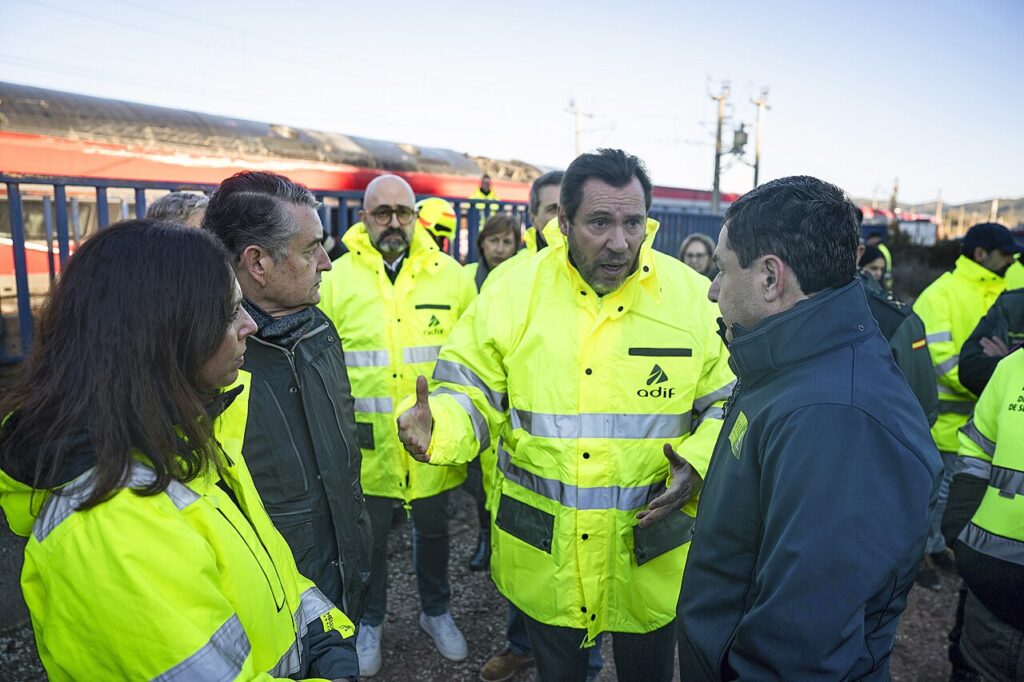
The disaster that ended his tenure happened on October 28, when a state-owned Renfe high-speed train ran into the back of a stationary private Iryo service near Urda, in Toledo province, about 130 kilometres south of Madrid. The crash was on the Madrid–Seville high-speed line, one of Spain’s busiest. Investigators say the Renfe train’s automatic safety system, known as LZB, had failed, halting traffic along the line, and that controllers in Madrid then took manual control and authorised the train to proceed despite a red signal. It struck the stationary train at an estimated 160 to 200 kilometres per hour.
All 69 people killed have now been identified: 54 Spanish citizens and 15 foreign nationals, among them four Americans, two Australians and two Japanese. More than 200 people were injured. The Renfe train was carrying 397 passengers; the Iryo train, 147.
The Urda crash came nine months after the first disaster of Puente’s tenure, at Adamuz in Córdoba, where an Iryo train derailed in January and collided with an oncoming Renfe service, killing 46 people and injuring 292. Both crashes happened on the same Madrid–Seville line and involved the same two operators. Together they have killed 115 people in a single year.
On Tuesday the government also announced a 30-million-euro aid package for the Urda victims and their families, including advance compensation payments and higher compulsory passenger insurance. Services on the Madrid–Seville line will run at reduced frequency until the Railway Safety Agency reviews the line’s safety system and the long-delayed European Rail Traffic Management System is rolled out.
The timing could hardly be worse for Sánchez. With the election less than four weeks away, the campaign is now dominated by questions about railway safety and ministerial accountability, and the opposition — which had demanded Puente’s resignation for days — will present his departure as a confession that the system failed. The deeper questions, though, are still unanswered: how a train was cleared to move at full speed past a red signal, and whether a network carrying far more trains since liberalisation in 2021 has outgrown the safety systems meant to protect it. Those answers will now fall to Puente’s successor — and to voters.