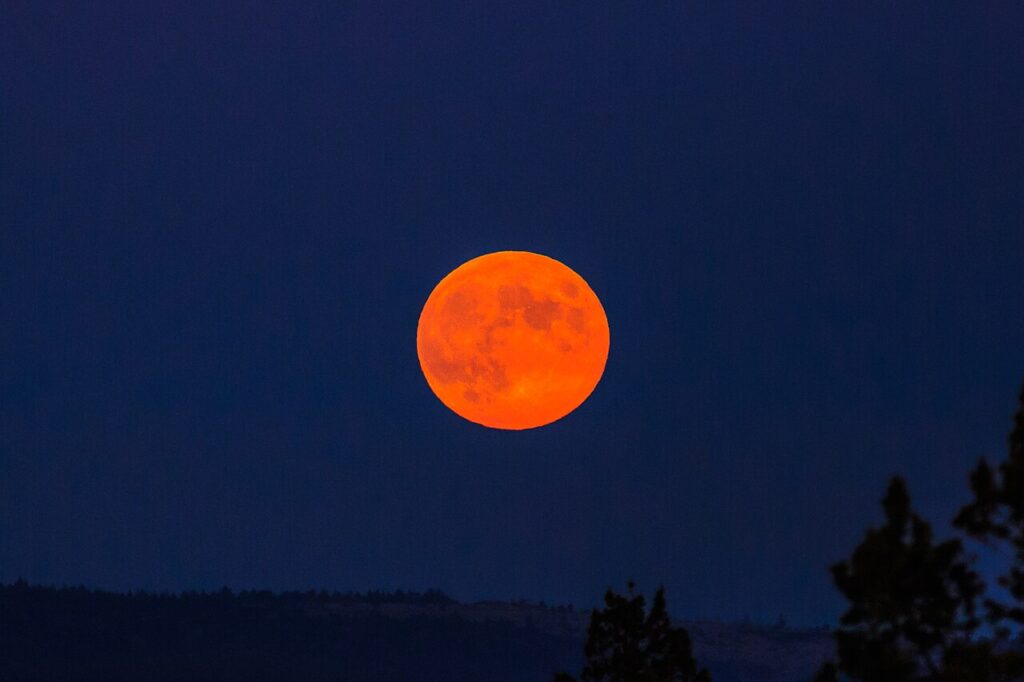
Informopedia Explains: you have seen it yourself. A full Moon climbs over the rooftops at dusk, fat and orange and impossibly large, and by the time it is high in the sky a few hours later it has shrunk to a small white coin. Everyone has watched it happen. And it is not real.
Measure the Moon at the horizon and again overhead, and it is the same size both times — in fact, slightly smaller at the horizon. Hold a pebble 8.4 millimetres wide at arm’s length and it will cover the full Moon wherever the Moon happens to be. Photograph it in both positions and the disc is identical. Your eyes are lying to you, and they have been lying to everyone for at least 2,300 years. The strange part is that after all that time, nobody can agree on why.
First, what is definitely not happening
The most popular explanation is also the most wrong: that the atmosphere acts like a lens and magnifies the Moon near the horizon. It does nothing of the sort. Air near the horizon does bend moonlight — a phenomenon called refraction — but the bending lifts the Moon’s lower edge more than its upper edge. The result is that the rising Moon is squashed, about 16% shorter than it is wide, like a slightly flattened oval. Every optical effect the atmosphere has on the Moon makes it smaller, not bigger.
The atmosphere does change the Moon’s colour, which is why the horizon Moon looks orange or red. That is the same scattering that makes the sky blue in the daytime: near the horizon, moonlight passes through far more air, and the blue light is scattered away, leaving the reds and oranges. Colour, yes. Size, no.
Nor is the Moon physically closer at the horizon. Geometry runs the other way. When the Moon is overhead, you are standing on the side of the Earth facing it, one Earth radius — 6,378 kilometres — closer than the planet’s centre. At the horizon, you are no closer than the centre is. The horizon Moon is about 1.5% farther away, and about 1.7% narrower. The difference is far too small to see, but it points in the wrong direction for anyone who thinks the Moon is genuinely bigger low in the sky.
The sky is flat — inside your head
So the trick is in the brain, not the sky. The question is which part of the brain’s size calculation goes wrong, and that is where 2,300 years of argument begins.
Aristotle noticed the illusion in the fourth century BCE and blamed mist. Ptolemy tried to explain it twice, around 150 AD. A cuneiform tablet from Nineveh, dated to the seventh century BCE, records it. The most enduring explanation came from the Arab scientist Ibn al-Haytham, around a thousand years ago: the apparent distance theory.
His idea was that we judge the sky as a flattened dome — closer overhead than at the horizon, like an upturned bowl. Trees, buildings and hills at the horizon give the brain a sense of vast distance, so it places the horizon Moon much farther away than the overhead Moon. And here is the brain’s faulty logic: if two objects make the same-sized image on your retina, but one is farther away, it must be physically bigger. So the horizon Moon looks enormous. It is the same logic that makes a distant building look bigger than a nearby one of the same apparent size — except that with the Moon, the distance is invented.
Pilots report seeing the illusion from the air, where there are no trees or buildings at the horizon at all, which supports the flattened-sky idea: the shape of the perceived sky itself, not the landscape, does the work.
The other suspects
The Ponzo illusion is the strongest rival. Draw two identical horizontal lines between two converging lines, like railway tracks vanishing into the distance, and the upper line looks longer. Your brain reads the converging lines as depth, decides the upper line is farther away, and inflates it. The horizon Moon sits at the far end of a similar set of converging cues — the ground, the landscape, the sky itself — and the brain does the same arithmetic.
Then there is the Ebbinghaus illusion: a circle surrounded by small circles looks bigger than the same circle surrounded by large ones. At the horizon, the Moon sits beside trees and houses — small things — and looks huge by comparison. Overhead, it floats in empty sky with nothing to compare it to, and shrinks.
Experiments in the 1950s and 1960s by psychologists Irvin Rock and Lloyd Kaufman showed that people perceive the horizon Moon as much larger — sometimes as much as three times bigger — than the Moon overhead. The size of the effect varies a lot from person to person and night to night, which is part of why the argument has never been settled.
Why nobody can agree
In 2002, psychologists Helen Ross and Cornelis Plug reviewed the whole history of the problem and concluded: “No single theory has emerged victorious.” A 2013 book, The Moon Illusion, gathered 19 chapters by different researchers reaching different conclusions. The typical illusion is an apparent increase in diameter of about 50% — but nobody can say for certain whether the brain is inflating the Moon’s perceived angular size, its perceived physical size, or both.
Part of the difficulty is that the illusion is genuinely hard to study. It depends on context — the landscape, the sky, the observer’s expectations — and it changes when you change any of them. Look at the horizon Moon through a cardboard tube, cutting out the landscape, and it shrinks back to normal size. Turn upside down and look at it between your legs, and the illusion weakens. Your brain needs the scene to do its faulty maths; take the scene away and the maths stops.
Why it matters
The Moon illusion is not really about the Moon. It is about the fact that seeing is not measuring. Your visual system does not report the world as it is; it builds a model of the world from incomplete information, fills in the gaps with assumptions, and presents the result as reality. Most of the time the assumptions are right, which is why you can catch a ball and cross a road. Sometimes they are wrong, and you see a Moon three times bigger than the one that is actually there.
That is worth knowing, because the same machinery runs everything else you see. The Moon is the oldest known case of the brain getting size wrong, and it is still unsolved — a reminder that the most familiar sights in the sky can hide the deepest questions about how we perceive anything at all.
Next time a full Moon rises, try the pebble test. Hold something small at arm’s length and watch it cover the enormous Moon at the horizon. Then wait for the Moon to climb, and cover it again. Same pebble, same Moon, same size. The only thing that changed was inside your head. And if you want another case of your senses playing tricks on you, the reason you see lightning before you hear thunder is a good place to start — that one, at least, has an answer.