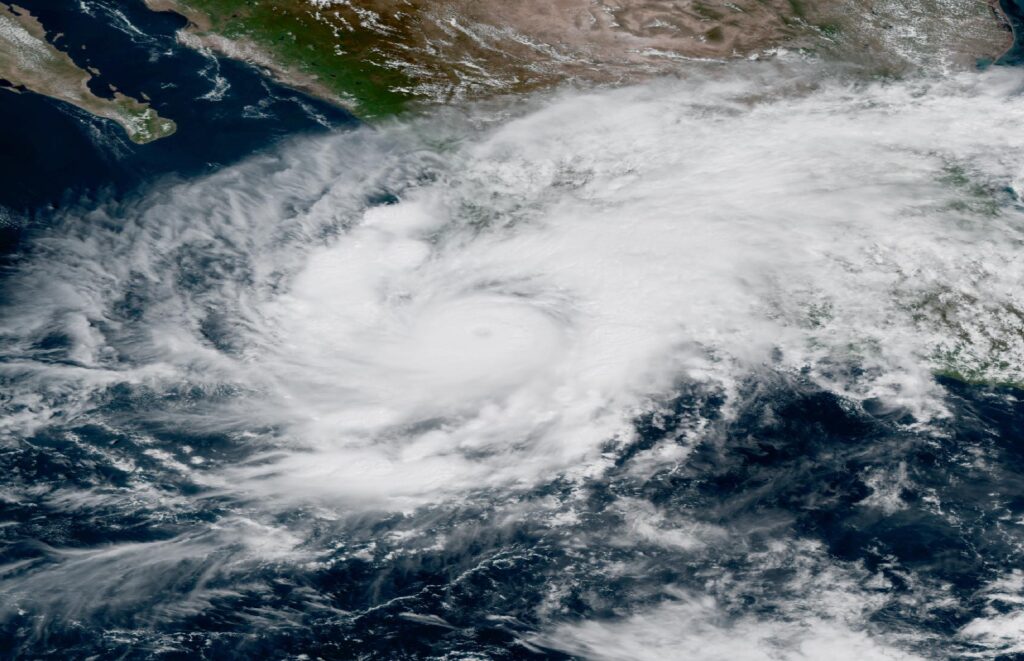
Hurricane Simon has weakened to a Category 2 storm, but Mexico’s Pacific coast is getting no relief. The hurricane’s eye stayed just offshore on Monday as its most powerful winds and rain hammered the communities squeezed between the Sierra Madre mountains and the sea — and forecasters say the worst may not be over. The National Hurricane Center expects Simon to remain a hurricane through the middle of the week, possibly strengthening again on Tuesday and Wednesday, before turning northeast and making landfall near Sinaloa on Thursday.
It is a remarkable comedown — and still a dangerous storm. Just two days ago, Simon was a Category 4 monster. On Saturday it exploded from a tropical storm into a major hurricane, its winds peaking at 155 mph (250 km/h) with a central pressure of 928 millibars, making it the ninth major hurricane of an extremely active 2026 Pacific season. The NHC had urged residents to rush preparations to completion, warning of “catastrophic damage” — roofs torn off well-built homes, trees snapped, power poles flattened, outages lasting weeks. By Sunday, maximum sustained winds had eased to around 120 mph as the center swirled parallel to the coast, closing in on the Puerto Vallarta area.
The human toll is already mounting. At least two people are dead and ten missing in Mexico in severe weather linked to Simon and Tropical Storm Rachel, which struck Baja California over the weekend. In Chilpancingo, the capital of Guerrero state, a 71-year-old man was killed when a wall collapsed, Governor Evelyn Salgado said. In Baja California, at least ten people were reported missing and a young girl died in the aftermath of Rachel, according to Governor Marina del Pilar, with more than 50 people in temporary shelters. Earlier, Simon’s rains had already flooded Acapulco — one person killed, two injured and 112 homes damaged, per the UN’s humanitarian office — downing 150 power poles and knocking out electricity for nearly 66,000 customers in Guerrero.
Mexico has responded with one of its largest civil protection operations of the season. Twenty-eight municipalities across Jalisco and Colima are on the highest cyclone alert level, with another 93 on high alert. About 5,000 people have evacuated in Jalisco and Colima combined; the Navy ferried around 100 families from the coastal villages of Yelapa and Quimixto to Puerto Vallarta. Puerto Vallarta’s international airport stayed shut through Monday morning, ports at Manzanillo, San Blas, Lázaro Cárdenas and Puerto Vallarta are closed to all navigation, and President Claudia Sheinbaum urged coastal residents in Jalisco, Colima, Nayarit and Michoacán to stay indoors. “If we let our guard down and try to come up with a last-minute action plan, it is highly likely that lives will be lost,” said Sergio Ramírez, Jalisco’s civil protection director.
Wind, though, is only half the story. Simon is moving slowly — at times barely 5 mph — which means its rain bands keep dumping on the same places. The NHC warns of storm totals up to 30 inches (76 cm) in parts of Michoacán, Colima and Jalisco, with “life-threatening flooding and mudslides, especially in areas of steep terrain.” In Manzanillo, soldiers waded through flooded streets on Sunday helping families out of inundated homes. “Everything got flooded,” said resident Maria Elena Vazquez, standing in ankle-deep water inside her house with her pants rolled up. In Acapulco, rising water in the Sabana River undermined a two-story house in the Ciudad Renacimiento neighborhood until it collapsed, putting neighboring homes at immediate risk; some 500 National Guard personnel are clearing debris and mud across the city.
Simon is not alone. Rachel’s remnants caused severe flooding in Las Vegas over the weekend — the city broke its daily October rainfall record — prompting flood watches across the American Southwest on Monday. And Mexico’s Pacific has been under siege for days: Hurricane Polo struck Baja California as a Category 2 earlier in the month, and just last week Hurricane Isaias came ashore in Florida, killing two and knocking out power for 800,000 after it had borne down on the Panhandle as a Category 3. Forecasters link the Pacific’s hyperactivity to a strengthening El Niño, which is weakening the wind shear that normally tears storms apart.
That matters for what comes next. Simon’s forecast turn toward Sinaloa puts one of Mexico’s most productive agricultural states in the path of a storm that has already shown how fast it can intensify — and Acapulco, still scarred by Hurricane Otis in 2023, knows better than most what a slow-moving storm can do to hillside neighborhoods. For the fishing towns between the Sierra Madre and the sea, the next 48 hours will decide whether Simon is remembered as a scare or a disaster.



One Comment