Informopedia Explains: right now, as you read this, roughly a hundred trillion ghost particles are streaming through your body. Here is why physicists spent four decades trying to catch just a few of them — and why one finally earned a Nobel Prize this month.
In 1988, a Belgian-born physicist named Francis Halzen stood up at a conference and proposed something that sounded faintly unhinged: bury thousands of light detectors in the ice at the South Pole, and wait for a signal from the universe.
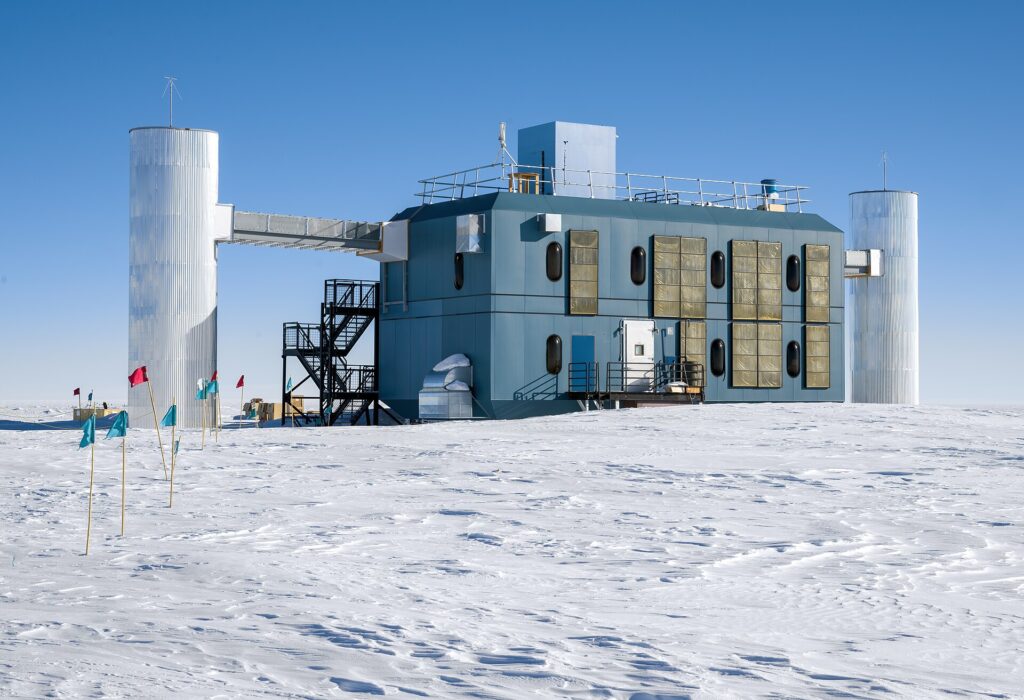
This month, at 82, Halzen won this month’s Nobel Prize in Physics for being right. His idea became IceCube — a cubic kilometer of Antarctic ice wired up as the largest telescope ever built. It does not look at light. It looks at ghosts.
The most antisocial particle in nature
Neutrinos are subatomic particles with almost no mass and no electric charge. They are born in staggering quantities — in the nuclear furnaces of stars, in supernova explosions, in the violent disks around black holes — and then they simply leave. Because they barely interact with matter, they pass through everything: stars, planets, lead walls, you.
The famous figure: every second, about 65 trillion neutrinos from the Sun pass through every square centimeter of your body. You feel nothing. A detector the size of a house feels nothing either. For every trillion neutrinos that cross the Earth, only a handful will ever collide with anything at all.
This is why physicists call them ghost particles. And it is why they are so valuable. Light from the universe’s most violent events gets blocked, bent or absorbed on its way to us. Neutrinos travel in dead-straight lines from their birthplaces, carrying information nothing else can — “messengers bring information from the cosmos,” as the Royal Swedish Academy of Sciences put it. “They open the door to distant galaxies and tell us about the processes of exploding stars.”
How you catch something that doesn’t want to be caught
You don’t, mostly. You catch its shadow.
IceCube does not detect neutrinos directly. Instead, on the rare occasion a neutrino collides with an atomic nucleus inside the Antarctic ice, it produces a secondary charged particle — often a muon. That particle races through the ice faster than light travels through ice, and just like a jet breaking the sound barrier, it produces a shock wave: a cone of faint blue light called Cherenkov radiation.
That flash is what IceCube sees. Spread through the ice are 5,160 digital optical modules — basketball-sized sensors — hanging on 86 strings sunk 1,450 to 2,450 meters deep. When one of them blinks, physicists compare which sensors lit up and in what sequence, down to nanosecond precision, and reconstruct the neutrino’s energy and the direction it came from. From that, they can point back across the sky to its source.
The ice itself is the secret ingredient. At that depth it is extraordinarily clear — no air bubbles, no dirt, no dust — so a faint blue flash can travel hundreds of meters before being absorbed. A cubic kilometer of it, sitting in total darkness under the South Pole, is the cleanest optical medium nature ever made.
Why it took forty years
Halzen’s proposal was mocked, then tolerated, then funded in stages. A smaller prototype called AMANDA proved the concept. IceCube itself was completed in 2011 — decades after the idea was born — and the payoff came fast.
In 2013, IceCube researchers announced the first strong evidence that some of the very-high-energy neutrinos they were catching came from beyond the solar system. Two of the earliest events were nicknamed Bert and Ernie, after the Sesame Street characters — a joke, but also a sign that the team knew something historic had happened. The universe had a new kind of messenger.
Then in 2018 came the smoking gun: a neutrino whose trail pointed back to a blazar called TXS 0506+056, nearly four billion light-years away. For the first time, physicists could say a specific cosmic object had produced a specific neutrino. Neutrino astronomy was born — a way of studying the universe that doesn’t depend on light at all, alongside gravitational-wave astronomy as the newest window on the cosmos.
Why this matters
The Nobel citation honored Halzen’s “decisive contributions” to IceCube and the discovery of high-energy neutrinos of astrophysical origin — and notably, he won it alone, the first sole physics laureate since Georges Charpak in 1992, even though more than 450 scientists from 58 institutions in 14 countries built and run the detector. That tells you how the committee views vision: the instrument exists because one person refused to stop arguing for it for four decades.
The practical payoff is still ahead. Neutrinos can reveal the engines of gamma-ray bursts, the interiors of supernovae, the particle accelerators around black holes — places light cannot escape from. A bigger IceCube is already being planned.
And there is a quieter lesson in it. Some of the most important instruments in science look ridiculous on paper: a telescope made of ice, in the middle of nowhere, waiting for flashes almost no one will ever see. The universe talks in whispers. Halzen’s achievement was building a machine patient enough to listen — and the persistence to spend a career arguing that we should.
A hundred trillion neutrinos will pass through you while you read this sentence. Thanks to a kilometer of ice at the bottom of the world, we are finally starting to hear what they are saying. Meanwhile, astronomers finding planets reborn around dead stars remind us how much of the cosmos still waits to be explained.