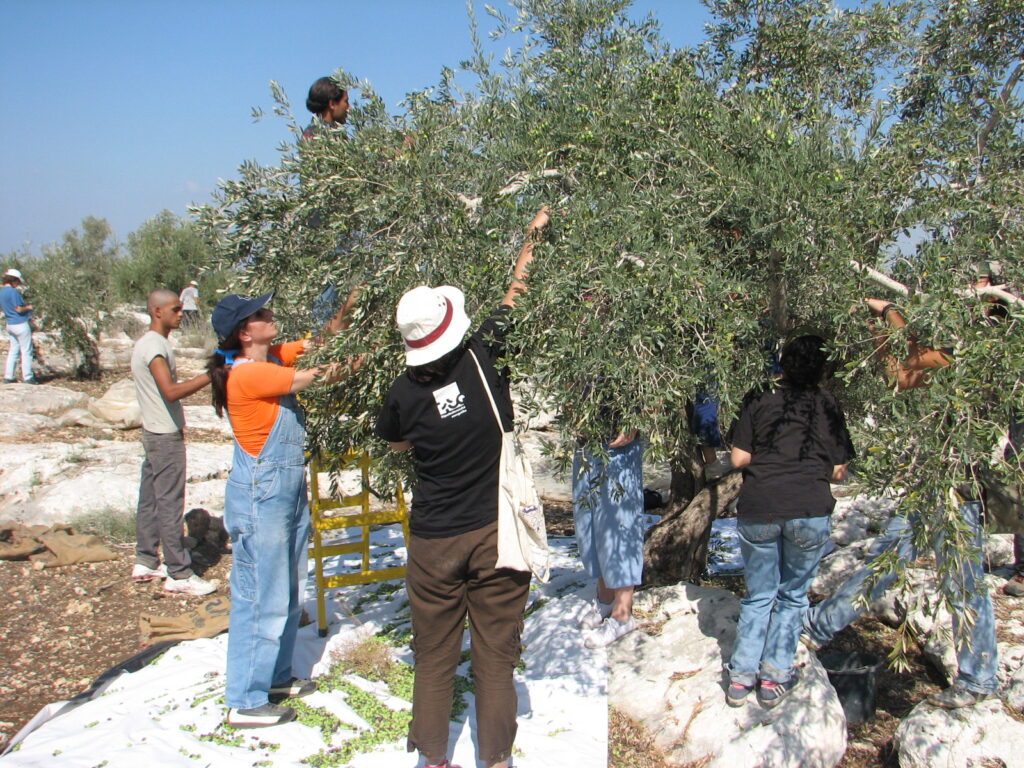
A Washington Post photojournalist is in a Ramallah hospital on Friday after dozens of masked Israeli settlers beat her, kicked her repeatedly and stole her cameras while she was photographing Palestinian villagers harvesting olives in the occupied West Bank. Heidi Levine, a 63-year-old American veteran of conflict reporting, was wearing a helmet and a protective vest clearly marked “PRESS” when the attack began near the village of Abu Falah.
It was the first full day of the olive harvest season. Villagers from Abu Falah, in the central West Bank, had gathered in a terraced olive grove to pick the season’s fruit when, according to Reuters witnesses, some 80 masked men descended from a nearby settlement — some carrying gas canisters — set fire to shrubs and olive trees, and launched rocks at the harvesters with slingshots. Villagers threw stones back in self-defence.
Levine was documenting the clashes when the settlers turned on her. Video recorded by fellow journalists shows at least three masked men surrounding her on a dirt path, beating her as she lies on her side with her hands over her face. She was pushed to the ground, kicked for what she estimates was about 10 minutes, and struck with sticks and clubs. Her cameras, her phone and the bag holding her passport were ripped off her and stolen or destroyed.
“Luckily I had [on] my flak jacket and helmet, otherwise I probably wouldn’t even be here, because they just kept kicking me and kicking me,” she told reporters from her hospital bed, where she was being treated for injuries to her hand, back and legs that will require stitches.
Levine is no stranger to danger. She has spent decades covering conflict across the Middle East — Israel, Gaza and the West Bank — as well as Afghanistan, Kosovo, Iraq, Lebanon, Libya and Syria. In 2022 she went to Ukraine on assignment for the Post, where she photographed the aftermath of the Bucha massacre. She was covering the Gaza war as recently as last year.
The Israeli military said soldiers and border police deployed to the area fired what it described as warning shots, and at one point fired toward a person the troops believed had posed a threat. “Attacks and violence against innocent civilians are grave and unacceptable acts,” the military said in a statement. The Israeli military said it would look into the attack on Levine, and Israeli police have opened investigations into the Abu Falah incident and a separate attack near Turmus Ayya. The Washington Post’s executive editor, Matt Murray, confirmed the attack on Friday and said the paper was “outraged by this unwarranted attack on a journalist doing her job,” urging a thorough investigation. The attack came two days after Israeli forces raided NGOs and a hospital in Ramallah, deepening the sense of a West Bank sliding further into violence.
The assault on Levine was the most high-profile of a string of Friday attacks across the West Bank. The Red Crescent reported at least 11 people wounded in settler attacks in Abu Falah, Burqa and Beit Ummar, while vehicles were set on fire near Turmus Ayya. And the danger to journalists in the territory is not new: on October 6, AFP photographer Jaafar Ashtiyeh was beaten by settlers with rifle butts while Israeli soldiers watched without intervening; on October 8, Portuguese correspondent Ricardo Esteves Ribeiro was arrested in Rantis and deported the next day; days later, Palestinian photojournalist Issam al-Rimawi was struck by rubber bullets fired by Israeli troops during clashes involving settlers near Ramallah — while wearing a vest marked “Press.” The Committee to Protect Journalists said it was alarmed by Friday’s attack.
The Israeli military and police say they are investigating. The IDF said troops and Border Police officers dispatched to the Abu Falah area dispersed what it described as a “violent confrontation” using riot-dispersal measures, and that “all circumstances surrounding the incident will be examined.” Police investigators are set to enter the area with an IDF escort to collect evidence and testimony. “The Israel Police and the IDF view any manifestation of violence gravely, particularly when it involves journalists carrying out their work,” the two said. The US Embassy in Jerusalem said it was aware of the incident and was monitoring it.
Why this matters goes beyond one attack. The olive harvest is a cherished annual ritual in Palestinian life — families gather for weeks in the groves, and the crop is the backbone of Palestinian agriculture. But it has become one of the most dangerous assignments in journalism. A 63-year-old photographer who has survived Afghanistan, Iraq and Ukraine needed a helmet and a flak jacket to survive photographing olive pickers. When the people holding the cameras become the targets, the world loses its ability to see what is happening in the West Bank at all — and Levine herself said she doubted any of her attackers would ever be prosecuted.

3 Comments