Key takeaways:
- Singapore’s air quality hit a 24-hour PSI reading of 229 in the central region on Friday afternoon — classified “very unhealthy” and the worst reading of 2026.
- The haze has been in the unhealthy range for 13 consecutive days, the longest stretch since 2015.
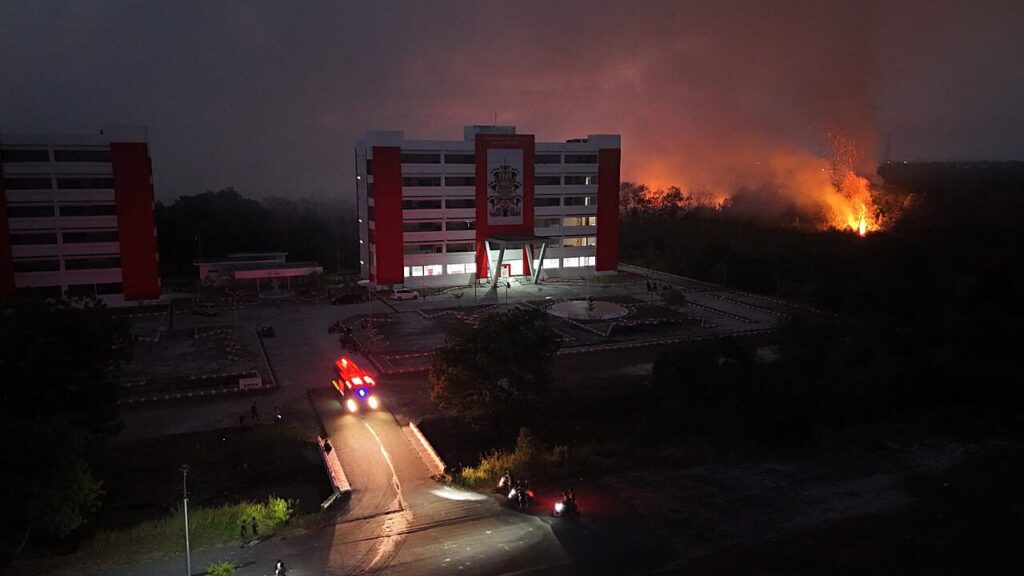
- The smoke is drifting from wildfires in Indonesia — in southern and central Sumatra and West Kalimantan — in the country’s worst fire season in 11 years.
- Neighboring Timor-Leste has suspended all in-person classes nationwide from October 15 to 17 as air quality deteriorates.
For two weeks now, people in Singapore have been waking up to the same grey-brown sky: a sun that rises red, a smell of burnt peat in the air, and a daily ritual of checking the numbers before deciding whether to run, whether to let the kids play outside, whether to open a window at all.
On Friday, October 16, the numbers gave the grimmest answer yet. Singapore’s National Environment Agency (NEA) recorded a 24-hour Pollutant Standards Index reading of 229 in the central part of the island between 3 and 4 p.m. — deep into the “very unhealthy” band, and the worst of 2026 so far. Earlier in the week, one-hour PM2.5 concentrations — the fine particles that lodge deep in the lungs — hit 288 micrograms per cubic metre in the west, nearly 20 times the World Health Organization’s daily guideline. Saturday’s forecast offers little relief: 150 to 230, squarely in unhealthy territory.
Thirteen consecutive days in the unhealthy range makes this the longest haze episode Singapore has endured since 2015, when the last truly catastrophic season choked the region for weeks and cost economies across Southeast Asia billions.
The fires on the other side of the sea
The source is not in Singapore. NEA traces the smoke to wildfires burning across southern and central Sumatra and West Kalimantan in Indonesia, with additional fires in Central Kalimantan — where the air-quality index in the city of Palangka Raya has topped 1,200, a level far beyond any official scale — plus Riau, Jambi, South Sumatra, South Kalimantan and East Nusa Tenggara. Satellite monitoring counted roughly 793 hotspots on October 11 alone.
This is Indonesia’s worst fire season in 11 years, supercharged by a strong El Niño that has dried out the region’s peatlands — the carbon-rich soils that, once ignited, can smolder underground for months and release staggering amounts of smoke. Indonesia has deployed more than 69,000 firefighters, and four people have died in fires in the Bromo Tengger Semeru area. Six companies have been sanctioned for alleged negligence, and Singapore has placed seven Indonesian firms under investigation under its Transboundary Haze Pollution Act of 2014 — a law passed specifically to go after companies whose fires poison the air beyond their borders. Singapore’s prime minister, Lawrence Wong, has warned of legal action, and Environment Minister Grace Fu has said hazardous levels cannot be ruled out.
Timor-Leste shuts its schools
The haze has crossed borders far beyond Singapore. In Timor-Leste — a small, young nation at the eastern end of the archipelago, which gained independence in 2002 — the government has suspended all in-person classes nationwide from October 15 to 17. The decision, made jointly by the Ministry of Education and the Ministry of State Administration on the warnings of the national disaster management directorate, followed air-quality readings in the capital Dili of 165 to 174. October 14 was set aside as a home-learning preparation day. President José Ramos-Horta has publicly expressed concern. The official statement pointedly does not name Indonesia as the source.
Malaysia has also been hit: roughly two million students were affected by school closures earlier this month. And on October 16, the ASEAN Specialised Meteorological Centre raised its haze alert to Level 3 — its highest — a formal acknowledgment that the region’s monitoring system now treats this as a full-blown emergency.
Why this matters beyond Singapore
The El Niño that is setting temperature records across the Pacific is also the engine behind these fires: the same climate pattern shifting rainfall away from Indonesia’s peatlands, loading the dice toward ever-longer fire seasons. Scientists studying this event have warned it could rank among the strongest El Niños in centuries — which means haze seasons like this one may stop being exceptional.
There is also the carbon math. Indonesia’s peat fires are not just an air-quality crisis; when peat burns, it releases carbon stored over thousands of years, in some past years putting Indonesia among the world’s largest carbon emitters for the duration of the fire season. The same week that California’s hills burned and 13,000 people fled the Norte Fire, Southeast Asia’s skies filled with smoke from the other side of the planet — two faces of a world where the fire season no longer stays in its lane.
NEA’s own forecast for the coming days is blunt: “Under the prevailing south-easterly or southerly winds, smoke haze may continue to drift towards Singapore.” Until the rains come or the winds turn, the region’s 650 million people will keep doing what they have done for two weeks — checking the numbers each morning, and hoping they come down.
Sources: Singapore National Environment Agency haze advisory; Timor-Leste government announcement on school suspensions.



One Comment