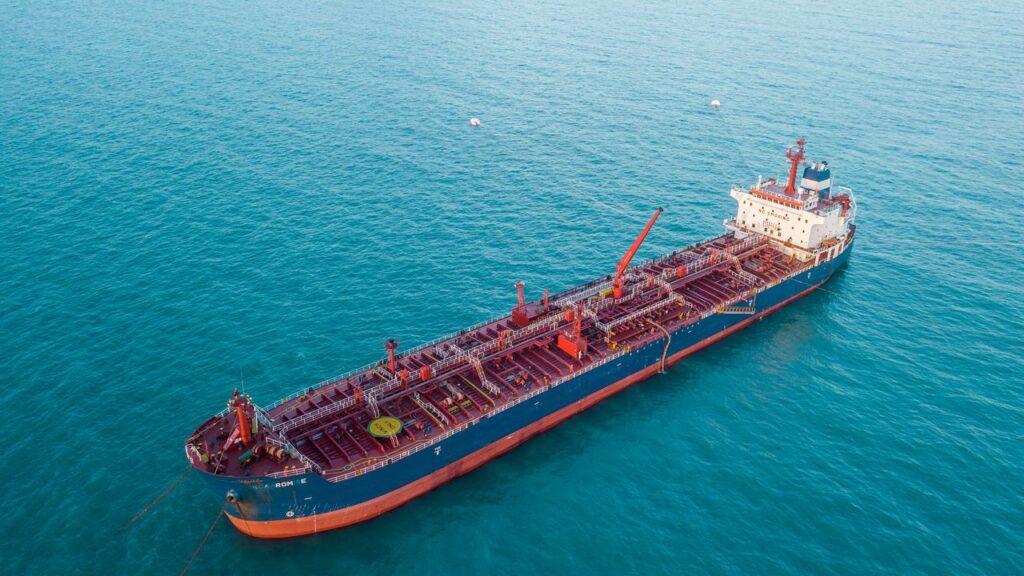
Iran’s Islamic Revolutionary Guard Corps (IRGC) said on Saturday that a second supertanker had struck a naval mine in the Strait of Hormuz and caught fire — the second such claim in a single day on the world’s most important oil waterway.
According to the IRGC Navy’s statement, carried by its official outlet Sepah News, the tanker was carrying more than two million barrels of crude oil when it hit the mine on Saturday morning. The explosion tore through the vessel’s engine room, leaving it immobilized and ablaze, the statement said.
The IRGC said the tanker had switched off its positioning and radar systems and was attempting to cross the strait through what Tehran calls an “unauthorized” route. It accused the vessel of operating with the support of the United States military and of disabling its tracking equipment at Washington’s instigation.
“The Strait of Hormuz is closed, and the consequence of defying Iranian regulations in the Strait of Hormuz is burning in the fire of trust in the terrorist US army,” the IRGC Navy said in its statement.
The Guard did not name the vessel, say which company owns it, or give any information about the crew, possible casualties, or whether any oil has spilled into the sea. The claim has not been independently verified.
A claim and a counter-claim
The announcement came hours after the IRGC reported a first supertanker striking a mine in the same waterway earlier on Saturday. Read our report on the first claim here.
Washington disputes Tehran’s version of events. The US military says it has cleared the strait of naval mines and that vessels are being struck by projectiles, not mines. On Friday, US Central Command said a civilian container ship, the M/V GFS Pride, had been hit by an IRGC projectile on Thursday — not a mine, as Iran claimed — and sank while it was being towed to shore.
“The Strait of Hormuz is controlled by the United States and our regional partners, not Iran,” CENTCOM commander Admiral Brad Cooper said on Friday. “It remains open for business.”
A UK maritime agency has reported 12 attacks on vessels in the past week, and transits through the strait are running about 70 percent below pre-conflict levels. The wave of strikes extended beyond the strait on Friday, when two tankers were hit off Saudi Arabia’s Jubail port in a single day. Read our report on the Jubail attacks here.
Why this matters
The Strait of Hormuz is the chokepoint through which roughly a fifth of the world’s seaborne oil moves. Two alleged mine strikes on supertankers — each carrying more than two million barrels — in a single day would put over four million barrels of crude at risk, and energy markets are already on edge: Brent crude topped $110 a barrel intraday on Friday amid the tanker attacks. Read our report on Friday’s market shock here.
The escalation comes as Iran’s war with the United States and Israel, which began in late February, grinds on. Diplomacy has not stopped — messages are still being relayed through mediators including Pakistan and Qatar. But with the US midterm elections on November 3, there are fears Washington could escalate afterward, and Tehran says it has no intention of backing down: on Saturday, Iran’s acting defense minister said it would be Iranian missiles, not American bombs, that decide the war’s future.
Türkiye’s foreign minister, visiting Baghdad, called on Saturday for freedom of navigation in the strait and the protection of international trade.
For now, the waters off Iran’s southern coast remain one of the most dangerous stretches of sea in the world — and the IRGC’s message to shipowners is unambiguous: use Tehran’s approved routes, or risk the same fate.


One Comment