The short version
- Two studies published this week paint a grimmer picture of Thwaites Glacier in West Antarctica — the so-called “Doomsday Glacier.”
- One, in Nature Communications, finds warm seawater flushing kilometres beneath the glacier could add up to 1.2 inches (30mm) to sea levels by 2100 — about twice earlier estimates.
- The other, led by the British Antarctic Survey, found Thwaites kept losing ice for 150 years even in a model where ocean melting was switched off completely.
Antarctica’s Thwaites Glacier has carried the nickname “Doomsday Glacier” for years. This week, two separate studies gave the world fresh reason to take that name seriously.
Published within days of each other, the papers attack the same problem from opposite directions. One, from glaciologists at the University of California, Irvine and NASA’s Jet Propulsion Laboratory, rewrote how meltwater reaches the glacier. The other, led by the British Antarctic Survey, asked whether any of the damage can ever be undone. Neither answer is comforting.
Warm water is getting much further under the ice
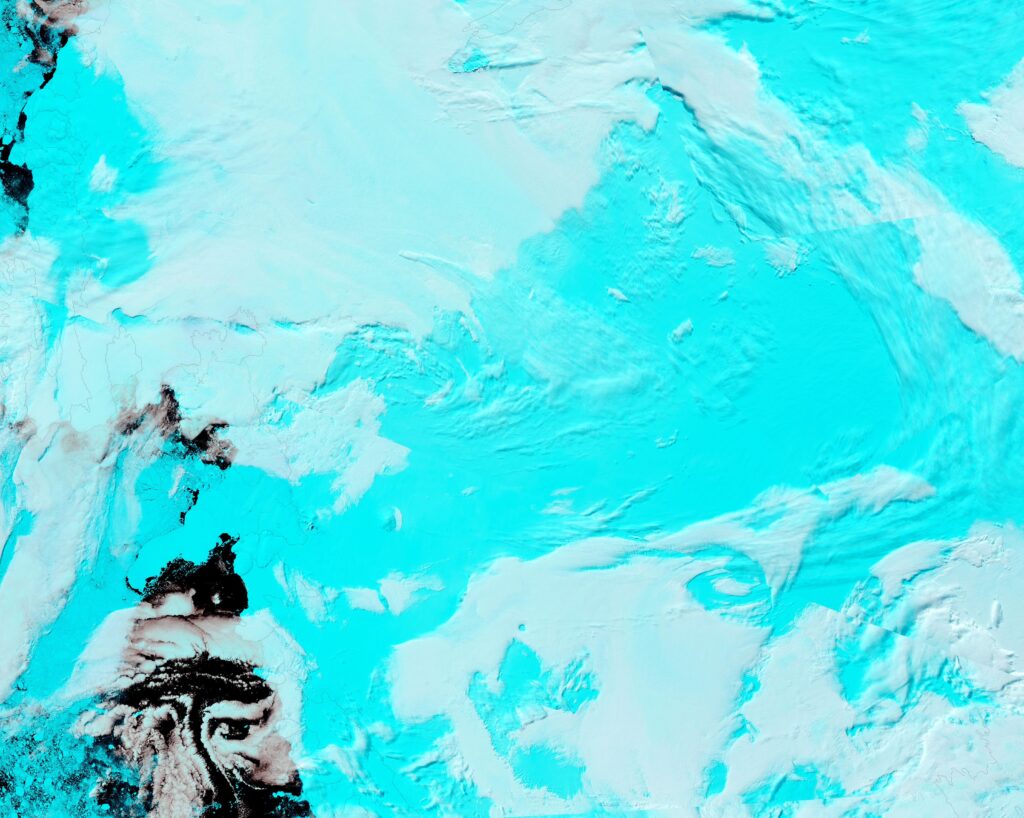
The Nature Communications study, released on October 12, focused on Thwaites’ “grounding line” — the place where the glacier lifts off the seabed and starts floating as an ice shelf. Older models treated it as a thin, fixed boundary; satellite data shows it is something else entirely: a “grounding zone” sometimes kilometres wide, where seawater flushes in and out with the tides, lifting and lowering the thick ice above.
This tidal pumping lets relatively warm ocean water penetrate deep beneath grounded ice, causing what lead author Mattia Poinelli, a project scientist at the University of California, Los Angeles, described as “vigorous melting.” Once the team added that process to their model, it reproduced Thwaites’ observed retreat and thinning from 1996 to 2023 far more accurately than conventional models.
Under a scenario where the climate simply stays as it is — no further warming at all — the model suggests Thwaites could add up to 30 millimetres (1.2 inches) to global sea levels by 2100, roughly double earlier estimates. There is now a 60 per cent chance the glacier detaches from Mouginot Ridge, the underwater ridge currently pinning it back, before the century ends — in some simulations, as early as 2038.
Ted Scambos, a senior research scientist at the University of Colorado Boulder who was not involved in the research, called the findings “a real gamechanger for sea level forecasting from Thwaites.” The results, said report author Eric Rignot, a professor of Earth system science at UC Irvine, “predict greater risk of and exposure for coastal flooding than anticipated in the coming decades.”
Even freezing the ocean might not stop it
The second study, led by Dr Rosie Williams of the British Antarctic Survey (BAS) and published in Geophysical Research Letters, ran a deliberate extreme: what if ocean-driven melting beneath Thwaites and its neighbour Pine Island Glacier simply stopped?
The scientists ran three independent ice-sheet models for 150 years. Pine Island behaved as textbooks would predict — thickening and re-advancing toward where it sat in the first half of the 20th century. Thwaites did not: it kept losing ice for the entire simulation, its losses slowing as the glacier thinned but never reversing.
“These results show that past changes in ocean-driven melting have now committed us to unavoidable future ice loss from Thwaites Glacier,” Williams said. “This ice loss cannot be undone or prevented by simply cooling the ocean.”
The team believes Thwaites is still responding to shocks from decades ago — including extreme El Niño conditions in the 1940s that destabilised Antarctica’s glaciers — on top of which human-driven warming has pushed the system further. As Williams put it: “Our general expectation was that if you turned off that ocean melting, the ice would be able to thicken and re-advance. It’s somewhat of a surprise that Thwaites glacier can’t do that.”
Why this matters far beyond Antarctica
Thwaites covers about 192,000 square kilometres — roughly the size of Senegal, bigger than the US state of Florida — and currently accounts for around 4 per cent of global sea-level rise. Its total collapse would add about 65 centimetres to oceans; the wider West Antarctic Ice Sheet holds enough ice for around five metres.
That makes the glacier everyone’s problem: in coastal cities, a 1.2-inch rise translates into more frequent flooding, more destructive storm surges and faster erosion — in a world where summer 2026 was already the hottest ever recorded in Western Europe. The same week these papers landed, the IPCC’s big Addis Ababa session was suspended without agreement on its next assessment cycle. The science, at least, is not standing still.
Getting direct measurements from beneath Thwaites is the next step. Rignot’s team plans to travel to the glacier in 2028 to deploy instruments at the grounding line and document the seawater flushing in and out. Robert Larter, a marine geophysicist at BAS who was not involved in either study, cautioned that “there is a lot we still need to find out about grounding zone processes to be able to make confident predictions about how fast ice will be lost.”
But the direction of travel is no longer in doubt. As Williams said: every fraction of a degree still counts — what is already in motion cannot be taken back, but what comes next is still ours to influence.