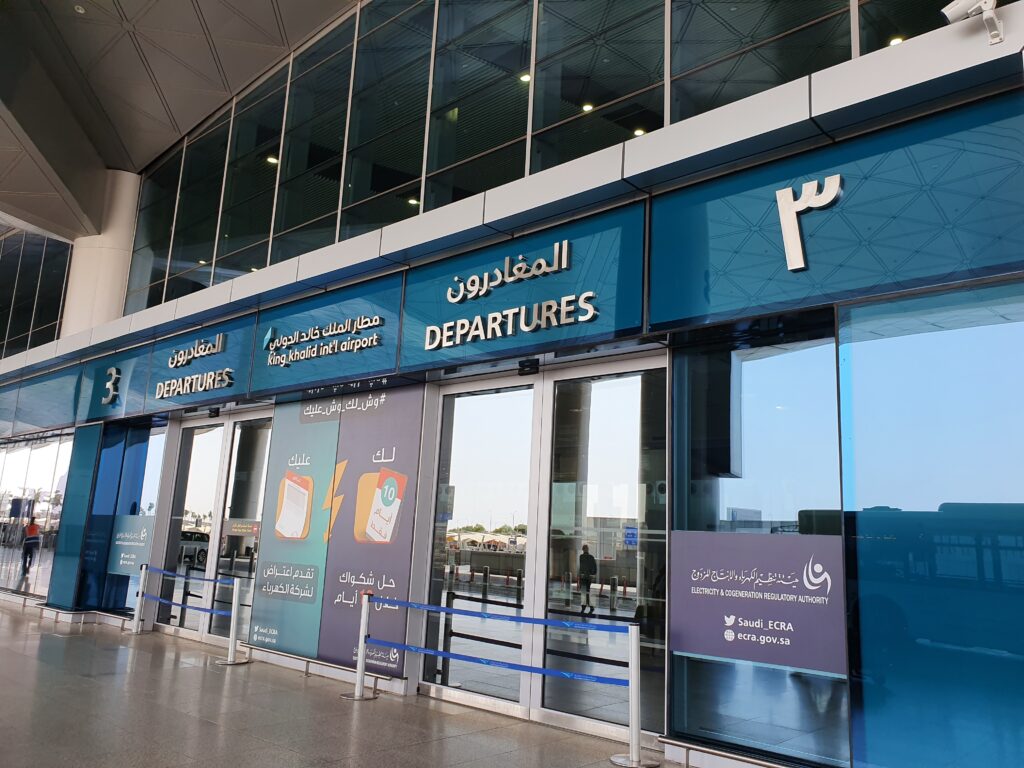
Three people are dead and 36 injured after two Houthi attacks on Saudi airports struck 24 hours apart, and the kingdom has answered with the heaviest round of retaliatory strikes in months. The Saudi General Authority of Civil Aviation (GACA) confirmed late Wednesday that Abha International Airport and King Khalid International Airport in Riyadh were hit in separate attacks on October 6 and 7.
At Abha, in the kingdom’s southwestern Asir province, the strike killed two female residents — a Moroccan woman and an Algerian woman — and wounded 28 others, among them Saudi citizens and residents from Bangladesh and the Philippines. In the capital, the Riyadh attack killed a Sudanese resident and injured eight more: five Saudi citizens, two Egyptian residents and one Pakistani resident. GACA said injuries ranged from minor to critical, and that all the wounded were taken to hospital.
“GACA is working in coordination with the relevant authorities to assess the damage, verify the safety of the facilities, and take the necessary measures to ensure the safety of passengers and maintain the security and safety of operations within the Kingdom’s civil aviation system,” the authority said in its statement.
The Houthis claim a wider campaign
Yemen’s Houthi movement wasted no time claiming responsibility. Military spokesman Yahya Saree said on X that the group hit King Khalid International Airport with drones, calling the strike “precise” and saying it disrupted air traffic. He added that fighters carried out two further operations against Abha International Airport and the Khamis Mushait airbase using ballistic missiles and drones, and separately claimed strikes on three military camps in Jizan and Asir provinces.
The wave went beyond the two Saudi airports. According to Yemen’s Transport Ministry in Aden, two ballistic missiles and several explosive-laden drones were fired at Aden International Airport around daybreak Wednesday, forcing a Yemenia Airways flight from Cairo to divert to Jeddah. One missile landed near the runway minutes before the plane was due to land.
Riyadh hits back: 82 targets across four provinces
The Saudi-led coalition responded late Wednesday with what it described as a major operation inside Yemen. Coalition spokesman Major-General Turki al-Maliki said coalition aircraft destroyed 82 Houthi military targets across four governorates — Saada, Hodeidah, Al-Jawf and Marib — including 11 mountain-based ballistic missile storage facilities in Saada, along with command and control centres, communications systems, missile and weapons depots, and Houthi headquarters.
Attacks on civilians and civilian facilities “will not go unpunished,” al-Maliki said. The coalition also reported intercepting a Houthi ballistic missile north of Riyadh on Wednesday, and said it had destroyed a launch platform in the Yemeni capital, Sanaa, as it was being prepared for another attack on the kingdom.
Region rallies behind the kingdom
GCC Secretary-General Jassim Mohammed al-Budaiwi condemned the airport strikes as “systematic crimes” targeting civilians, calling them “a dangerous escalation and a flagrant violation of international laws and norms” and declaring that Gulf states stand united with Saudi Arabia. Jordan issued a similar condemnation.
The United States Embassy in Riyadh issued a security alert urging Americans to exercise “heightened vigilance” amid Houthi threats against airports and Saudi airspace, warning of possible flight cancellations, airspace closures and travel disruptions.
A conflict that had been cooling is heating up again
The exchange marks a sharp escalation after a period of relative calm following a UN-brokered truce in April 2022. Fighting reignited in July, and the Houthis seized strategic positions in Al-Hudaydah and Taiz provinces in September — including the port city of Mokha — before pushing to Mayyun Island in the Bab al-Mandeb Strait. Meanwhile, Saudi-backed Yemeni government forces launched their own operation this week near Mocha, claiming to have “neutralised” 1,860 Houthi fighters, though that figure has not been independently verified.
This week’s tit-for-tat — airports hit inside the kingdom, missile depots hit inside Yemen — suggests neither side believes the current round is finished. Civilian airports were off-limits through most of the recent lull; that unwritten boundary is now broken. For the tens of millions who fly through Riyadh and Abha each year, the question is no longer whether the war stays on the other side of the border.




One Comment