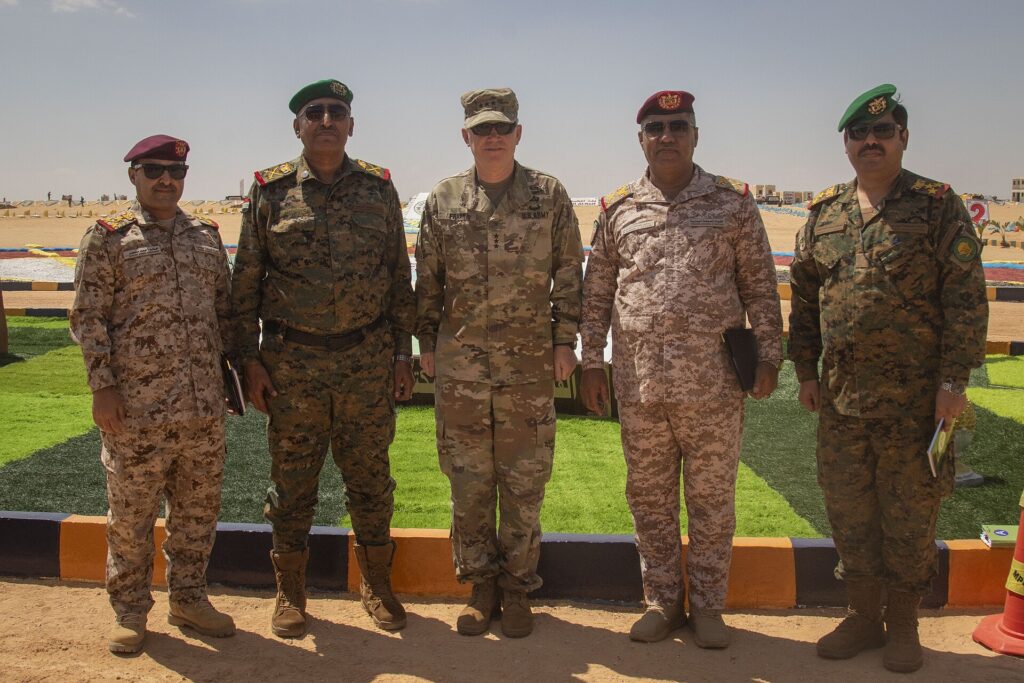
A rift nine months in the making may be closing
The United Arab Emirates has agreed to resume paying southern Yemeni forces fighting the Iran-aligned Houthis, in exchange for Saudi Arabia providing air cover — the first tangible sign that the deep rift between the two Gulf powers over Yemen’s future is starting to heal, according to an exclusive in The Guardian reported on Saturday.
The deal restores payments to the southern forces at the center of Yemen’s anti-Houthi campaign, chiefly the Giants Brigades, which were previously trained and financed by Abu Dhabi and are regarded as “some of the most effective in the disjointed anti-Houthi military coalition.” That funding was cut off in January, when the UAE quit its operations inside Yemen after a bitter falling-out with Riyadh.
The rapprochement comes as the Houthis advance across Yemen and Saudi Arabia faces near-daily drone and missile attacks on its airports and energy infrastructure. On Friday, two Houthi missiles struck Aden’s airport while a Yemenia Airways passenger aircraft was preparing to depart, landing about 500 metres from the plane and roughly 100 metres from the runway’s midpoint, according to Information Minister Moammar al-Eryani. No casualties were reported. A day earlier, a Houthi attack on a presidential palace in Aden killed at least five people and injured 16.
Why the coalition fractured
For most of the world, Yemen’s war looks like one fight — Saudi Arabia and its allies against the Houthis. On the ground, it has been two wars: the northern war against the Houthis, and a southern struggle over who gets to rule whatever comes next.
The UAE backed the Southern Transitional Council (STC), a separatist movement that wants to restore the independent South Yemen of 1967–1990. Saudi Arabia backed the internationally recognised Yemeni government, based in Aden. In January, the tension snapped: STC leader Aidarous al-Zubaidi tried to take control across the south and announced a secession referendum, Saudi forces bombed UAE arms shipments intended for STC troops, and Zubaidi fled to Abu Dhabi. Riyadh’s allied government threatened to try him for treason. Abu Dhabi walked out of the coalition and shut off the money.
That money matters. The Giants Brigades were built, trained, and paid by the Emirates. Without them, the anti-Houthi effort lost its most capable ground force just as the Houthis — fresh from a lightning offensive in September that seized all of Yemen’s Red Sea coast — began besieging Taiz and pressing toward Marib. Houthi drone strikes have also repeatedly disrupted Saudi airports, bringing the war’s fallout directly into the kingdom.
What changes now
Under the reported arrangement, the UAE resumes the financial pipeline to southern forces while Saudi jets fly overhead. Yemen’s UN-recognised government declared a counteroffensive last week to drive the Houthis from the capital, Sanaa, but the drive has so far met with limited success around Majzar near Marib and the Bab el-Mandeb strait. The United Nations says more than 200,000 people have been displaced by the fighting since August.
The secession question remains the deal’s fault line. The STC this week demanded a referendum that would restore the 1967–1990 borders, and neither Riyadh nor Abu Dhabi has publicly responded. STC fighters have refused to deploy beyond the borders of the old South Yemen — though an explicit Saudi agreement to a referendum would likely lift that restriction, The Guardian reports. There is still no direct contact between Zubaidi and Saudi officials.
The rapprochement is drawing in the wider region. Egyptian President Abdel Fatah al-Sisi announced an emergency parliamentary session to grant the military powers to defend Saudi Arabia, saying Egypt “would not be taking any offensive action, and would only defend Saudi Arabia.” Britain has dispatched an RAF Voyager air-to-air refuelling aircraft following Saudi requests for military assistance. On October 15, the UN Security Council issued a statement affirming Saudi Arabia’s right to act in self-defence under international law.
Why this matters beyond Yemen
For nine months, two of America’s most important Gulf partners were effectively working at cross-purposes in the same war — one bombing the other’s arms shipments while Iranian-backed fighters advanced. The deal matters less as a battlefield move than as a diplomatic admission: the Houthis’ offensive has become threatening enough to force Riyadh and Abu Dhabi to choose unity over their differences. If the coalition now pushes the Houthis back from the Red Sea coast and the Bab el-Mandeb strait — one of the world’s most critical shipping lanes — global energy prices, already rattled by the war in Iran and the Hormuz crisis, could stabilise. If the reunion fractures again over the secession question, the opposite happens: the Houthis gain ground, the air attacks on Saudi infrastructure continue, and yet another war’s ripple effects wash up on the world’s fuel prices.
Both the Iran-backed Houthis and the STC, along with the US State Department, have been contacted for comment on the reported agreement. Neither the UAE nor Saudi Arabia has publicly confirmed the arrangement. Iran has separately offered to mediate the war, arguing there is no military solution.



One Comment