Informopedia Explains: in December 1945, Alexander Fleming accepted the Nobel Prize for penicillin — and warned the world we would ruin it. Here is the story he told that day. Imagine a man with a sore throat, he said. Penicillin is now sold over the counter, so he buys some and takes too little — not enough to kill the streptococci in his throat, but enough to teach them to resist the drug. He then infects his wife. She develops pneumonia, is treated with penicillin, and the treatment fails because her bacteria are now resistant. She dies. Who was responsible for her death? The man whose careless dosing changed the nature of the microbe.
That was 1945, the year penicillin became widely available. The first penicillin-resistant gonorrhea cases were already in the medical literature by 1946, and as far back as 1940 researchers in Florey’s own laboratory had trained staphylococcus to resist penicillin in a petri dish. The drug had barely arrived, and the bacteria were already learning.
When a scratch could kill you
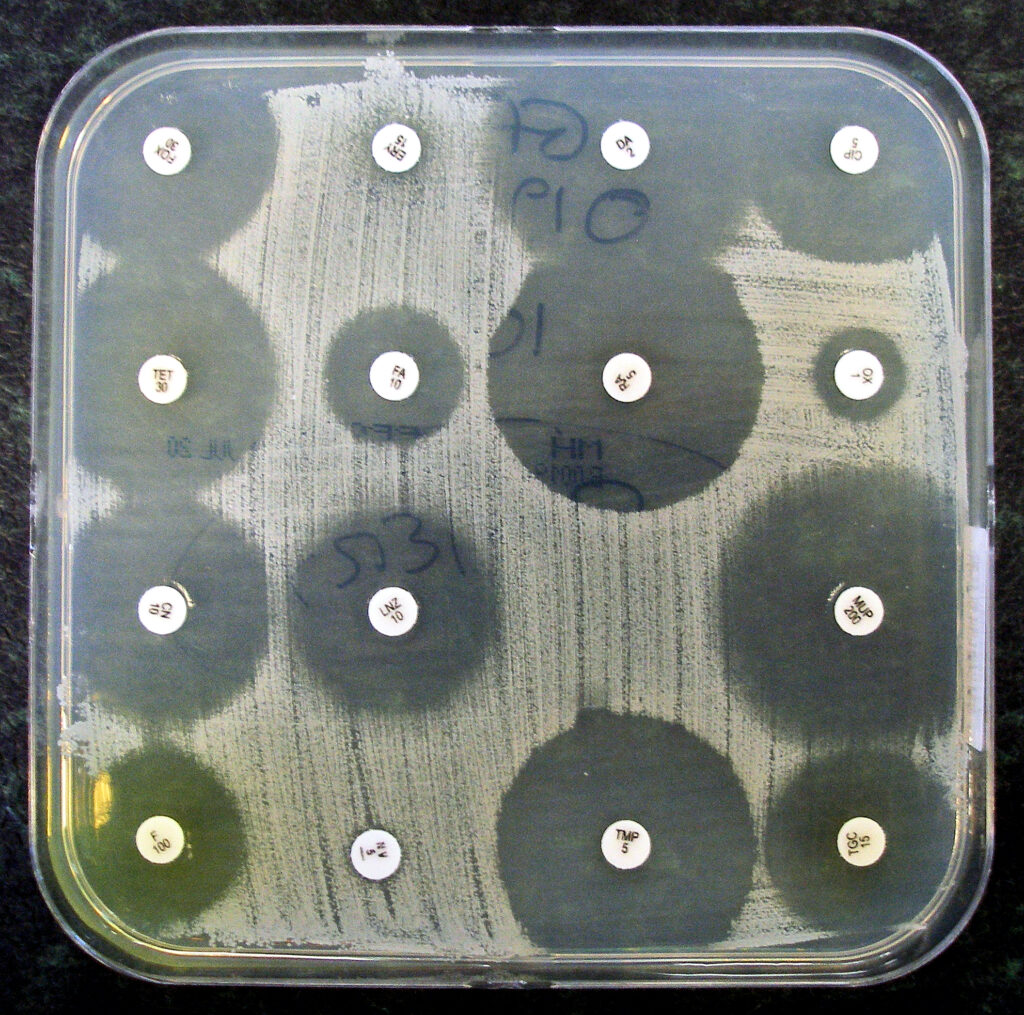
In the early twentieth century, infections caused roughly four in ten deaths in Britain; a thorn scratch, a shaving cut, a difficult childbirth could all turn fatal. Then came one of history’s most famous accidents. In 1928, Fleming returned from a holiday to find a stray mold, Penicillium notatum, had cleared a halo on a discarded bacterial plate where staphylococcus could not grow. He named the substance penicillin — but he could not purify it, and the discovery sat on a shelf for more than a decade.
The rescue came from Oxford. In 1939, Howard Florey, Ernst Chain and Norman Heatley began purifying penicillin in earnest. On February 12, 1941, they tried it on a human for the first time: Albert Alexander, a 43-year-old Oxford policeman dying of a facial infection that had already cost him an eye. Within 24 hours his fever dropped and the abscesses began to heal — but the team was so short of the drug they recycled it from his urine, and it ran out after five days. He relapsed and died. The drug worked; there simply was not enough of it yet.
By D-Day, mass production — much of it developed in the United States after Florey and Heatley crossed the Atlantic seeking help — had made penicillin abundant. The decades that followed brought wave after wave of new antibiotics, and medicine was transformed so completely we forgot what came before. Modern surgery, chemotherapy and transplants all assume infections can be beaten. We built the entire edifice of modern medicine on these drugs, then started eroding the foundation.
How bacteria learn to fight back
Antimicrobial resistance is not a malfunction. It is evolution on fast-forward. A bacterium can divide every twenty minutes or so, and every division is a chance for a random copying error — a mutation. Once in a while, one lets the bacterium survive a dose of antibiotic: an enzyme that chews up the drug, a pump that flushes it out, a subtle change to the target the drug is supposed to hit.
Through conjugation, transformation and transduction — essentially, bacterial file-sharing — a resistance gene can move between cells, and even between species. One successful resistance gene can sweep through a hospital ward like gossip.
Antibiotics supply the selection pressure that decides which genes win. Kill off the susceptible bacteria and the resistant few inherit the world. And we have supplied that pressure on an industrial scale: prescriptions for colds and flu, which are caused by viruses the drugs cannot touch; half-finished courses. But the largest driver sits in agriculture: roughly 70 percent of the world’s antibiotics go into farm animals, often to prevent disease in crowded conditions or to promote growth. Resistant bacteria and their genes travel back to us through the food chain, water, and the people who work with the animals.
Counting the dead
For years, the death toll from resistance was guesswork. That changed in 2022, when the Global Research on Antimicrobial Resistance (GRAM) project published the first comprehensive estimate in The Lancet, covering 204 countries.
The numbers: in 2019, resistant bacterial infections were directly responsible for about 1.27 million deaths worldwide, and played a role in nearly 5 million — more than HIV/AIDS and malaria combined. One combination alone, methicillin-resistant Staphylococcus aureus (MRSA), directly caused more than 100,000 deaths.
A 2024 update added a forecast: if current trends hold, more than 39 million people will die of resistant infections between 2022 and 2050, with the heaviest toll in western sub-Saharan Africa.
The United States tells the same story in miniature. The CDC’s 2019 threats report found more than 2.8 million antibiotic-resistant infections and 35,000 deaths each year — one infection every 11 seconds, one death every 15 minutes. Add in Clostridioides difficile, a gut infection driven by antibiotic use, and the toll exceeds 48,000. A 2014 UK-commissioned review warned that resistance could kill as many as 10 million people a year by 2050 if nothing changes.
The most-wanted list
Not all resistant bugs are equal. In 2008, infectious-disease researcher Louis Rice coined the acronym ESKAPE for six pathogens that increasingly “escape” antibiotics: Enterococcus faecium, Staphylococcus aureus, Klebsiella pneumoniae, Acinetobacter baumannii, Pseudomonas aeruginosa and Enterobacter species — the hospital killers behind bloodstream infections and pneumonias that no longer respond to first-line drugs.
The World Health Organization keeps its own Bacterial Priority Pathogens List, updated in 2024, to steer research money. The critical tier is dominated by gram-negative bacteria resistant to last-resort drugs: carbapenem-resistant Acinetobacter baumannii, carbapenem-resistant and third-generation cephalosporin-resistant Enterobacterales, and rifampicin-resistant tuberculosis. The high tier includes MRSA, vancomycin-resistant enterococci, carbapenem-resistant Pseudomonas, and drug-resistant gonorrhea, which is inching toward untreatability worldwide.
Why the cavalry isn’t coming
Here is the part of the story that feels like a design flaw in capitalism itself. Developing a new drug takes 10 to 15 years and on the order of a billion dollars. A good new antibiotic must then be used as sparingly as possible — held in reserve as a last resort so resistance develops slowly. Low sales by design means the company that develops it cannot earn back its investment. So the industry walked away: according to WHO analyses, no entirely new class of antibiotics has reached patients in roughly 30 years, and in 2021 the WHO warned that none of the 43 antibiotics then in development were sufficient to counter resistance. A later pipeline review counted 90 candidates, but only 15 were genuinely innovative and just five targeted the WHO’s critical-priority pathogens.
The proposed fixes are about money, not chemistry. Economists argue for “delinking” — paying companies for a new antibiotic’s availability rather than for each pill sold, through lump-sum market-entry rewards, subscription-style payments, or insurance-type models. The science of killing bacteria is hard but solvable; the business of selling that solution is broken. Until the incentives change, the pipeline stays dry.
What can still be done
The fight is not hopeless, but it is unglamorous. Antibiotic stewardship — prescribing only when needed, diagnosing faster, finishing courses — is Fleming’s 1945 sermon turned into hospital policy. It buys time, and time is the one resource we have.
Then there is the oldest new idea in the field: bacteriophages, viruses that hunt and kill bacteria. Phage therapy was pioneered by Félix d’Hérelle around 1917 and carried forward at the Eliava Institute in Tbilisi, Georgia, founded in 1923. The West abandoned phages when antibiotics arrived; the Soviet Union kept using them, and Georgia still does. Each phage attacks only specific bacterial strains, which makes therapy fiddly but spares the patient’s microbiome. Interest is surging — the first US clinical trial of intravenous phage therapy was approved in 2019 — though no phage medicine is licensed in the West yet.
Vaccines deserve a mention too: every infection prevented is an antibiotic course never taken, and less use means slower resistance. And beneath all of it sits surveillance — knowing where resistance is spreading, the way GRAM finally let us measure the dead. You cannot fight what you refuse to count.
Why this matters
Antimicrobial resistance is a pandemic without the drama. No lockdowns, no daily case counts on the evening news, no single pathogen with a name. It kills well over a million people a year already, quietly, in hospital wards and nursing homes — and that invisibility is its superpower. Every other great health crisis of our century announced itself with sirens. This one just keeps billing the morgue.
What happens next is a choice, not a mystery. Either the world starts paying for new antibiotics the way it pays for fire departments — for being there when needed, not for gallons pumped — or modern medicine slowly reverts to its pre-1945 form. Fleming, standing in Stockholm with the world’s newest miracle in his hands, told us exactly how we would lose it. He asked us to use enough. We did not listen.


One Comment