Informopedia Explains: every night, above fields and forests across the world, an arms race plays out in total darkness — between bats that hunt by sound, and moths that survive by becoming almost impossible to hear. Now engineers are copying the moths’ trick to silence our cities.
Picture the scene. A bat pours ultrasonic shrieks into the night — up to 160,000 cycles per second, far beyond human hearing — and listens for the echo. A moth flutters into the beam. Physics says the sound should bounce off its wings and paint a target for the bat. But some moths barely register. Their wings absorb the sound instead of reflecting it, the way black velvet swallows light. The bat hears almost nothing. The moth lives.
This is not a metaphor. It is engineering — the kind evolution spent millions of years perfecting, and the kind humans are only now learning to copy.
The wing that drinks sound
The secret is in the scales. A moth’s wing is tiled with thousands of microscopic scales, and researchers at the University of Bristol — led by Professor Marc Holderied — discovered that in some species, this scale layer behaves like what physicists call an acoustic metamaterial: a structure that manipulates sound in ways no ordinary material can.
The numbers from their 2020 study, published in the journal PNAS, are startling. The moths’ scale layer absorbs up to 72 percent of incoming sound energy at frequencies around 78 kilohertz — squarely in the bat’s hunting range — across a broad band from 20 to 160 kilohertz. And it does this in a layer less than 0.3 millimeters thick: 111 times thinner than the longest sound wavelength it absorbs. For comparison, the acoustic foam panels in a recording studio need to be centimeters thick to tame far gentler, lower-frequency sound.
How does it work? Each scale acts like a tiny resonator — a microscopic tuning fork — sitting on a shared flexible membrane. Because the scales come in diverse shapes and sizes, each resonates at a slightly different frequency, and together they spread their absorption across the whole band of bat calls. It is the acoustic equivalent of a choir where every singer covers a different note, so no pitch escapes.
The moths that fight back with mirrors
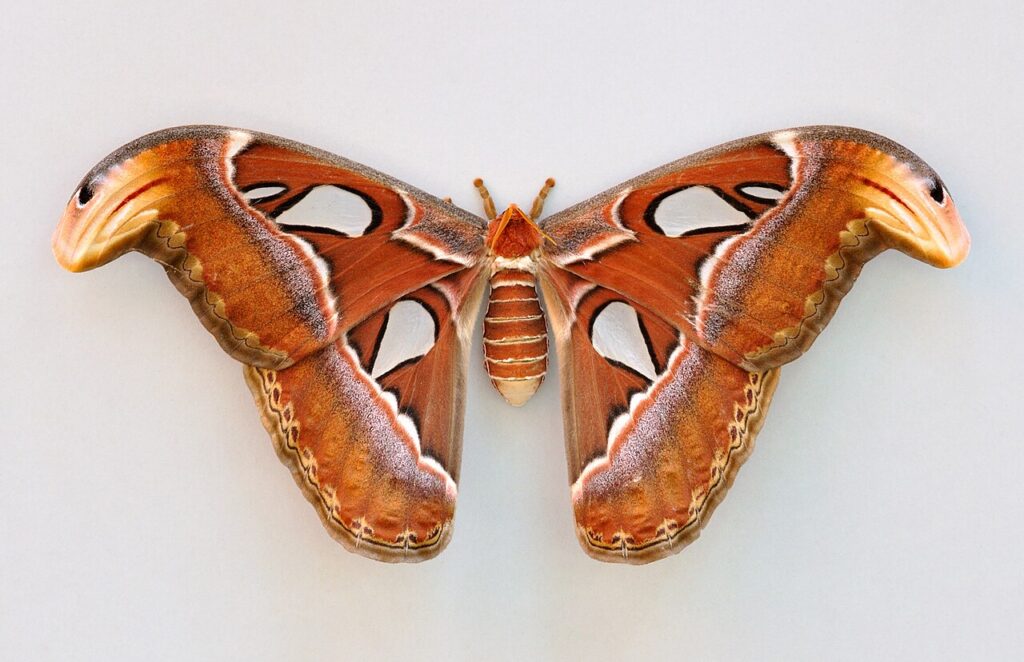
Evolution, characteristically, did not settle on one trick. A 2021 study found that some silkmoths — including the spectacular Attacus atlas, one of the largest insects on Earth — pull the opposite move with their wingtips: the scales there are arranged to act as an acoustic retroreflector, bouncing the bat’s own call back at it like a mirror flashing sunlight into a pursuer’s eyes. A decoy, meant to draw the bat’s attention to the expendable wingtip instead of the body. Two species, two opposite acoustic strategies, one battlefield.
“Nature has spent millions of years refining solutions to incredibly complex problems, and moths are masters of acoustic stealth,” as Holderied put it. Bristol’s own press office calls the absorbing wing an “invisibility cloak” — a phrase that is PR, but not entirely unfair.
From the night sky to your walls
This is where the story leaves the forest and enters the factory. On October 6, 2026, the University of Bristol announced a spinout company, Attacus Acoustics — named for the atlas moth — to commercialize ultra-thin sound-absorbing materials based on the moth-scale research. Led by CEO Dr. Akash Gupta, with patents filed through the university, the company aims to build panels and coatings as thin as one-hundredth of the sound wavelength they absorb, targeting the low-frequency rumble that conventional materials handle worst.
The claimed payoff: sound absorption comparable to conventional materials at up to ten times thinner. The applications read like a list of modern life’s loudest corners — construction, transport, aerospace, noise-reducing wallpaper, quieter aircraft and vehicle cabins.
A word of honest caution: this is pre-commercial science. The “ten times thinner” figure is the company’s target, not a product you can buy. Spinouts fail; lab results do not always survive manufacturing. What is real is the underlying physics — peer-reviewed, reproduced, and genuinely remarkable.
An arms race 65 million years old
To appreciate how good the moths are at this, consider what they are up against. Bats are the most sophisticated sonar operators in nature: a hunting bat adjusts its calls dozens of times per second, shifting frequency and timing as it closes in, reading the returning echoes for the size, speed and even the texture of its target. Moths have been evolving countermeasures since bats first took to the night sky, some 65 million years ago — an evolutionary arms race older than primates.
Some moths jam the radar: tiger moths click back ultrasonic pulses that scramble the bat’s timing. Some fly erratically, making their echo hard to track. And some, like the species Holderied’s team studied — including Antheraea pernyi and Dactyloceras lucina — simply go quiet, their wings drinking the sound. It is a measure of how brutal the selection pressure has been that a single insect order evolved stealth, jamming and decoys in parallel.
Biomimicry — engineering that copies biology — has a strong record of turning such discoveries into technology: Velcro from burrs, wind-turbine blades from whale fins, water-repellent coatings from lotus leaves. But acoustics is a young branch of the field, and the moth work is among its most elegant examples, because the structure being copied is so improbably good at something humans find genuinely hard. Making thin materials absorb low-frequency sound is one of acoustics’ classic unsolved problems; the moth solved it with scales and a membrane.
Why this matters
Because noise is not just an annoyance — it is a public-health crisis wearing earplugs. The World Health Organization estimates that traffic noise alone costs Western Europe at least a million healthy life years every year, through stress, sleep disruption, cardiovascular disease and reduced wellbeing. Existing soundproofing is bulky, heavy and resource-intensive: lining a building or a train carriage against low-frequency noise means adding centimeters of foam or mass-loaded vinyl, with real costs in weight, space and materials.
A material that absorbs sound at a fraction of the thickness changes the economics of quiet. Thin, light acoustic panels could go where today’s materials cannot: inside car doors, on apartment walls, around the heat pumps and air conditioners humming in every neighborhood. The moth solved a harder version of this problem — absorbing bat sonar at wavelengths measured in millimeters, with a wing thinner than paper — because its life depended on it. Ours may not depend on it. Our health, increasingly, does.
What happens next
Attacus Acoustics will spend the next years trying to scale a biological structure into a manufactured product — the hardest leap in biomimicry, where elegant lab physics meets the brutal realities of cost, durability and fire regulations. Animal biology keeps handing engineering these gifts — and physics keeps revealing that nature’s strangest solutions are often the most instructive. Whether or not your walls ever wear moth-inspired wallpaper, the deeper lesson is already in: the quietest engineer in the forest has been a moth all along. We are only now learning to listen.
Sources: University of Bristol — Attacus Acoustics spinout announcement; WHO — Burden of disease from environmental noise.